Congratulations. You Finished First. Now Start Again.
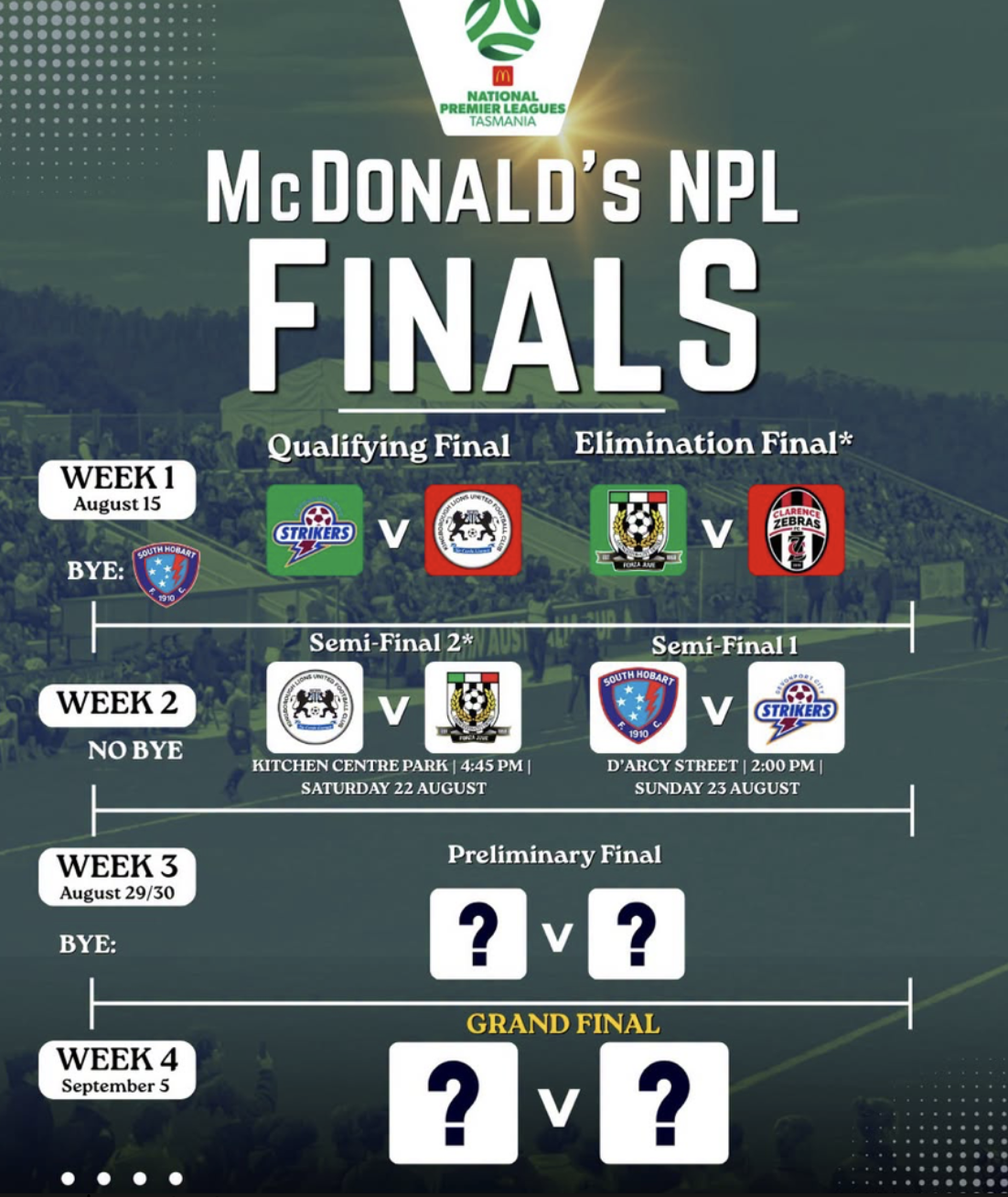
Photo courtesy of Football Tasmania
Australia loves a finals series. But in an 18-game NPL season, are we using our football calendar the right way?
We are currently living in that strange twilight zone of Tasmanian football called the finals series.
The league season is finished.
South Hobart are the 2026 NPL Tasmania Premiers.
Eighteen matches have been played, the ladder has been completed and the team with the most points has finished on top.
Normally, in football, that sentence would be followed by something along the lines of:
Congratulations. You won the league.
But this is Australia.
So instead it is:
Congratulations. You finished first.
You have earned a week off.
Now start again.
I am not entirely sure I like it.
A Very Australian Idea
Perhaps some of my discomfort is cultural because finals are a very Australian sporting thing.
We love them.
AFL has them. Rugby league has them. Basketball has them. Australian sport seems almost uncomfortable with the idea that a season could simply finish with the team on top of the ladder being declared the winner.
We want elimination games.
We want preliminary finals.
We want Grand Final week.
We want somebody lifting something at the end of one enormous afternoon.
And there is no doubt finals can create fantastic theatre.
But football in Australia has spent much of its history trying to reconcile that Australian sporting instinct with the traditions of the game itself.
Interestingly, our national football competition did not always do things this way.
When the NSL Did It Differently
When the National Soccer League began in 1977, the system was decidedly traditional.
Finish top of the table and you were champions.
Eastern Suburbs-Hakoah won the inaugural NSL by finishing first and, for the early years of the competition, the league table determined the national champion.
There were finals introduced not long afterwards, but initially they were something extra.
You could have a finals series without using it to decide who had actually won the league.
Which, to anyone raised on traditional football, makes a fair bit of sense.
The league answered one question.
Who was the best team across the season?
The finals provided some extra football and a bit of end-of-season excitement.
Then Australian soccer started becoming a little more Australian.
Then Football Became More Australian
By the mid-1980s the NSL had moved towards finals determining the national champion.
There was a brief return to first-past-the-post in 1987, but from 1988 until the NSL disappeared in 2004, the Grand Final became the big prize.
And sometimes it worked spectacularly.
Grand Finals created huge occasions.
They produced memorable matches, big crowds and genuine drama.
There is the great argument in favour of them.
Finals create events.
They give television something to promote.
They give supporters a date to circle.
They give clubs another opportunity to put people through the gate.
They give us the possibility of extra time, penalties, upsets and one extraordinary afternoon that people remember for years.
By the time the NSL ended, the Grand Final had become part of Australian football culture.
So when the A-League arrived in 2005, Australian football did not go back to the traditional model.
Instead, we came up with a very Australian compromise.
The A-League Compromise
We decided to have both.
The team finishing first after the regular season would be the Premiers.
The team winning the Grand Final would be the Champions.
Two achievements.
Two trophies.
Two ways to win.
It is perhaps the perfect expression of Australian football.
Much of the football world says:
Who finished first?
Australia says:
Yes, yes. Very good.
But who won the Grand Final?
And maybe there is absolutely nothing wrong with that.
I have watched plenty of wonderful A-League finals.
Knockout football produces a different kind of tension.
One mistake matters.
One goal can change everything.
A team that has been brilliant all season can suddenly find itself hanging on for dear life with ten minutes remaining.
That is sport.
It is exciting.
It is theatre.
But I think my problem with the Tasmanian NPL finals is slightly different.
Eighteen Games Is Not Much of a Season
Our NPL teams have just played an 18-game league season.
Now we have a finals series stretching across another four weekends.
Five of the ten NPL clubs qualified.
Half the league.
South Hobart finished first and received the opening-week bye. Then they enter the finals in week two and, potentially, keep playing until the Grand Final on 5 September.
And I find myself wondering something quite simple.
If we have another four weekends available for football, should our first priority really have been a finals series?
Or should we be asking whether 18 league matches is enough in the first place?
That is where I think the comparison with the A-League becomes important.
The A-League has traditionally given clubs a longer regular season before reaching its finals.
The finals feel like the climax of the competition.
In Tasmania, they feel a little more like an addition to a league season that finished before I was quite ready for it to finish.
Perhaps finals are not actually the problem.
Perhaps the short season is.
We Already Have a Knockout Competition
There is another reason I have never felt desperately in need of a finals series in football.
We already have a magnificent competition designed specifically for knockout drama.
The Cup.
That is exactly what the Cup is for.
The Statewide Cup asks:
Can you win today?
Can the underdog beat the favourite?
Can you handle the pressure of a knockout match?
Can you survive extra time?
Can you win a penalty shootout?
Wonderful.
That is the magic of Cup football.
But a league is supposed to ask a different question.
What Is a League Supposed to Tell Us?
A league asks:
Who is the best team over time?
Who can win consistently?
Who handles injuries, suspensions and dips in form?
Who can travel away and find a result on a miserable winter afternoon?
Who can recover from a bad week?
Who has the squad depth?
Who keeps accumulating points?
There is something beautifully unforgiving about a league table.
After everybody has played everybody, it does not care whether you would have preferred another opportunity.
It tells you where you finished.
That is why I have always regarded winning a league as such an enormous achievement.
It rewards sustained excellence.
A final rewards excellence on the day.
Both have value.
But they are not the same thing.
And I am not sure we should pretend they are.
This Is Not About South Hobart
Before anyone suggests this is simply a South Hobart person worrying about what might happen in the finals, let me save you the trouble.
I will feel exactly the same way if South Hobart wins the Grand Final.
This is not about South Hobart.
It is not about which club ultimately wins the finals series.
It is about what we want our premier football competition to be.
South Hobart have already achieved what the league competition asked of them.
Over 18 matches they accumulated more points than everybody else.
They are the Premiers.
Now we are playing another competition.
And that is fine, as long as we are honest about what it is.
Maybe One Winner Wasn't Enough
There is something wonderfully Australian about the whole thing.
We inherited a game in which finishing first traditionally means you are champions.
Then we put our own stamp on it.
We kept the ladder.
We kept the Premiership.
Then we added a finals series and a Grand Final because apparently one winner wasn't quite enough.
Maybe that is simply Australian football now.
Finals have been part of our national football culture for decades.
They are not going anywhere in the A-League and perhaps supporters here will embrace them too.
I hope the matches attract good crowds.
I hope they produce great football.
I hope the Grand Final is a terrific occasion.
But I still cannot quite shake the feeling that we have things slightly back to front.
If our best players are available for another month, I would rather first ask how we can give them a longer and stronger league season.
More meaningful football.
More matches in which every point counts towards determining who wins the league.
Then, if there is room for finals as well, terrific.
Because right now we are in a peculiar place.
The league has been won.
The Premiers have been crowned.
Half the competition is still alive.
And we have another month before somebody wins the Grand Final.
Very Australian.
I'm just not completely convinced it is very football.