Are We Actually Safe?
The question I can’t shake
For years, I have been the person at my club responsible for annual club licensing.
Every NPL club has to go through it.
It is not simple.
Five categories.
Dozens of benchmarks.
Pages of documents.
Declarations. Sign-offs. Evidence.
Financials are not a side note. They are a core part of the process.
At licensing forums, we are told:
This is not here to catch you out.
This is here to support clubs.
To help them grow.
And I want to believe that.
Because at times, if I am honest, it has felt like the opposite.
At times, it has felt less like support, and more like a test you do not want to fail.
Like something that could just as easily be used to say:
You do not meet the standard.
You do not get a licence.
And to be clear, this is not a small administrative task.
It is detailed.
It is structured.
It is time-consuming.
It is meant to mean something.
To be fair, my experience locally has not been negative.
Greg from Football Tasmania has been helpful and approachable through the licensing process.
And I do not think clubs are walking away from licensing feeling unsupported.
If anything, it is the opposite.
Clubs do the work.
They take it seriously.
They want to meet the standards.
But perhaps that is exactly where the vulnerability sits.
Because when you do everything that is asked of you, you assume the system is doing its part as well.
So I keep coming back to the same question.
If all of that exists…
What exactly is it protecting?
What has happened in Canberra
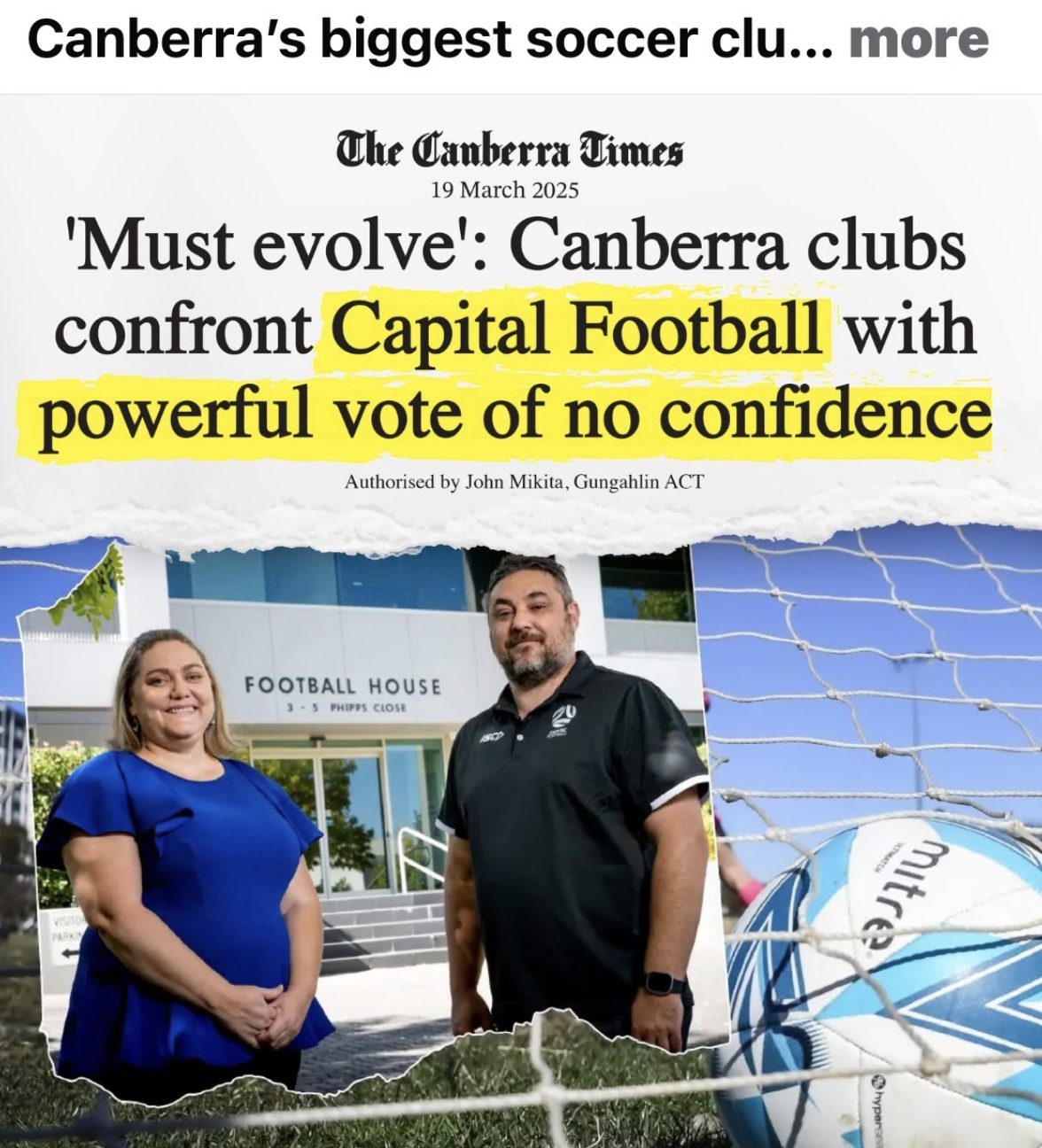
A few days ago, a group of senior Canberra clubs issued a vote of no confidence in Capital Football.
That is not routine.
It is one of the strongest signals clubs can send.
It means this:
We no longer trust this leadership to run the game.
Not one club.
A group.
That matters.
Because collective action does not happen lightly. It usually happens when clubs feel they have run out of quieter ways to be heard.
To understand it, you have to go back
In October 2025, Gungahlin United, a major NPL club, collapsed.
Publicly.
The figures are significant.
More than $550,000 owed.
Some reporting closer to $680,000 to $700,000.
Around 2,000 players and families affected.
Competitions disrupted.
Teams displaced.
The system forced to adjust around the failure.
This was not a marginal club.
This was a licensed club.
A club approved to compete.
A club operating inside the system.
And that is exactly why this has hit so hard.
What has emerged since
Recent reporting has added another layer.
The liquidator’s investigation has identified:
Significant unsecured debts approaching $700,000.
Concerns about inadequate financial records.
Financial information that may not have accurately reflected the club’s true position.
The possibility the club had been operating in financial distress, potentially as far back as 2021.
There has also been reporting about possible legal action and public examinations of former committee members.
These are serious findings.
They move this beyond a simple club failure.
This is no longer just a story about a club that went under.
It is a story about financial accuracy, oversight, and accountability inside a system that is supposed to be checking for exactly these things.
The audit question
Reporting has also raised questions about whether earlier intervention was possible.
It suggests there were provisions within governance frameworks for:
Financial oversight.
The ability to trigger audits.
Escalation where concerns existed.
There are also indications that concerns had been raised over a number of years.
If that is the case, it sharpens the issue even further.
Because the question shifts.
Not just:
How did this happen?
But:
What could have been identified earlier?
And if there were mechanisms available to look more closely, why were they not used sooner, or why did they not change the outcome?
And this is where the tension sits
Because those same years sit inside the licensing cycle.
The same process that requires:
Financial reporting.
Declarations.
Evidence of viability.
So again:
How does a club present financial information, meet requirements, be approved to compete…
And still collapse under that level of debt?
That is the question clubs are entitled to ask.
And it is not an attack to ask it. It is the obvious question.
Where responsibility sits
The federation position has been consistent.
Clubs are independent.
They are responsible for their own financial management.
Warnings and breach notices were issued.
The clubs perspective is different.
You licence us.
You assess us.
You approve our participation.
You set the framework we operate within.
And when something fails inside that framework, especially at this scale, it is difficult to accept that responsibility sits entirely on one side.
That is where trust starts to fray.
Because clubs are told the system is there to support, monitor, and uphold standards.
But when failure arrives anyway, the support can start to look more like paperwork than protection.
The gap
This is not about one decision.
It is about a gap.
A gap between:
What the system requires
And what the system is able to detect
A gap between:
Compliance
And protection
Because licensing is mandatory.
It is presented as a safeguard.
It is presented as something meaningful.
So when a licensed club fails at this scale, the natural question is not just about the club.
It is about the system around it.
Not because the system caused the collapse.
But because the system was there, and the collapse still happened.
Why this has escalated
A vote of no confidence does not appear without context.
It is not the first step.
It is the last.
Concern.
Discussion.
Frustration.
Then public action.
By the time it reaches this point, confidence is not just questioned.
It is withdrawn.
That is why this matters.
A vote of no confidence is not just disagreement. It is a public declaration that the relationship between clubs and governing body has broken down badly enough that silence is no longer acceptable.
The question for every club
This is not just Canberra.
Because if you remove the names…
And replace them with any federation…
The question does not change.
Are we safe?
Does the system we are required to comply with actually protect us?
Or does it simply assess us, document us, and approve us… until something goes wrong?
That is the part that should make every club pause.
Because most clubs do the work in good faith.
They meet deadlines.
They gather the documents.
They sign what needs to be signed.
They trust that the process has value.
They trust that it is there for a reason.
The uncomfortable reality
Licensing is meant to:
Set standards.
Ensure viability.
Support clubs.
Protect the game.
That is the purpose.
But when a club can:
Submit financials
Meet requirements
Be approved to compete
And still collapse with debts of this magnitude…
That purpose has to be examined.
Not casually.
Not defensively.
Seriously.
Because once people stop believing the process is protecting the game, what is left is compliance without confidence.
And that is a dangerous place for any governing system to end up.
The line that cannot be ignored
A club did not just fail.
It failed owing more than half a million dollars.
With reporting suggesting financial distress may have existed for years prior.
During the very period it was being assessed and approved.
That is the fact pattern people cannot simply wave away.
It is too big.
Too public.
Too damaging.
And for the families, players, coaches and volunteers left picking through the wreckage, it is also too real.
Closing
If a system designed to assess financial viability cannot detect a failure of this scale…
And if mechanisms for earlier intervention may have existed…
Then the question is no longer just what went wrong.
It is whether the system is doing what clubs are told it is doing.
Because clubs are not just being asked to participate.
They are being asked to trust.
To trust the standards.
To trust the oversight.
To trust the process.
And when a club can pass through that process and still collapse like this, trust does not just weaken.
It gets damaged.
Final line
We do the work.
We meet the standards.
We sign the documents.
We trust the process.
But right now, every club has a right to ask one simple question.
Should we?