Brian Murphy: finding clarity, grounding and belonging in Tasmanian football
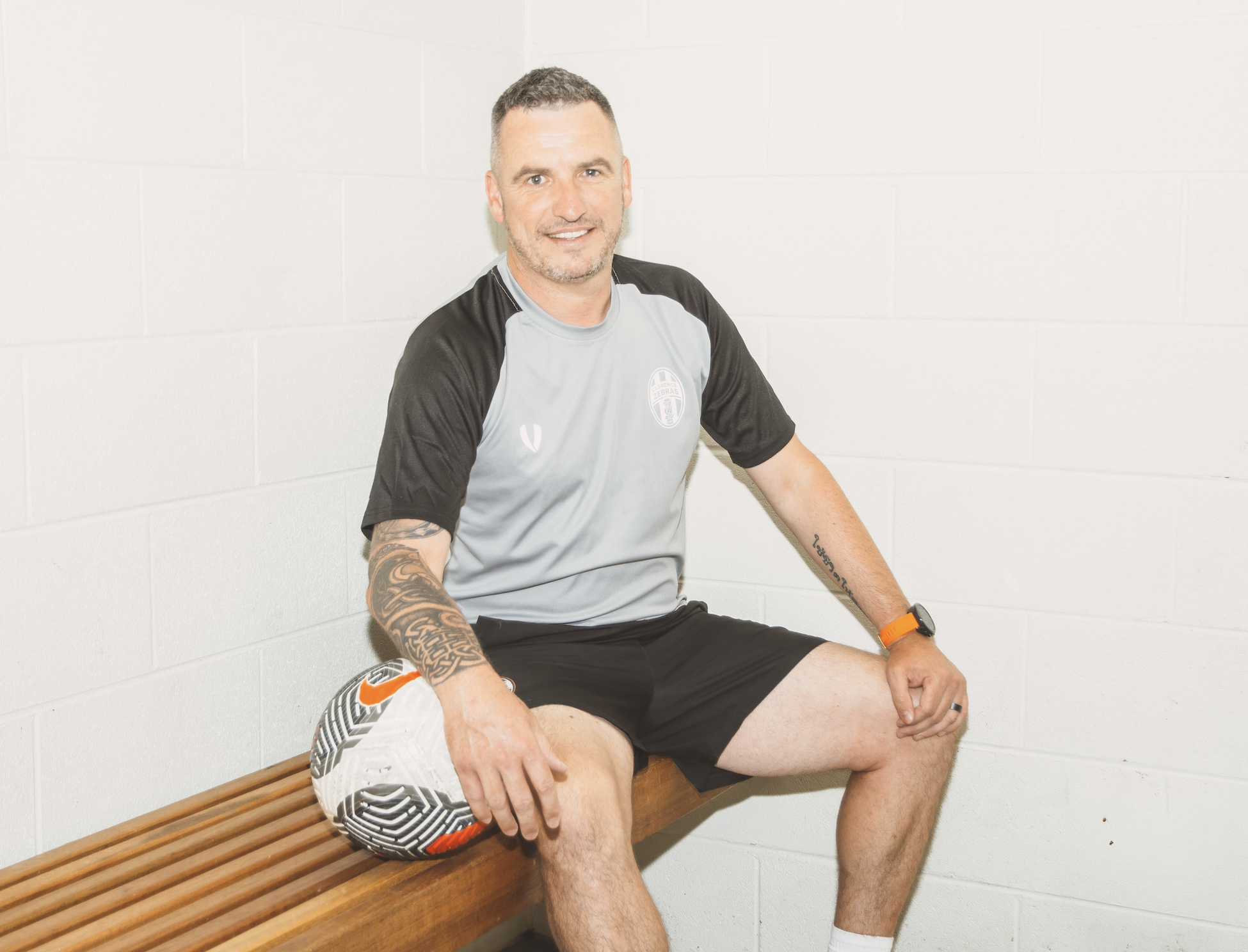
Brian Murphy photographed by Nikki Long
There are moments in football where it’s worth pausing and listening rather than rushing to the next result.
Brian Murphy wrote back after the questions to say he had really enjoyed the process. He said Tasmania is a small football community and stories spread quickly, so he appreciated the chance to share his thoughts directly. That alone tells you something about how he approaches the job.
Not with spin, but with a preference for clarity.
Brian arrived in Tasmania carrying a lot at once. A new league. A new state. A young family settling into a new life. A season at Glenorchy Knights that had not unfolded the way he expected. Ongoing postgraduate study. And, quietly, a decision about whether Tasmania was somewhere he wanted to stay and contribute long-term.
It felt worth stopping for.
Where football first took hold
Football first grabbed Brian during Italia ’90, when Ireland played in their first World Cup. That tournament sparked his love for the game, encouraged by his father and his late Uncle Eamon.
He went on to play at a strong level across Ireland, the UK, Australia, New Zealand and Asia, lining up for clubs including Shamrock Rovers, St Patrick’s Athletic, Kilkenny City, Monaghan United, Kildare County, Port Vale, DPMM FC in Brunei, Springvale White Eagle in Victoria and Eastern Suburbs in New Zealand.
At 32, a ruptured Achilles tendon ended his playing career. That setback became the turning point that pushed him into coaching.
The influences that stayed
When Brian talks about influence, he doesn’t reach for famous names.
Roger Wilkinson in New Zealand had a huge impact early, giving him belief and helping him see the game in its simplest form.
But New Zealand itself changed him more deeply. Ireland shaped his resilience and fight. Aotearoa grounded him in ideas of connection and belonging. Through conversations with high-performance psychologist Dom Vettise, those ideas became part of how he leads.
“Dom probably has had the biggest influence on me,” Brian says simply.
“I am just an Irish/Kiwi who is following his dreams.”
Seeing Tasmania from the outside
Brian arrived in Tasmania without strong expectations. What surprised him most was not the football itself, but how Tasmanian football is perceived from outside the state.
He feels the league is often looked down on, despite the potential he sees. He believes Football Australia should be investing more in Tasmania, not just at state level but across grassroots and pathways.
His young family fell in love with life here, and that mattered. He also believes the state is overdue an A-League team. The culture and talent base exist. What’s missing, in his view, is backing and vision.
Visibility matters as well. He credits the work of people like Matt Rhodes, Walter Pless and Tanner Coad for helping keep the league visible, noting that without that coverage the competition would receive far less recognition.
Lessons from Knights
Brian describes his season at Glenorchy Knights as a major learning experience.
“I was probably a little naive going into the role,” he says.
It taught him the importance of clarity, structure and alignment. Expectations need to be written down. Support needs to be real. A head coach needs authority and framework to lead.
“Being let go gave me space to reassess,” he says.
That reassessment helped him understand the Tasmanian landscape properly and think about what mattered most to him and his family.
Why Clarence felt right
When Clarence Zebras emerged as an option, it felt right early. The club made it clear they wanted him and they welcomed his family.
For Brian, a club must feel like a family. A place where honest disagreement is possible, where trust exists and where forgiveness is real.
After speaking with four clubs, Clarence stood out. Shared values, trust and responsibility to lead properly mattered more than short-term opportunity.
Building from the inside out
When Brian officially started in November, his first priority was understanding the club.
He immersed himself in Clarence’s history, learned who was involved and why, and tried to understand the motivations of players, staff, volunteers and board members. Honesty about the past came first. Structure followed.
Clear standards. Defined roles. Recruitment focused on people who fit the culture and believe in the project.
When he recruits, his first question is simple. “Are they a good person?”
“If they’re not, no matter how talented they are, they won’t play for me.”
“There is no room for egos in the dressing room.”
Values before philosophy
Brian is wary of big coaching language. “The word philosophy gets thrown around too much,” he says.
What matters are values.
“I want their love for the game to grow, not fade.”
“It’s rarely the money, trophies or medals that stay with you most — it’s the people.”
Consistency, character, attitude, work ethic and courage are non-negotiable. Those standards come from upbringing and experience and they shape the people he wants beside him when things are hard.
Overrated, underrated, and the part people avoid
Brian thinks coaching sometimes spends too much energy on tactics and worrying about opponents.
“Focus on what you can control. Execute your plan.”
He adds a line that will make some people nod and others argue. “Football is about 80% motivation and 20% technical skill.”
He sees football more simply. “Football is movement, creating space, exploiting space, connecting between the lines.”
Commitment matters. He points to a recent friendly cancelled because a team could not field players. Off-field responsibility, he says, matters as much as skill on the pitch.
Learning beyond courses
Brian’s postgraduate study confirmed much of what he already believed, but refined it.
It deepened his understanding of psychological development, environment and leadership. It also showed him that learning does not only happen through federation courses.
Exposure to practitioners who had worked in Premier League and international environments gave him a different depth of perspective.
Supporting coaches properly
When Brian speaks about support at state level, he talks about connection.
“There is a huge amount of knowledge in this state. It’s an untapped resource,” he says.
He would like to see regular forums where coaches share ideas, mentor younger coaches and work collectively to improve football in Tasmania. Improve the coaching environment, he believes, and the whole game improves.
Coaching in a small football world
Tasmania’s size took adjustment. As an outsider, Brian noticed resistance to change and the speed with which stories travel. Trust takes time.
At Clarence, he says he has found his people, his village. The club’s sense of community has made it easier to lead and build culture grounded in trust and shared vision.
Clarence now and next
Brian believes Clarence needs a clear pathway from juniors through to seniors.
With Nick Taylor leading juniors, Dave Smith overseeing youth and Brian guiding seniors, the aim is a consistent club-wide identity that reduces reliance on external recruitment.
He is also clear that progress must include the women’s program. Being the club of choice on the Eastern Shore means providing pathways for players of all ages and genders.
The board has been open to that vision. But as Brian reminds us, “Rome wasn’t built in a day.”
Staying with the work
What stays with me after this conversation is not a tactical blueprint or a promise about results. It’s Brian’s insistence on clarity, alignment and belonging and the sense that he has learned as much from what didn’t work as from what did.
In a small football ecosystem like Tasmania, where stories travel fast and structures are often assumed rather than examined, that kind of reflection matters. Clarence’s journey under Brian won’t be defined only by wins and losses, but by whether the club continues to build something coherent, humane and sustainable.
That work takes time. It takes trust. And it takes people willing to stay, listen and keep going when the easy option would be to move on.