Different Doors, Same Room
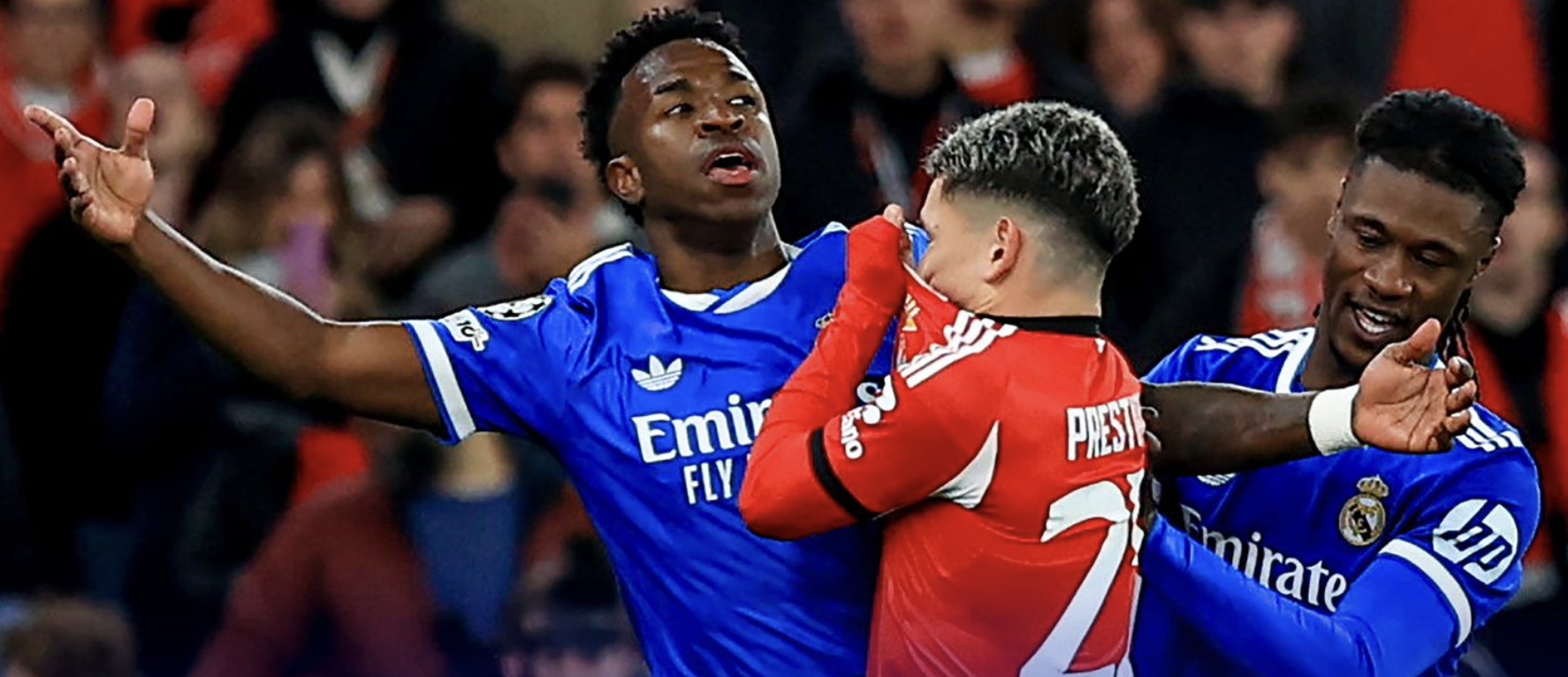
Face covered. What is being said?
What happened, 101
During a UEFA Champions League play-off match between Real Madrid and Benfica 18 February 2026, Real Madrid forward Vinícius Júnior alleged that Benfica player Gianluca Prestianni directed a racist slur at him after he scored.
Vinícius reported the incident to the referee.
The referee stopped the match for around ten minutes while UEFA’s anti-racism protocol was activated.
Prestianni denied making any racist remark.
UEFA opened an investigation.
After the match, Benfica coach José Mourinho said he did not know who was telling the truth and tried to take a neutral stance, suggesting the situation may have been sparked by Vinícius’ celebration.
That is the basic sequence.
No rumours.
No spin.
Just what happened.
Neutrality is not neutral
When something ugly happens in football, everyone looks to procedure.
Did the referee stop the match.
Did UEFA follow the protocol.
Will there be an investigation.
But the real test is not the protocol.
It is what leaders say afterwards.
Because racism in football rarely arrives shouting.
It arrives dressed in careful language.
Let us stay neutral.
Let us hear both sides.
Let us wait.
Those words sound reasonable.
They are not neutral.
They shift attention away from racism and onto behaviour.
Reputation before reality
Managers protect clubs.
Associations protect competitions.
Institutions protect their image.
So they talk about history.
Tradition.
Values.
We are not racist because of who we are.
But football’s history does not protect players in the present.
Reputation is not reality.
And reputation is often defended more fiercely than people.
The protocol worked. The culture didn’t.
UEFA has anti-racism steps.
Matches can stop.
Announcements can be made.
Investigations can begin.
Football can tick every box.
Yet Vinícius keeps reporting abuse, season after season, stadium after stadium.
That tells us something uncomfortable.
Football loves campaigns.
It struggles with consequences.
Structures exist.
Culture resists.
This is what Andy Brennan had to contend with
I am about to publish an interview with Andy Brennan.
Andy is intelligent, articulate, thoughtful, a professional footballer who also carries a university degree and a life beyond football.
He is also a man who came out publicly as gay in men’s professional football.
And suddenly the game he loved changed around him.
Not always with slurs.
Not always with headlines.
Sometimes with silence.
Sometimes with jokes.
Sometimes with careful neutrality.
Andy spoke about hearing comments from the sideline and online.
The constant awareness.
The calculation about how to react.
The need to keep performing while carrying something heavy.
That is the same culture Vinícius is facing, just through a different door.
One player hears monkey chants.
Another hears whispers about masculinity.
Different prejudice.
Same mechanism.
Football says it is inclusive. Players know better.
Football launches campaigns.
Respect.
Say No to Racism.
Rainbow Laces.
But players still carry the burden.
Vinícius has to keep playing while crowds abuse him.
Andy had to keep playing while wondering who might see him differently.
The protocol can stop a match for ten minutes.
It cannot change dressing room jokes.
It cannot change online abuse.
It cannot change leaders who choose neutrality over clarity.
What young players are watching
Young players are always watching.
They watch how adults respond when someone is targeted.
Do leaders speak clearly.
Do teammates stand beside someone.
Do clubs act, or wait.
These moments tell young players what football really is.
Not the slogans.
The culture.
Racism is not an incident
Football treats racism as a moment.
It is not.
It is a culture.
Crowd behaviour.
Media framing.
Leadership language.
Fear of consequences.
The same patterns appear with racism, homophobia, sexism, bullying.
Silence.
Deflection.
Neutrality.
Closing
The referee did his job.
UEFA will investigate.
But football’s real test is still ahead.
Will leaders speak clearly.
Or will they stay neutral.
Because neutrality, in moments like this, is never neutral at all.