Gediminas “Gedi” Krusa – From Lithuania to Launceston
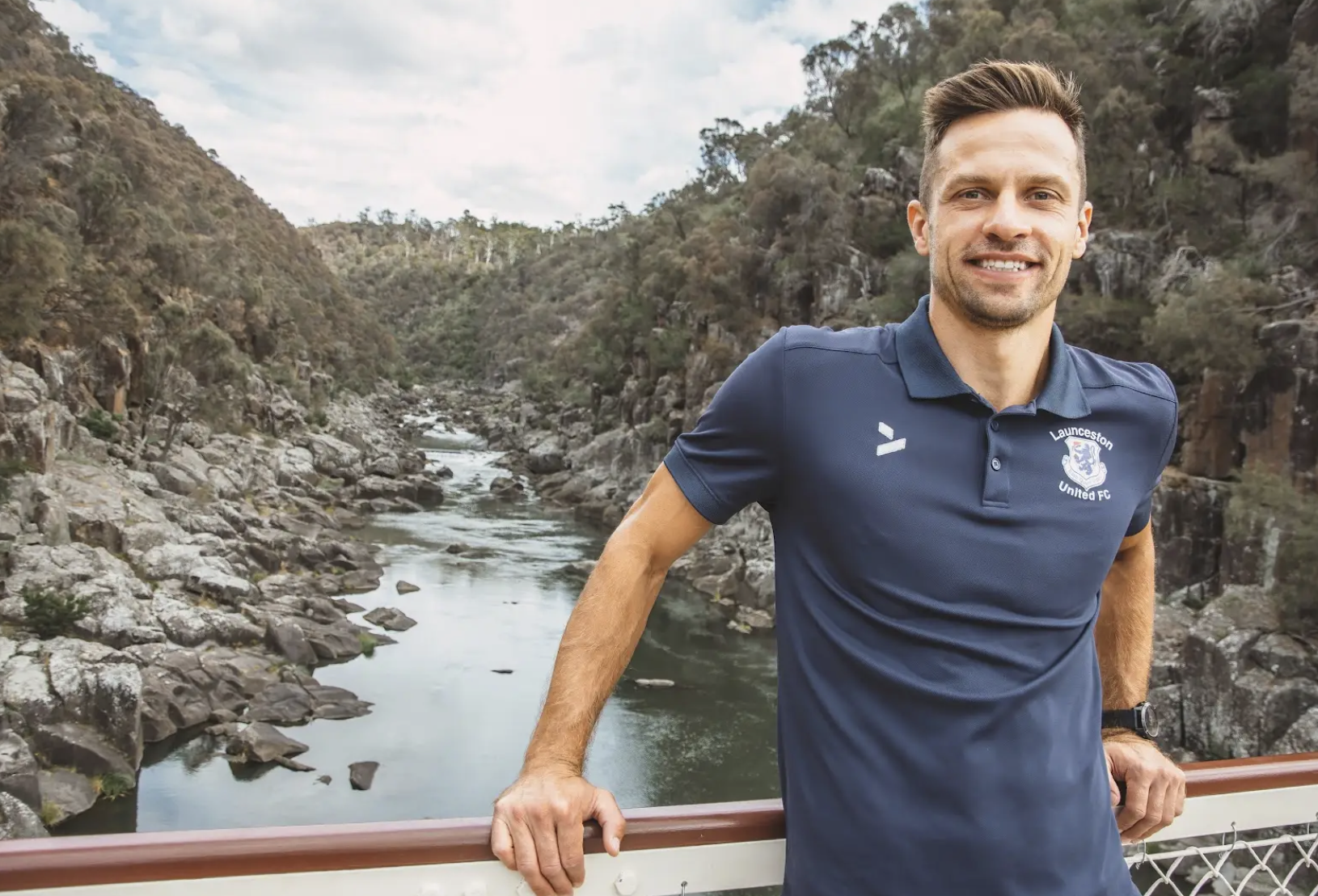
Gedi photographed by Nikki Long
Tasmanian football has a habit of collecting stories from around the world.
Gediminas “Gedi” Krusa arrived from Lithuania eight years ago expecting a short adventure. Instead he found a home, a family and a place in the game in northern Tasmania.
After playing across several clubs in the state, Krusa now leads Launceston United in the NPL while still balancing life as both a player and a coach.
His journey has taken him from European professional football to Tasmania’s north, where his first training sessions were at Valley Road in Devonport, and now into coaching in Launceston.
A childhood built around football
Like many footballers, his relationship with the game started early.
“I started playing in kindergarten when I was four years old and since then the only sport I trained for was football,” he says.
“My mum tried to push me into dancing once when I was in Grade 1 at school. I remember there were tears involved because the only thing I wanted to do was play football.”
That early obsession eventually became a professional career in Europe before a twist of circumstance brought him to Tasmania.
An unexpected journey to Tasmania
“There was a moment in my professional career when I was around 26 or 27 when I was coming back from a bad injury and looking at my options. I realised that at that age my career probably wouldn’t go any further up, so I started thinking about what I would like to do after football.”
He enrolled at university while still playing and began planning for life beyond the pitch. Then an unexpected conversation changed the direction of his life.
“One of my best friends who was also a player mentioned that he was thinking about going to Australia to see the other side of the world and still play football.”
“The funny thing is he never ended up coming. But a couple of months later I was already training at Valley Road, Devonport.”
Eight years later Tasmania is firmly home.
“I can call Tasmania my home away from home and I am very grateful to have two beautiful daughters and my partner here with me.”
Adapting to Tasmanian football
Krusa has since played for several clubs in the north of the state, experiences he says shaped both his understanding of the game and how football operates in a community setting.
“In total I played for four Tasmanian clubs, three of them in Launceston,” he explains.
“That experience helped me adapt to a very different playing style. Football here is much more direct and transitional, with less emphasis on tactics compared to Europe.”
But the biggest adjustment was cultural rather than tactical.
“From a coach’s point of view it gave me a very good understanding of how clubs operate at this level. When you are working in a community club you need to manage players and people very differently than you would in a professional setup.”
From player to coach
The move from player to coach came gradually rather than through a single decision.
“I think it happened naturally. When you reach a certain age in your career you start to see the game differently and realise you have knowledge to give.”
Krusa admits the transition has brought its own challenges, particularly as he continues to play while coaching.
“During games my brain sometimes operates too much like a coach, thinking about positions and structure, instead of focusing purely on my role as a player.”
He also spends much of his time working with younger players through academy coaching.
“Planning sessions and coaching youth players and senior players on the same day is very different.”
Life away from football
Away from football, life is centred firmly around family.
“Probably half of my time is taken by my two beautiful daughters. They definitely keep me on my toes.”
Living in Launceston means beach trips require some planning, but weekends often involve exploring northern Tasmania.
“I love nature, so we spend a lot of time in parks, wineries and the bush.”
Another passion is tennis.
“I try to get to the Australian Open in Melbourne each year.”
Football is a simple game
As both a midfielder and now a coach, Krusa believes football’s complexity is often misunderstood.
“I always remind players that football is a very simple game,” he says.
“When I was a teenager I loved having many touches, doing skills and playing beautifully. But with experience and different coaches I realised the difference is made by the basic elements of the game.”
“If we do the basics well, and do them quickly, the difference in quality will come very soon.”
A European perspective on Tasmanian football
Having experienced both European and Tasmanian football environments, Krusa speaks candidly about the challenges facing the game locally.
“Coming from a professional setup, unfortunately almost everything in Tasmanian football is still behind,” he says.
“The infrastructure is one of the biggest issues. NPL matches are often the second or third game scheduled on the day, which means the pitch is rarely in the condition it should be for top football.”
“We still need improvement in many areas to reach even mainland Australian standards, let alone European levels.”
But he is also quick to recognise the strengths of the Tasmanian football community.
“I love the involvement of females in the game here. The participation numbers are fantastic.”
“And I value the work of volunteers enormously, because without them Tasmanian football simply wouldn’t survive.”
Building a team at Launceston United
As a coach, Krusa places emphasis on discipline, chemistry and understanding the players in front of you.
“Football philosophy always depends on the players you have, their qualities, their style and their characteristics.”
“The best coach is the one who gets the most out of every individual player so that the whole picture works together.”
That philosophy now underpins his work at Launceston United, where he holds the dual role of NPL head coach and technical director.
“Before joining United I didn’t know what to expect, or how people would welcome me because I didn’t know many people at the club,” he says.
“But everyone has been incredibly welcoming, which makes it much easier to set and work towards goals.”
His first focus has been raising the physical standards of the team.
“To compete with the top clubs we needed to become stronger physically. That is the foundation of any team.”
From there the aim is to build a side that is aggressive without the ball and creative with it.
“We will go into every game to compete for points, not simply to avoid being beaten heavily.”
Developing Tasmanian players
Krusa remains passionate about youth development, although he believes geography remains a major challenge for Tasmanian players.
“There are many talented young players in Tasmania, but a combination of factors makes it difficult for them to reach higher levels.”
One piece of advice he gives regularly is confronting but realistic.
“I often recommend that talented players leave Tasmania early, ideally between 14 and 16 years old.”
“The longer they stay, the harder it becomes to bridge the gap with stronger competitions.”
He believes the state also needs stronger support structures for coaches.
“Support, education, mentoring and pathways are all important,” he says.
“If coaching could provide a meaningful income, competition between coaches would increase and that would raise standards.”
Lessons from the coaches who shaped him
Mentors have played an important role in his own development.
“I’ve worked with many excellent coaches during my career,” he says.
“One of my teenage coaches didn’t allow me to take more than one touch in training because I always wanted to do too much. That helped me enormously later in my career.”
Despite the intensity of football, Krusa says perspective remains important.
“My family helps me step away from football when I need to.”
Looking ahead
Looking to the future, he admits the path is not entirely mapped out.
“I’m not sure whether I want to chase a professional coaching career,” he says.
“I live a great life in Tasmania, and that would probably mean leaving the state.”
For now his ambition is clear.
“If I am given enough time I want to see Launceston United become one of the top teams not only in Launceston but in the whole state.”
A simple hope
And when it comes to legacy, the answer is simple.
“I would love if people said that Gedi is a nice and genuine person.”