Six Thousand Kilometres: Drew Smith and the Reality of Football on Tasmania’s North West Coast
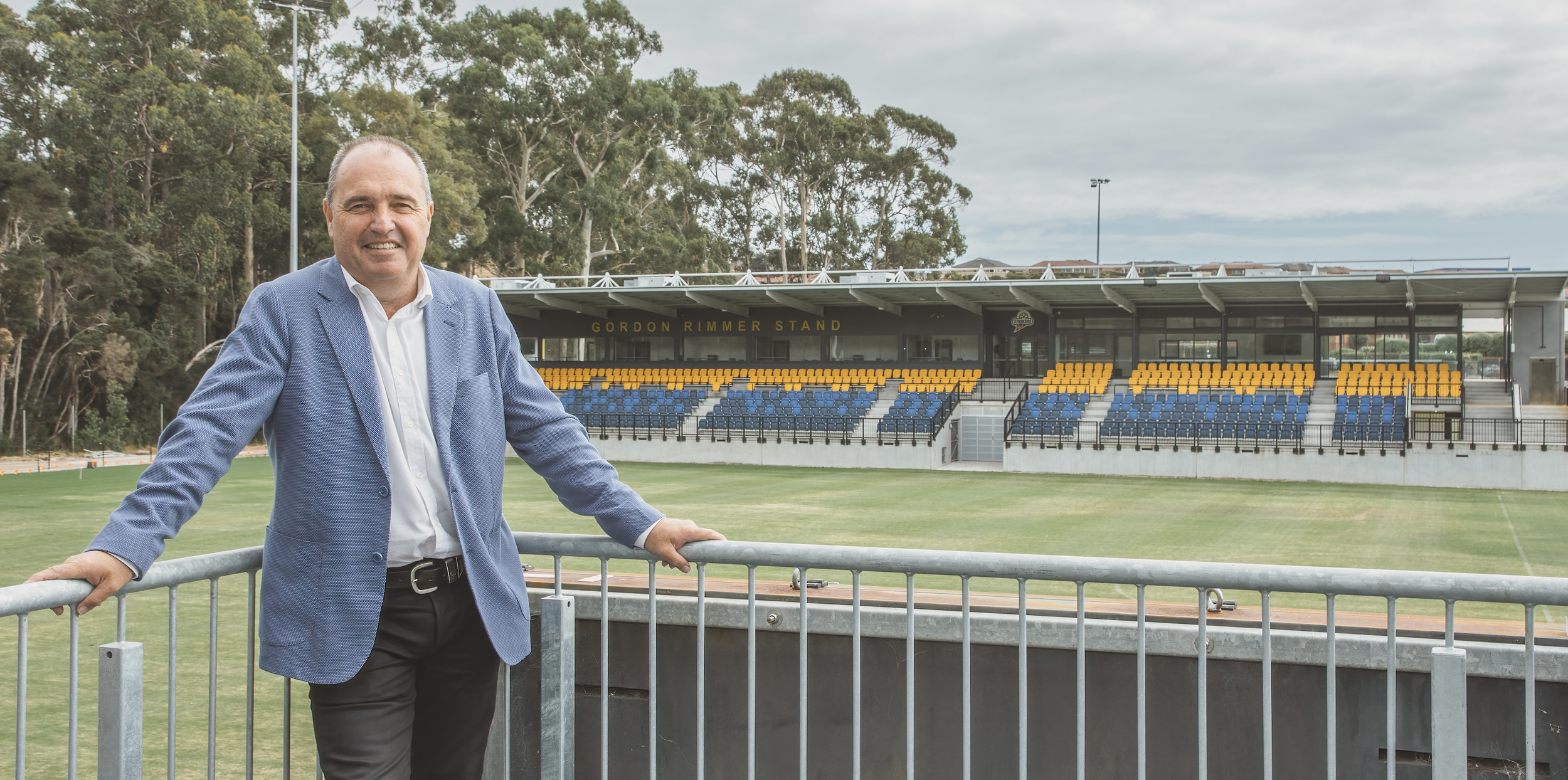
Drew Smith at Valley Road - Photo Nikki Long
Carrying the Load: Drew Smith and Football on the North West Coast
Devonport City Strikers have been one of the most successful clubs in Tasmanian football over the past decade.
Behind that success sits a great deal of unseen work. Volunteers. Logistics. Long travel days. Governance. Fundraising. The constant balancing act of running an elite football club in a small sporting economy.
Drew Smith has been President of the Strikers since 2018. By profession he is a Chartered Accountant and Managing Partner with Findex in Devonport. By football accident he found himself leading one of the state’s flagship clubs.
What follows is a conversation about leadership, travel, regional football and the reality of carrying elite football on the North West Coast.
Not a football beginning
Drew Smith did not grow up in football.
His first sporting life was in Australian Rules.
Outside of football I am married to Leanne and have two children Dominic and Griffin. I am a Chartered Accountant by profession having been in Public Practice for nearly forty years and am currently a Managing Partner with the sixth largest accounting group in Australia, Findex, based in Devonport.
Football wasn’t my first go to sport when growing up. I played state underage AFL as I now call it and State League AFL for Devonport and later for Latrobe in the NWFL.
My pathway to football came through my eldest son Dominic who has played football all of his life and has now played in excess of 250 NPL and Cup games for the Devonport Strikers.
Through his involvement and watching endless games over his football journey I developed a real love for the game and an appreciation of the skill required and the technical side of the sport.
The accidental President
Smith did not arrive at the presidency through a long campaign.
Instead it began with noticing the toll the role was taking on someone else.
My first cousin Rod Andrews was in his fifth year as President in 2018. I could see the weight of the position starting to take its toll on him as the club started to grow and become more successful.
As I was around the club a lot I reached out to him to see if I could assist which led to him asking if I was interested in taking over as President.
For me it was a relatively easy decision as my assessment of the club was that it had a great brand and reputation, good people and a great culture. All of the key ingredients you need for success.
I felt that I had a skill set that the club needed and so I committed to taking it on for three years with a clear three year plan.
Eight years later I am still here.
Rod has remained an important part of the club over my tenure having been the head of our Football Department and we have formed a great partnership.
A marathon, not a sprint
Running a football club at this level is often misunderstood.
From the outside it can look like match days and trophies.
From the inside it looks very different.
The time commitment is huge on top of an already busy professional and business life.
The role requires a significant amount of resilience and perseverance and if you think you are in the role for a sprint you are wrong. It is a marathon.
With the constant lift in requirements for clubs to meet and the increased professionalism within the sport there is no respite. It goes all year round which is why I often laugh when people say you must be enjoying the off season.
What off season.
Sporting clubs are complex beasts and they have many different elements to them. At the end of the day you are running a business that operates in a number of high risk segments with bars, food, gaming and working with children so you have to be constantly on your game.
Unless you have been in the role I think it is very difficult for anyone to have a real appreciation of what it actually takes.
The drive to win
For Smith the motivation is simple.
Competition.
I am super competitive by nature and so what keeps me going is the competition and the desire to be the best.
I have been lucky in that the club has been the most successful club in Tasmania over the last decade and tasted success beyond our wildest dreams both on field and off field which makes all of the hard work and effort worthwhile.
There are plenty of times when it would have been easy to walk away as with anything if you have highs there will also be the lows however that is life and you just have to pick yourself up and go again.
Six thousand kilometres
For clubs based in Hobart, travel can mean a short bus ride.
For Devonport it means something entirely different.
Being based on the North West Coast and until this season being the only team from the region, travel has always been a major impediment.
When I first took on the role I used to sit down and work out the travel distance that each club would have to undertake for the upcoming season.
At that stage there were five teams in Hobart and we would consistently be doing between six thousand and eight thousand kilometres a year particularly when we went deep into the Cup and kept drawing away games.
This amount of travel would be two to four times more than any other club.
Managing players over a season when confronted with such a heavy travel regime has always been challenging as has the time commitment required from our players particularly those with partners and young families.
It has not been uncommon for our NPL team to leave at 8.30 in the morning and not return home until after midnight.
Managing logistics is a constant issue as we have three teams and two buses and often the teams are playing at different venues.
Figuring out when teams need to leave, which teams need to be on which buses and ensuring we stay within the allotted travel time before overtime charges apply is always part of the planning.
If we draw an away game in Hobart in the Cup it is the worst financial outcome for the club as the club is required to subsidise the travel with no reimbursement from Football Tasmania at a cost of nearly $1,500 per team.
A fragile region
For Smith the bigger concern is not just travel.
It is the fragility of football on the North West Coast.
I think people in the south do not appreciate the fragility of the sport on the North West Coast.
We are starting to see evidence of that this year with some clubs having difficulty fielding teams.
As a club we want the whole region to be successful and to thrive so that the sport grows which in turn supports competition structures in the North West and the North of the state.
The North West has no full time or part time Football Tasmania staff based in the region driving the development of the sport.
Given it is a regional area it can also be a challenge to attract appropriately qualified coaches, players and support staff.
Scarcity
Running a football club often comes down to the same pressures.
Money.
People.
Facilities.
The scarcity of resources whether that be volunteers, money or facilities is a major constraint and pressure point for all clubs.
Given the scarcity of resources it becomes even more important that the key stakeholders within Tasmanian football understand the roles they should play in the football ecosystem for the sport to prosper and grow.
At the moment I do not believe there is clarity around this which in turn leads to some of the structural flaws currently impacting the sport.
The promise of a statewide league
Despite the challenges Smith believes the statewide NPL structure still has an important role.
The best thing about having a statewide NPL competition is that it extends the player pathways in the state and also provides a competition structure for professional footballers wishing to play in Tasmania which in theory should lift the standard of the sport.
The other benefit is the opportunities it provides clubs to play on the national stage whether that be through the Australia Cup or National Second Division competitions.
The flaw
But one change, he believes, has altered the balance.
The abolition of the player points system.
The old player points system really placed the onus back on clubs to develop talent within their own club as local talent attracted very low points.
In the absence of a salary cap for the NPL it also provided a bit of a safety net which does not exist under the current structure.
More affluent clubs can now acquire the best young talent in the country without falling foul of a points or salary cap system.
We are starting to see that play out when you look at the number of players clubs are bringing into their squads that are not local which means talented local players are missing the opportunity to develop.
A structure under pressure
Looking at the bigger picture Smith believes Tasmanian football is approaching an important moment.
I do not believe the current structure of the sport in Tasmania is sustainable.
As such I believe now is the time to bring together the best minds in the sport to undertake a strategic review of football in Tasmania.
We need a process that ensures the structure of football in Tasmania supports the outcomes the sport is seeking to achieve.
Representation
Governance is another issue Smith believes needs attention.
With the game administered in Hobart, no North West representation on the Football Tasmania Board and minimal on site visitation to the region, it can easily feel Hobart centric.
On the flip side we appreciate that the greater Hobart region has the most players and teams in the state so there are arguments both ways.
But there needs to be balance and at the moment I do not believe that balance supports the growth of the sport on the North West Coast.
Clubs currently carry the majority of the elite level football burden.
Without a shared vision of what elite level football looks like for the state that aligns with and enhances current player pathways and creates new ones that currently do not exist my concern is that the sport will never reach its full potential in Tasmania.
I also believe the key stakeholders in the sport, the clubs themselves, are often not heard and do not have a forum or structure which supports them being properly heard.
For me that is a critical structural deficiency that needs to change.
When the clubs stood together
Leadership inevitably brings difficult decisions.
Some remain private.
Some become defining moments.
It has always been difficult when we have had to remove a coach particularly if they have not seen it coming and believe they are doing a good job.
One of the biggest decisions I was involved in was when the NPL clubs decided to withdraw from the competition around the time of COVID due to differences with Football Tasmania.
It was a powerful moment when all the clubs put aside their differences and stood united.
Volunteers
In the end Smith says football clubs still run on volunteers.
People need to appreciate and probably be constantly reminded that we are a volunteer organisation.
Without volunteers the club would not survive.
It is not all glitz and glamour and you need to be prepared to get your hands dirty and be on the tools.
It takes an enormous amount of work to get teams on the park every week and clubs receive no guaranteed funding.
Every year clubs must find every dollar required in their budget.
Unfortunately that means the cost of delivering football programs continues to rise particularly when you consider that fees levied on clubs have increased by around fifty percent over the last five years.
Unfinished work
Smith is not yet ready to walk away.
But he does have an end point in mind.
I am a goal driven person and I have a couple of pieces of unfinished business.
One is completing a Strategic Review of Football in Devonport with associated recommendations.
The second is completing the design and planning for the greater Valley Road precinct for which we have received State Government funding.
Once those pieces are completed it may be time to step aside.
Over the years I have sat in many meetings with Drew representing the Strikers. He is thoughtful, intelligent and always focused on the bigger picture. What I have appreciated most is his willingness to work with fellow club presidents, even when clubs are competing fiercely on the field. Like many people running football clubs in Tasmania, he gives an enormous amount of time and energy to the game, often quietly and without recognition.