The Tyranny of Distance
Driving home yesterday from the Devonport Cup, I said to Ken that I wasn't sure I'd want to be a Devonport player.
Not because of the football.
Because of the travel.
Today, Devonport will get back on a bus and head south again for the Lakoseljac Cup Final and the Women's Statewide Cup Final.
And good on them.
But it got me thinking.
At the moment there are five southern clubs in the NPL.
That means five league trips to Hobart every season.
Then there are three trips to Launceston.
A trip to Ulverstone.
Cup matches.
Statewide finals.
Representative football.
It adds up.
A lot.
Football Tasmania often points to travel costs as one of the reasons the NPL licence fee sits above $20,000.
Distance costs money.
It always has.
But it also costs something else.
Time.
For most NPL players, football isn't their full-time job.
They have work.
Families.
Partners.
Children.
Study commitments.
Then they climb on a bus for another away trip.
The remarkable thing isn't that football is expensive.
The remarkable thing is that so many people continue to do it.
Choosing to play state league football in Tasmania is, in many ways, a lifestyle choice.
Nobody is getting rich.
Nobody is building a retirement fund.
They're doing it because they love the game.
Tasmania Sits On An Island At The Arse End Of The World
We are incredibly lucky to live where we do.
I wouldn't swap Tasmania for anywhere.
Clean air.
Open spaces.
A football ground ten minutes away.
No traffic worth talking about.
A community where people still know each other.
But every choice comes with a cost.
And one of the costs of living on an island at the arse end of the world is distance.
Lots of distance.
Back in the 1980s, before the internet was a thing, a friend of mine arrived in Perth from Finland.
She and her travelling companion bought bicycles.
Their plan was simple.
Ride from Perth to Sydney.
To them it seemed perfectly reasonable.
After all, in Europe you can ride through multiple countries in a relatively short period of time.
Australia looked large on the map.
But maps don't always tell the full story.
From memory, they made it about 40 kilometres before a road train driver stopped and asked where they were heading.
When they told him Sydney, he apparently informed them that they were likely to die if they continued.
Not because he was being dramatic.
Because he was probably right.
I've driven across the Nullarbor twice.
The word comes from the Latin nullus arbor.
No trees.
Not an Aboriginal word at all.
Six years of Latin at school finally proving useful.
The name is remarkably accurate.
Roadhouses.
Petrol stops.
Big skies.
Huge distances.
And not much else.
It's one of those places that reminds you just how enormous Australia really is.
Europe Has A Secret Advantage
Australian football constantly compares itself to Europe.
The Premier League.
The Bundesliga.
La Liga.
The Champions League.
We compare crowds.
Television deals.
Facilities.
Player pathways.
But there is one advantage Europe enjoys that nobody talks about.
Geography.
A club in England can travel a couple of hours by bus for an away game.
Supporters can follow their team and sleep in their own bed that night.
Many clubs can play an entire season without seeing an airport.
Imagine that.
No flights.
No baggage check-in.
No airport parking.
No weather delays.
Just football.
Tasmania doesn't even have the luxury of being attached to the mainland.
Before a Tasmanian team can participate nationally, the first challenge isn't the opposition.
It's getting off the island.
A Map Matters
The older I get, the more I think geography might be the most underrated force in Australian football.
We spend endless hours talking about governance.
Television deals.
Participation numbers.
Facilities.
Pathways.
Yet perhaps Australian football's biggest challenge has always been a map.
Australia has around 27 million people.
Spread across an entire continent.
England has around 67 million people.
Germany around 84 million.
Spain around 49 million.
All packed into relatively compact geographic areas.
Tasmania sits on an island off the bottom of a continent.
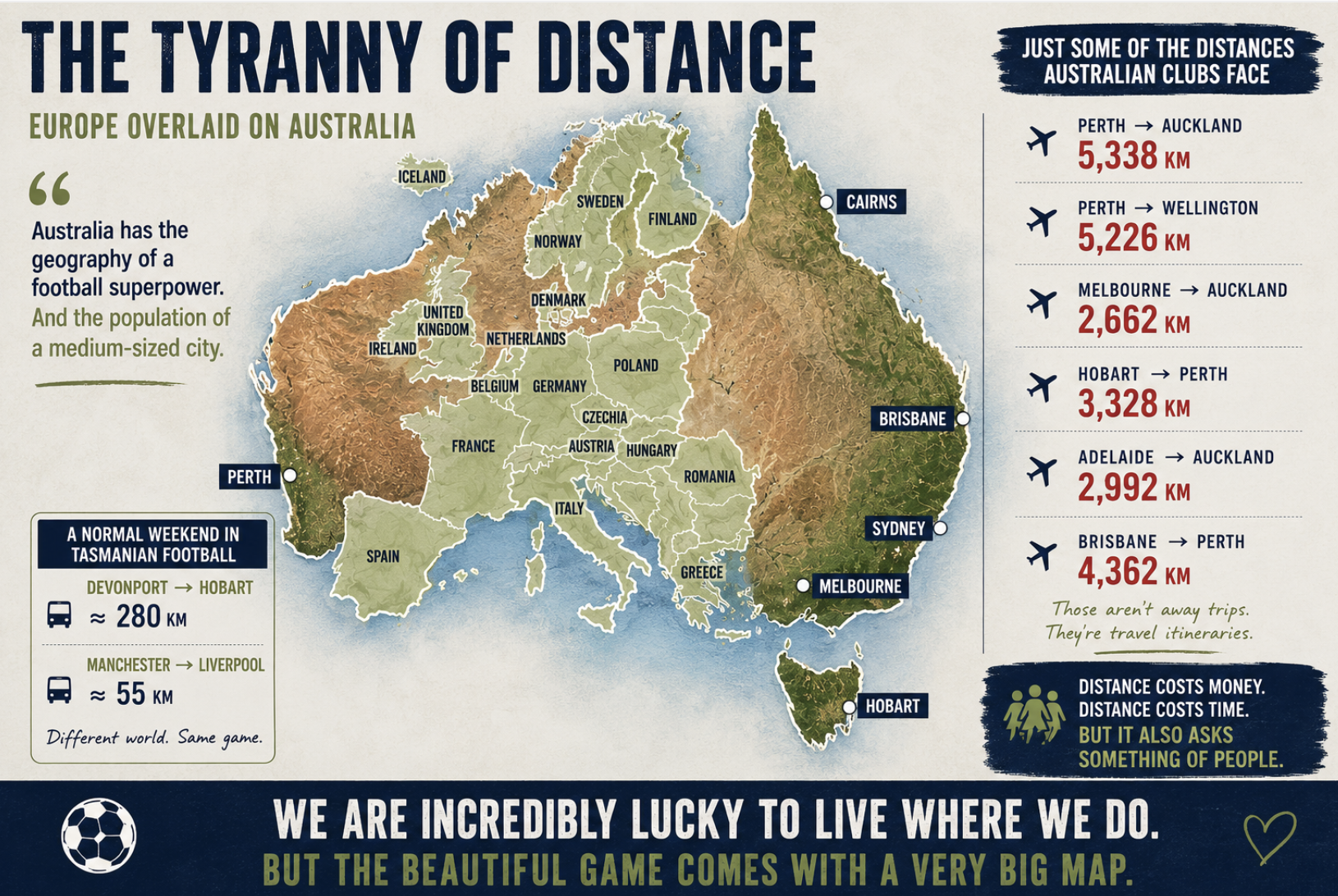
Australia has the geography of a football superpower.
And the population of a medium-sized city.
That combination creates challenges.
Lots of them.
Let's Compare
Devonport to KGV is around 280 kilometres.
A decent trip.
Hundreds of Devonport supporters will make it today because cup finals matter.
Manchester United to Liverpool is around 55 kilometres.
Perth to Auckland is more than 5,000 kilometres.
Perth to Wellington is more than 5,000 kilometres.
Hobart to Perth is more than 3,000 kilometres.
Melbourne to Auckland is around 2,600 kilometres.
Those aren't away trips.
They're travel itineraries.
The remarkable thing isn't that Australian football occasionally struggles financially.
The remarkable thing is that football people somehow make it work.
Distance Costs More Than Money
Distance costs money.
Every kilometre costs money.
Every flight costs money.
Every hotel room costs money.
Every airport transfer costs money.
Football Tasmania will tell you that.
Club treasurers will tell you that.
Anyone who has organised a national tournament will tell you that.
But distance also asks something of people.
A Devonport player finishing work on a Friday.
A volunteer organising another trip.
A parent driving hundreds of kilometres for representative football.
A supporter climbing on a bus before dawn for a cup final.
Distance asks something of all of them.
And football people keep saying yes.
The Hidden Cost Of National Competitions
This is where Australian football becomes fascinating.
We often compare ourselves to Europe.
Maybe we shouldn't.
England has 67 million people living in a country smaller than Victoria.
Germany has 84 million people.
Australia has 27 million people spread across an entire continent.
And then we wonder why national competitions are expensive.
The AFL wrestles with it.
The NRL wrestles with it.
Football wrestles with it.
It's not because administrators are stupid.
It's because geography is expensive.
And geography never changes.
Every discussion about television deals, sponsorship, club sustainability and league structures eventually runs into the same opponent.
A map.
A Question Worth Asking
This isn't an argument against ambition.
It isn't an argument against national competitions.
And it certainly isn't an argument against professional football.
It is simply an observation.
Australian football often discusses money as though it exists in isolation.
It doesn't.
Money and geography are connected.
The further apart we are, the more expensive football becomes.
The more expensive football becomes, the harder sustainability becomes.
Perhaps the question isn't whether Australian football should be national.
Perhaps the question is how national football can be while remaining financially sustainable.
That's a very different conversation.
The Remarkable Part
As the Strikers head south today, they'll probably be thinking about the game.
The tactics.
The opposition.
The occasion.
The possibility of bringing a cup back home.
That's what football people do.
The remarkable thing is that next week somebody will make the trip again.
Somebody will board another bus.
Somebody will catch another flight.
Somebody will drive another few hundred kilometres.
Because football matters to them.
Distance isn't going away.
The map isn't changing.
But neither is the passion.
And perhaps that's the most remarkable thing of all.