Who Knew About the Seats?
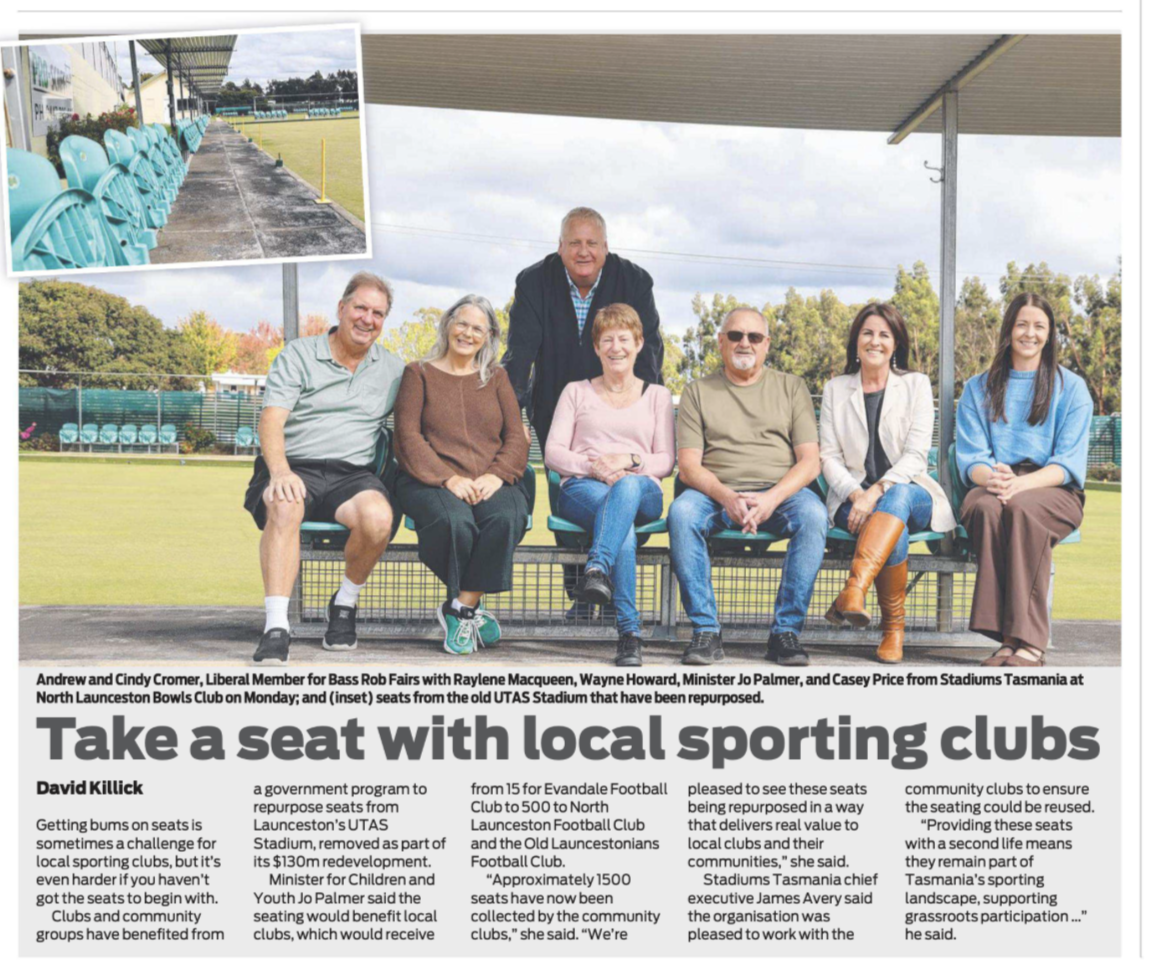
The Mercury 7 April 2026
I was scrolling when I saw the announcement.
“Stadium seating finds new life with local sporting clubs.”
At first glance, a great idea.
More than 1,500 seats removed from UTAS Stadium, redistributed to 15 local clubs.
Sustainable. Practical. Community focused.
Exactly the kind of initiative you want to see.
And then you look a little closer.
The Announcement
The Tasmanian Government, through Jo Palmer, confirmed that:
more than 1,500 seats were redistributed
15 clubs received them
and “every club that applied got what they were after”
On face value, fair.
No complaints there.
But that sentence shifts the question.
The List
When you look at the clubs, the picture becomes clearer.
The recipients are overwhelmingly Australian Rules football clubs, along with one bowls club.
No football clubs.
Not Launceston City FC
Not Launceston United FC
Not Riverside Olympic FC
Clubs that play in the NPL.
Clubs with facilities.
Clubs that host games.
Clubs that would absolutely use seating.
And in Launceston United’s case, the seats would have been closer to their colours than most.
But it doesn’t stop there.
Across the north there are Championship clubs, community clubs, and social teams who would also have benefited.
Clubs where people stand on the sidelines.
Clubs where parents bring their own chairs.
Clubs where even a small bank of seating would make a difference.
This wasn’t just an opportunity for the top end.
It was an opportunity for the whole game.
A Fair System?
Let’s be clear.
There is nothing in the announcement that suggests bias.
In fact, it suggests the opposite.
Every club that applied got seats.
That is, on paper, a fair process.
So the Question Changes
The issue is no longer:
Who got the seats?
It becomes:
Who was told, and how?
Because I cannot find:
a public call-out
an expression of interest
a grant page
a visible application process
Maybe it existed.
Maybe it went through Football Tasmania
Maybe it went through AFL Tasmania
Maybe it was sent directly to clubs
But if it did, it wasn’t visible.
And that matters.
Let’s Be Honest
There are a few possibilities.
Football didn’t know.
Football knew but too late.
Football knew and didn’t act.
All are possible.
None are proven.
But all lead to the same outcome.
And yes, it is possible football clubs knew and didn’t act. That’s a different conversation, but just as important.
AFL Does This Well
It’s also worth saying this clearly.
AFL clubs are organised.
They are connected.
They respond to opportunities.
They are ready when something becomes available.
That is not criticism.
That is reality.
Football Wasn’t in the Room
Because when you strip it back, that’s what this is.
A practical opportunity.
Free infrastructure.
Delivered into one sporting ecosystem.
Not the other.
No outrage required.
No conspiracy needed.
Just a simple observation:
Football doesn’t appear to have been in the room.
This Isn’t About Seats
This is about something bigger.
How information moves.
Who hears it.
Who is organised to respond.
Because too often, football isn’t missing out at the end.
It’s missing out at the start.
A Question Worth Asking
So this isn’t criticism.
It’s a question.
A genuine one.
Who was told, and how?
Because if it was open to all, and only one code responded, that tells us something.
And if it wasn’t broadly communicated, that tells us something else.
Either way, it’s worth understanding.
Because Next Time Matters
There will be another opportunity.
There always is.
The question is whether football will be in the room when it happens.
Or reading about it afterwards.