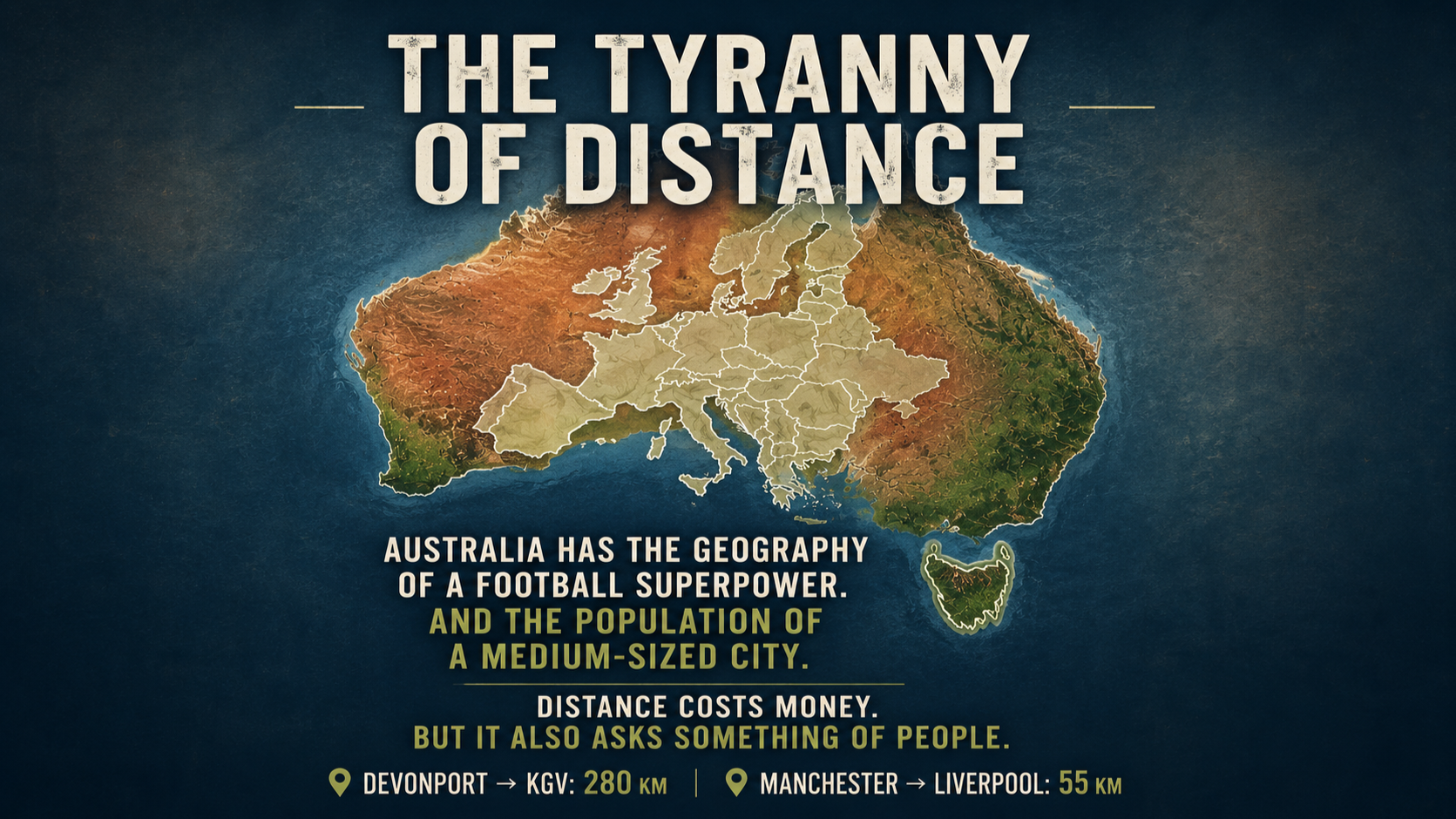
The Tyranny of Distance
Driving home yesterday from the Devonport Cup, I said to Ken that I wasn't sure I'd want to be a Devonport player.
Not because of the football.
Because of the travel.
Today, Devonport will get back on a bus and head south again for the Lakoseljac Cup Final and the Women's Statewide Cup Final.
And good on them.
But it got me thinking.
At the moment there are five southern clubs in the NPL.
That means five league trips to Hobart every season.
Then there are three trips to Launceston.
A trip to Ulverstone.
Cup matches.
Statewide finals.
Representative football.
It adds up.
A lot.
Football Tasmania often points to travel costs as one of the reasons the NPL licence fee sits above $20,000.
Distance costs money.
It always has.
But it also costs something else.
Time.
For most NPL players, football isn't their full-time job.
They have work.
Families.
Partners.
Children.
Study commitments.
Then they climb on a bus for another away trip.
The remarkable thing isn't that football is expensive.
The remarkable thing is that so many people continue to do it.
Choosing to play state league football in Tasmania is, in many ways, a lifestyle choice.
Nobody is getting rich.
Nobody is building a retirement fund.
They're doing it because they love the game.
Tasmania Sits On An Island At The Arse End Of The World
We are incredibly lucky to live where we do.
I wouldn't swap Tasmania for anywhere.
Clean air.
Open spaces.
A football ground ten minutes away.
No traffic worth talking about.
A community where people still know each other.
But every choice comes with a cost.
And one of the costs of living on an island at the arse end of the world is distance.
Lots of distance.
Back in the 1980s, before the internet was a thing, a friend of mine arrived in Perth from Finland.
She and her travelling companion bought bicycles.
Their plan was simple.
Ride from Perth to Sydney.
To them it seemed perfectly reasonable.
After all, in Europe you can ride through multiple countries in a relatively short period of time.
Australia looked large on the map.
But maps don't always tell the full story.
From memory, they made it about 40 kilometres before a road train driver stopped and asked where they were heading.
When they told him Sydney, he apparently informed them that they were likely to die if they continued.
Not because he was being dramatic.
Because he was probably right.
I've driven across the Nullarbor twice.
The word comes from the Latin nullus arbor.
No trees.
Not an Aboriginal word at all.
Six years of Latin at school finally proving useful.
The name is remarkably accurate.
Roadhouses.
Petrol stops.
Big skies.
Huge distances.
And not much else.
It's one of those places that reminds you just how enormous Australia really is.
Europe Has A Secret Advantage
Australian football constantly compares itself to Europe.
The Premier League.
The Bundesliga.
La Liga.
The Champions League.
We compare crowds.
Television deals.
Facilities.
Player pathways.
But there is one advantage Europe enjoys that nobody talks about.
Geography.
A club in England can travel a couple of hours by bus for an away game.
Supporters can follow their team and sleep in their own bed that night.
Many clubs can play an entire season without seeing an airport.
Imagine that.
No flights.
No baggage check-in.
No airport parking.
No weather delays.
Just football.
Tasmania doesn't even have the luxury of being attached to the mainland.
Before a Tasmanian team can participate nationally, the first challenge isn't the opposition.
It's getting off the island.
A Map Matters
The older I get, the more I think geography might be the most underrated force in Australian football.
We spend endless hours talking about governance.
Television deals.
Participation numbers.
Facilities.
Pathways.
Yet perhaps Australian football's biggest challenge has always been a map.
Australia has around 27 million people.
Spread across an entire continent.
England has around 67 million people.
Germany around 84 million.
Spain around 49 million.
All packed into relatively compact geographic areas.
Tasmania sits on an island off the bottom of a continent.
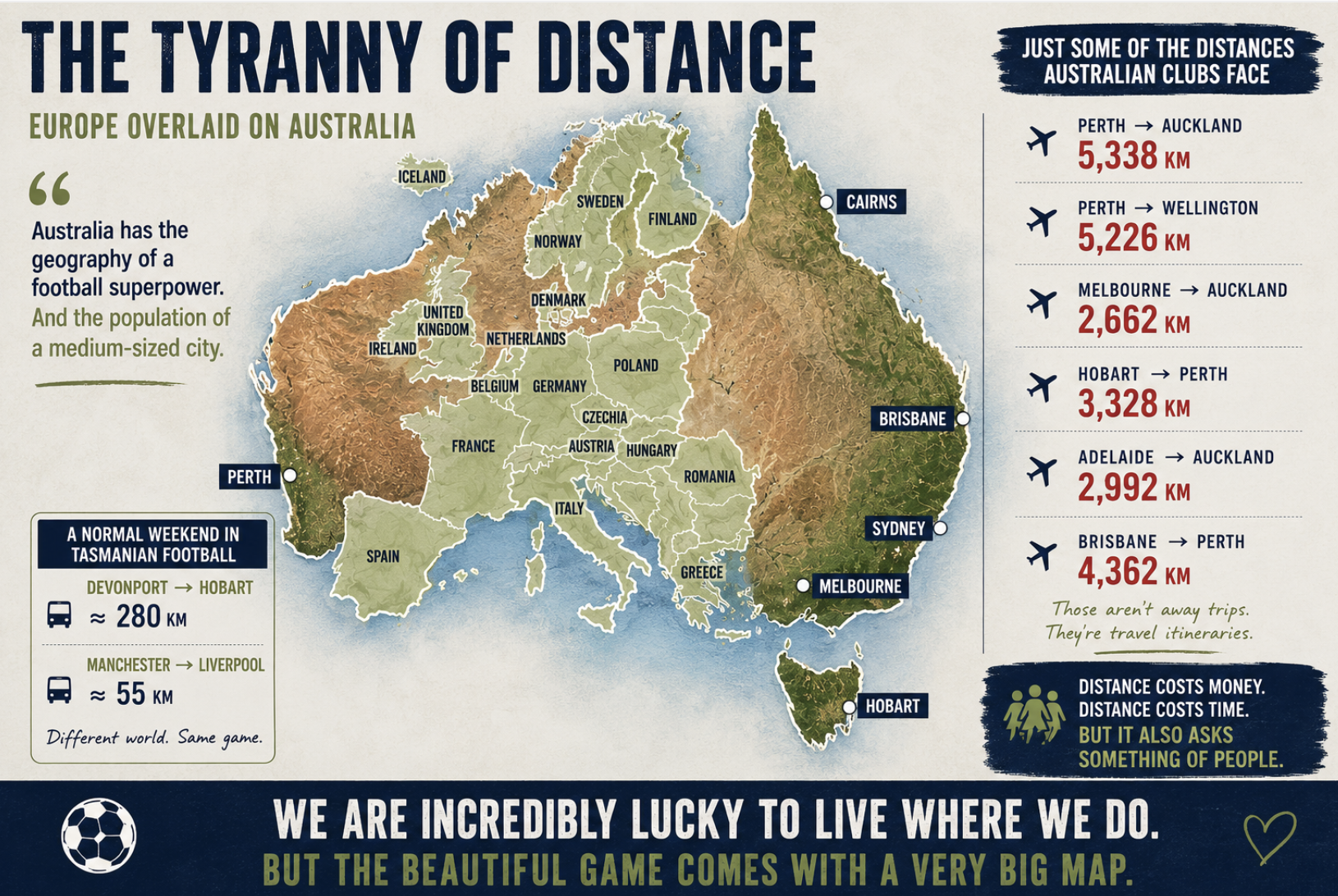
Australia has the geography of a football superpower.
And the population of a medium-sized city.
That combination creates challenges.
Lots of them.
Let's Compare
Devonport to KGV is around 280 kilometres.
A decent trip.
Hundreds of Devonport supporters will make it today because cup finals matter.
Manchester United to Liverpool is around 55 kilometres.
Perth to Auckland is more than 5,000 kilometres.
Perth to Wellington is more than 5,000 kilometres.
Hobart to Perth is more than 3,000 kilometres.
Melbourne to Auckland is around 2,600 kilometres.
Those aren't away trips.
They're travel itineraries.
The remarkable thing isn't that Australian football occasionally struggles financially.
The remarkable thing is that football people somehow make it work.
Distance Costs More Than Money
Distance costs money.
Every kilometre costs money.
Every flight costs money.
Every hotel room costs money.
Every airport transfer costs money.
Football Tasmania will tell you that.
Club treasurers will tell you that.
Anyone who has organised a national tournament will tell you that.
But distance also asks something of people.
A Devonport player finishing work on a Friday.
A volunteer organising another trip.
A parent driving hundreds of kilometres for representative football.
A supporter climbing on a bus before dawn for a cup final.
Distance asks something of all of them.
And football people keep saying yes.
The Hidden Cost Of National Competitions
This is where Australian football becomes fascinating.
We often compare ourselves to Europe.
Maybe we shouldn't.
England has 67 million people living in a country smaller than Victoria.
Germany has 84 million people.
Australia has 27 million people spread across an entire continent.
And then we wonder why national competitions are expensive.
The AFL wrestles with it.
The NRL wrestles with it.
Football wrestles with it.
It's not because administrators are stupid.
It's because geography is expensive.
And geography never changes.
Every discussion about television deals, sponsorship, club sustainability and league structures eventually runs into the same opponent.
A map.
A Question Worth Asking
This isn't an argument against ambition.
It isn't an argument against national competitions.
And it certainly isn't an argument against professional football.
It is simply an observation.
Australian football often discusses money as though it exists in isolation.
It doesn't.
Money and geography are connected.
The further apart we are, the more expensive football becomes.
The more expensive football becomes, the harder sustainability becomes.
Perhaps the question isn't whether Australian football should be national.
Perhaps the question is how national football can be while remaining financially sustainable.
That's a very different conversation.
The Remarkable Part
As the Strikers head south today, they'll probably be thinking about the game.
The tactics.
The opposition.
The occasion.
The possibility of bringing a cup back home.
That's what football people do.
The remarkable thing is that next week somebody will make the trip again.
Somebody will board another bus.
Somebody will catch another flight.
Somebody will drive another few hundred kilometres.
Because football matters to them.
Distance isn't going away.
The map isn't changing.
But neither is the passion.
And perhaps that's the most remarkable thing of all.
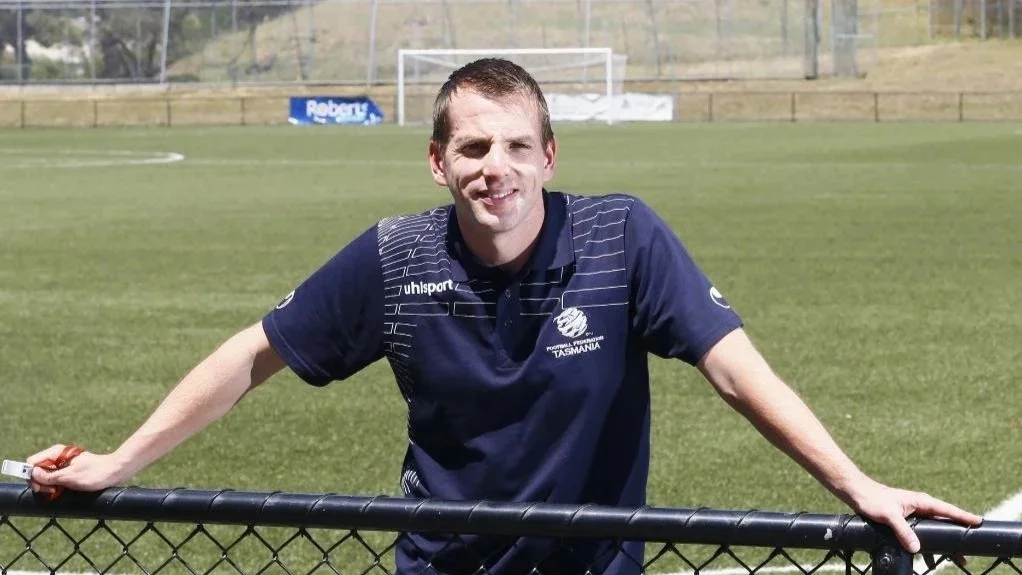
The English Referee Who Found a Home in Tasmania
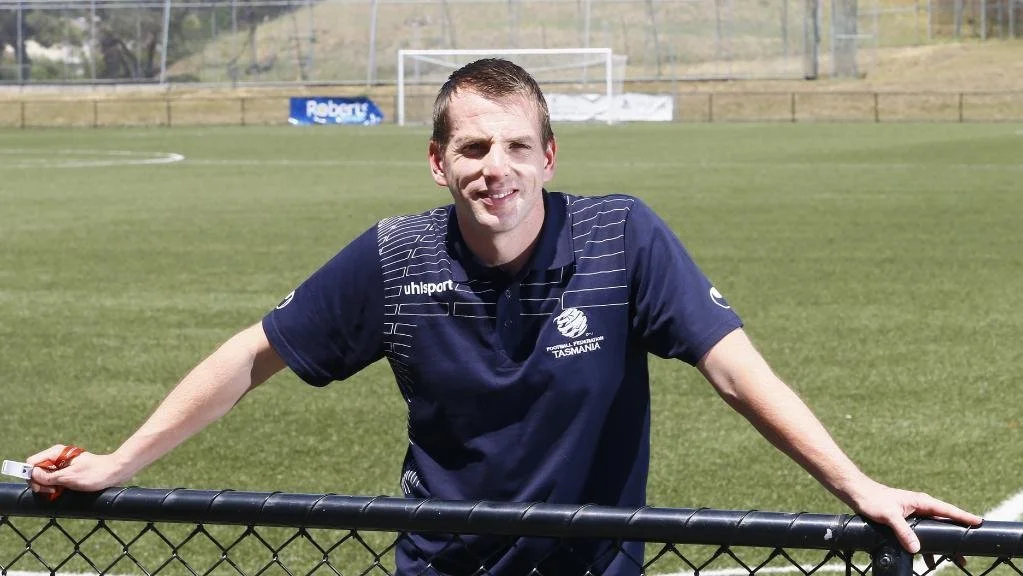
Photo: Football Tasmania
From the English Championship to Preston Lions, Tony Peart reflects on refereeing, leadership, community and the football people who shaped his journey.
When Tony Peart talks about Tasmania, he doesn't sound like someone describing a former workplace.
He sounds like someone talking about home.
Years after leaving for bigger roles in Victorian football, he still owns a house in Tasmania. He still visits regularly. And when asked whether moving here was the right decision, his answer arrives without hesitation.
"Absolutely.”
"I loved my time in Tassie. I still have a house there, still come back for visits, and it will always feel like home."
For many people in Tasmanian football, Tony will always be remembered as Football Tasmania's Referee Development Manager. Others will remember him from referee courses, development programs, radio interviews and countless weekends spent helping officials improve their craft.
Today he is the General Manager of Preston Lions, one of Australia's most historic football clubs.
But his football story began a long way from Tasmania.
It began in England.
A Different Path Into Football
Football was a huge part of Tony's childhood.
Like millions of English children, weekends revolved around the game. Playing it. Watching it. Talking about it.
But while many youngsters dreamed of scoring goals in packed stadiums, Tony became fascinated by something different.
His physical education teacher happened to be a Premier League referee.
That influence proved significant.
While still at school, Tony started refereeing matches himself.
Partly, he jokes, because it occasionally got him out of lessons.
Mostly because he discovered he genuinely enjoyed it.
The responsibility.
The decision making.
The challenge.
Refereeing offered a pathway into football that his playing ability may never have provided.
What started as a schoolboy activity soon became something much more serious.
The Championship Years
Tony progressed through the English refereeing system at a relatively young age.
League One and League Two provided valuable experience before he stepped into the Championship.
For those outside England, the Championship often sits in the shadow of the Premier League.
Those inside football know differently.
"The Championship itself is one of the toughest competitions in world football," Tony says.
"The intensity, crowds, scrutiny and expectations are enormous."
Every match matters.
Promotion can transform a club's future.
Relegation can be devastating.
Every decision is examined.
Every mistake is noticed.
It was an environment that demanded preparation, resilience and consistency.
The lessons learned there would stay with him throughout the rest of his football career.
Finding Tasmania
Like many people, Tony had travelled extensively around Australia before deciding he wanted a new challenge and a different lifestyle.
He had already secured permanent residency before he began looking seriously at opportunities.
Football Tasmania provided one.
The role centred on referee development.
The location offered something completely different from England.
His first impression remains vivid.
"The first thing that struck me was just how friendly and welcoming everyone was."
From his first interview with then CEO Mike Palmer through to conversations with Ian Colhoun before he arrived, Tony felt supported and encouraged.
His introduction to Tasmania was immediate.
One moment he was arriving from England.
The next he was being collected from the airport and taken straight into radio and television interviews.
He laughs about it now, but it was a fitting introduction to a football community that quickly embraced him.
Tony still remembers the people who helped him settle.
Michele.
Glen.
Edo.
Andy Cooling.
Mike Palmer.
Years later, their kindness still stands out.
Discovering Tasmanian Football
Tony arrived with the perspective of somebody who had worked in professional football in England.
Tasmania immediately presented a different environment.
One of the first things that surprised him was the number of clubs.
Coming from England, he initially thought there seemed to be relatively few.
Then he realised something.
Each club was carrying a remarkable amount of football.
Large numbers of teams.
Multiple age groups.
Hundreds of players.
The scale was different.
The commitment wasn't.
Another difference was the football calendar itself.
In England, midweek football is a regular part of life.
In Tasmania, most football activity is concentrated across weekends.
It created a very different rhythm to the game.
What impressed him most, however, was the sense of unity.
Despite the geographical challenges of the state, the referee group displayed a genuine willingness to work together.
There was a strong feeling that everyone was moving in the same direction.
What Tasmania Gets Right
When discussing his years in Tasmania, Tony repeatedly returns to one word.
Development.
"My first few years in Tasmania were probably the most enjoyable of my football career in Australia."
"There was a real focus on development, not just for players, but also for coaches."
From a refereeing perspective, he felt he could genuinely make a difference.
There was a willingness to listen.
A willingness to embrace new ideas.
A willingness to invest in people.
One observation particularly stood out.
Many of Tasmania's stronger clubs operated with multiple teams playing at the same venue throughout the day.
That meant Technical Directors and club leaders could be present.
They could observe players.
Support coaches.
Monitor behaviour.
Reinforce standards.
Shape club culture.
Development wasn't something discussed in a boardroom once a month.
It was happening in front of them every weekend.
Tony believes Tasmania's football community possesses something larger football states sometimes struggle to maintain.
Connection.
People know each other.
Volunteers know coaches.
Referees know club officials.
Administrators know the people on the ground.
Problems are often solved through conversations rather than processes.
"Never underestimate the value of community."
For Tony, that remains one of Tasmania's greatest strengths.
The Challenges Of Being An Island
That doesn't mean the challenges disappear.
Tony jokes that one of football's biggest competitors in Tasmania remains "that oval-shaped ball that seems to dominate the headlines."
Behind the humour sits a serious reality.
Geography influences almost every aspect of football in Tasmania.
Travel costs.
Player pathways.
Referee development.
Competition structures.
Development opportunities.
Simply bringing people together regularly requires significant time, money and effort.
Football also continues to compete for facilities, funding and media attention.
Tony believes there have been times when football has struggled to receive recognition that reflects its participation levels.
Access to facilities.
Facility maintenance.
Government funding.
Media coverage.
All remain ongoing challenges.
Yet what impressed him most was the determination of the people involved.
Rather than becoming discouraged, volunteers, clubs and administrators simply kept working.
The passion never disappeared.
Building Referees, Building People

Photo: Football Tasmania
Ask Tony what he is most proud of and he doesn't talk about positions.
He talks about people.
He talks about seeing young referees grow in confidence.
Develop their skills.
Progress through the system.
Reach higher levels of the game.
Claire Green officiating the A-League Women Grand Final.
Brenton, Thomas, Josh and Nathan earning Australia Cup and Championship appointments.
Elliana preparing for and officiating the Matildas' pre-World Cup match.
Groups of Tasmanian referees attending National Championships.
These moments still make him smile.
Even after moving to Victoria, Tony continued to follow the progress of Tasmanian referees closely.
He speaks proudly about seeing groups of Tasmanian officials attend National Championships while he was coaching referee groups at those events.
Watching referees he had worked with continue to progress after he left Tasmania was a reminder that development is rarely about one person or one season.
It is about building pathways that continue long after you move on.
Yet perhaps the achievements he values most are different again.
He speaks proudly about Nathan Coad and Nathan Hill progressing into referee development and leadership roles.
Watching their leadership grow.
Watching them give back to younger referees.
Watching them become mentors themselves.
For Tony, success was never simply about producing better referees.
It was about helping people reach their potential.
"Hopefully, along the way, I helped them grow not only as referees, but as good people as well."
That sentence probably explains more about Tony's philosophy than anything else in this interview.
The Sacrifices Behind Football
Football people are often the visible faces.
The referees.
The coaches.
The administrators.
What is less visible are the people who support them.
Towards the end of our conversation, Tony made a point of acknowledging his partner, Tina.
"Tina deserves a special mention for her unwavering support, sacrificing nearly every weekend for years."
It is an easy detail to overlook.
Hundreds of matches.
Long drives.
Nights away.
Weekends consumed by football.
Behind every long football career there are usually people making sacrifices that never appear in league tables, annual reports or newspaper stories.
For Tony, Tina has been one of those people.
It was important to him that she was acknowledged.
It is important that she is.
Why He Left
If Tasmania felt like home, why leave?
The answer is neither dramatic nor bitter.
It is simply honest.
During his final period in Tasmania, Tony spent almost ten months acting as Competitions Manager while simultaneously managing discipline matters and continuing as Referee Manager.
The workload was enormous.
Eighty-hour weeks became common.
Budget cuts increased pressure and there was a growing expectation to do more with less.
He began to feel he was having less impact on driving positive change.
His voice, he says, was becoming increasingly isolated within the organisation.
Then another opportunity emerged.
Football Victoria advertised the Head of Referees role.
The position offered a chance to influence the game on a much larger scale.
"It was simply an opportunity that was too good to pass up."
Victoria, Preston Lions And A Different Perspective
Today, Tony is General Manager of Preston Lions, one of Australia's most historic football clubs and now part of the Australian Championship structure.
The role brings together everything he has learned throughout his football journey.
Facilities.
Sponsorship.
Volunteers.
Player welfare.
Council relationships.
Government funding.
Football operations.
Events.
Media.
Long-term planning.
Every day presents a different challenge.
Every day reinforces how interconnected football really is.
Moving to Victoria also exposed Tony to football on an entirely different scale.
The number of clubs.
The number of participants.
The diversity of football communities.
The complexity of governance.
Everything became bigger.
Tasmania had allowed a highly personal approach.
Victoria demanded systems capable of managing hundreds of clubs and thousands of participants.
The move broadened his understanding of football administration and reinforced just how much football depends on volunteers.
Without them, the game simply does not function.
Referees, Respect And Governance
One area where Tony remains passionate is referee retention.
Recruitment is important.
Retention is harder.
Expectations continue to rise.
Respect has not always kept pace.
Young referees can face behaviour that should never be accepted.
Creating environments where officials feel safe, valued and supported remains one of football's biggest challenges.
On governance, Tony believes Australian football is improving.
Particularly at club level and within the Championship structure, he sees stronger governance standards, improved transparency and a better understanding of what good administration looks like.
But football remains complicated.
Stakeholders often only see outcomes.
Rarely do they see the hundreds of considerations behind competition structures, fixture scheduling, referee appointments, disciplinary matters, facility allocations or funding decisions.
One of the biggest lessons Tony has learned through refereeing, administration and club management is that there are rarely simple solutions in football.
Decisions that appear straightforward from the outside often carry consequences for clubs, players, referees, volunteers, facilities, finances and governance.
The challenge is finding the best balance among competing priorities rather than searching for a perfect answer.
Usually there is simply the best available option.
The New IFAB Laws
Tony has also been following the new IFAB law changes that will be introduced ahead of the 2026 FIFA World Cup.
Overall, he views them positively.
Football has always evolved.
The key, he believes, is ensuring changes are practical, understandable and consistently applied.
The change he expects to have the greatest impact involves reducing time wasting during substitutions.
Supporters want to see the ball in play.
Anything that encourages that is generally beneficial.
The most controversial change may prove to be the new visual countdowns for goal kicks and throw-ins.
Tony remains interested to see how players and referees adapt.
"We'll see, I guess."
If he could introduce one additional law tomorrow, however, he knows exactly what it would be.
Temporary dismissals for dissent.
Sin bins.
Having participated in IFAB trials in Victoria, he saw immediate improvements in player behaviour.
Players understood there were consequences.
Teams became more accountable.
Referees gained another tool to manage misconduct before situations escalated.
It remains a concept he believes football should continue exploring seriously.
Where Football Wastes Energy
Towards the end of our conversation, I asked Tony where Australian football wastes the most energy.
His answer was thoughtful.
"Too often, football spends time arguing internally rather than focusing on collective growth."
Politics.
Historical disagreements.
Stakeholder battles.
The longer he has spent in football, the more he has realised that most people ultimately want the same thing.
A stronger game.
The challenge is getting everyone moving in the same direction.
The View From The Pub
Ask Tony what he misses most about Tasmania and the answer arrives quickly.
The people.
Friendly.
Welcoming.
Always willing to help.
The countryside.
The clean air.
And perhaps most importantly, a lifestyle where you can still get around without spending your life sitting in traffic.
Towards the end of our discussion, I asked him how he would explain Australian football to his mates back in England.
His answer felt like the perfect conclusion.
"You'd absolutely love the passion," he said.
"But you'd also spend half the night shaking your head at the opportunities the game is still trying to unlock."
An English referee arrived in Tasmania looking for a job.
He left with lifelong friendships, a generation of referees he helped develop, a deeper understanding of Australian football, and a place he still calls home.
That's not a bad legacy.

Where Tasmania Meets

Last night I stood on the banks of the Mersey River and watched the Spirit of Tasmania depart for Geelong.
This morning, before a football had been kicked, its sister ship arrived from the mainland and made its way into Devonport.
Two ships, one leaving and one arriving.
Watching them, I was reminded that Devonport has always been a place of connection.
For many people, it is Tasmania's gateway to the mainland.
This weekend, it is Tasmania's gateway to itself.
Hundreds of young footballers, parents, coaches and volunteers have travelled from every corner of the state for the Devonport Cup, brought together by football but connected by something much bigger.
Community.
More Than A Football Tournament
The Devonport Cup, organised by the Devonport Junior Soccer Association, is one of Tasmania's great grassroots sporting events.
Over a few days, thousands of people pass through the city's football grounds.
Children pull on club colours.
Parents set up camp chairs.
Coaches deliver team talks.
Volunteers keep everything running.
There will be goals scored, trophies won and medals handed out.
But the real value of a tournament like this cannot be measured by results.
It is measured in experiences.
For many young players, this is their first opportunity to travel away with teammates and represent their club outside their normal competition.
That matters.
These are the weekends children remember long after the scores have been forgotten.
The Town Is Buzzing
Walk through Devonport this weekend and you can feel it.
The cafes are busy.
The restaurants are busy.
Accommodation providers are full of football families.
The lobby of the Novotel feels like a gathering place for Tasmanian football.
Club jackets and football bags are everywhere.
Parents are catching up over coffee.
Players are spotting friends from other clubs.
Coaches are talking football.
Volunteers are exchanging stories.
The whole city feels alive.
There is no doubt local businesses enjoy weekends like this.
Visitors spend money, stay overnight and support the local economy.
But what strikes me most is not the economic impact.
It is the atmosphere.
Rivals, Not Enemies
One of the great things about junior sport is that it teaches children something that sometimes gets forgotten by adults.
You can compete fiercely and still respect each other.
This weekend there will be some hard-fought matches.
Players will desperately want to win.
Coaches will be passionate.
Parents will be invested.
Yet an hour later those same players may be sharing a meal in the same restaurant.
Parents from opposing clubs will be chatting in hotel foyers.
Coaches will be standing together watching another game.
The rivalry exists on the field.
The relationships exist off it.
That is one of the healthiest lessons football can teach.
Compete hard.
Play to win.
Respect your opponents.
Then shake hands and move on.
Bringing Tasmania Together
Tasmania is a small state, but it can sometimes feel like a collection of separate regions.
The North-West.
The North.
The South.
The East Coast.
We often live in our own football bubbles.
Events like the Devonport Cup bring those bubbles together.
Children from different regions meet each other.
Parents make connections.
Volunteers share ideas.
Clubs build relationships.
For a few days, football creates a meeting place where geography becomes less important than shared experience.
That is valuable.
Not just for football, but for Tasmania.
A Credit To The Volunteers
None of this happens by accident.
Behind every fixture, every field and every kick-off time sits an army of volunteers.
The work begins months before the first team arrives.
Grounds are prepared.
Draws are organised.
Canteens are stocked.
Problems are solved.
Most participants never see the countless hours invested behind the scenes.
That is often the sign of a well-run event.
The hard work becomes invisible because everything simply works.
The Devonport Junior Soccer Association and its volunteers deserve enormous credit for creating an event that has become a highlight of the football calendar.
What Really Matters
The football is important.
The competition is important.
But perhaps the most important thing is the sense of belonging these events create.
Children travel with teammates.
Families spend time together.
Communities gather.
Friendships are strengthened.
Memories are created.
Long after the trophies have found a place on a shelf, those memories remain.
As one Spirit of Tasmania leaves the Mersey and another arrives, it feels like a fitting reminder of what Devonport does so well.
It connects people.
And this weekend, through football, it is bringing Tasmania together.

Football's Greatest Gift: The Power of Belonging

This week I was reading about Barcelona launching a pioneering mental health program for its athletes.
Psychologists.
Researchers.
Medical experts.
Education programs.
Referral pathways.
The sort of initiative you would expect from one of the biggest football clubs in the world.
It is impressive.
It should be applauded.
But it also made me wonder whether grassroots football already possesses something that no amount of money can buy.
Belonging.
The Thing Football Cannot Measure
Football measures everything.
Registrations.
Goals.
Trophies.
Minutes played.
League positions.
Pathways.
We love a spreadsheet.
We love a KPI.
We love a strategic plan.
Yet the most important thing football provides rarely appears in any report.
Belonging.
A coach who notices when a player hasn't been at training for two weeks.
A teammate who sends a message after an injury.
A volunteer who knows everyone's name.
A team manager who quietly checks in when someone seems a little off.
A familiar face on a cold Tuesday night.
You can't measure belonging.
But you know when it's there.
What People Actually Remember
My husband Ken is 79.
One of the things that happens whenever we go to football is that somebody will stop him for a chat.
Sometimes several people.
They shake his hand.
Ask how he is.
Tell him a story.
"You coached me in a state team in 1982."
"You coached me when I was 15."
"I'll never forget that trip away."
The funny part is that they always seem to know exactly who Ken is.
Ken, meanwhile, is often trying to work out who on earth they are.
Not because he doesn't care.
Because a 15-year-old boy from 1982 doesn't look much like a 55-year-old man in 2026.
After coaching thousands of players over five decades, the faces inevitably blur together.
At that point I usually make myself scarce and leave Ken to it.
Partly because it is his moment.
Partly because I know he is desperately hoping they introduce themselves before the conversation gets too far.
What fascinates me, though, is what those former players remember.
They rarely talk about a trophy.
They rarely talk about a result.
They rarely talk about a league table.
They remember a coach.
A bus trip.
A conversation.
A team.
A feeling.
They remember belonging.
And perhaps that's the point.
We spend a lot of time talking about player development.
Yet decades later, what people often remember most is not what they achieved.
It's how they felt.
Football Is Not Therapy
Football should not try to become therapy.
That is not the role of coaches.
That is not the role of clubs.
Some challenges require professional support and we should never pretend otherwise.
But football does provide something increasingly rare.
Community.
Routine.
Friendship.
Responsibility.
Connection.
Researchers have spent years studying youth wellbeing and repeatedly arrive at the same conclusion: people do better when they feel they belong.
Grassroots football has been creating those conditions for decades without calling it a program.
The Resilience Debate
There is a lot of discussion these days about resilience.
Some argue we protect children too much.
Others argue sport is too demanding.
I suspect both sides miss the point.
Football is supposed to be difficult.
You lose games.
You make mistakes.
You get left out.
You sit on the bench.
You miss penalties.
You get dropped.
You fail.
Those experiences are not failures of the system.
They are the system.
We sometimes talk as though protecting children from disappointment is the same thing as caring for them.
It isn't.
Caring for children means helping them navigate disappointment.
Football gives them a place to practise.
A place where failure has consequences, but not catastrophic consequences.
A place where mistakes hurt, but are recoverable.
A place where they learn that one bad game is not the end of the world.
And that is where belonging matters.
Because football gives young people something incredibly valuable.
A place where they can experience setbacks and discover they are still welcome.
Lose a grand final.
Miss a penalty.
Get dropped.
Make a mistake.
Then come back on Tuesday night and discover people still want you there.
That is belonging.
A Tribe
Human beings need tribes.
For most of history we found them through family, neighbourhoods, churches, community groups and local organisations.
Many of those connections have weakened.
People move more often.
Spend more time online.
Spend more time alone.
Yet every week football quietly recreates something many communities have lost.
Children and adults gathering in the same place.
Working towards a common goal.
Sharing successes and disappointments.
Looking out for each other.
Sometimes I think grassroots football undersells itself.
We spend endless hours talking about facilities, funding, pathways and competitions.
All important.
But perhaps the greatest thing football does is create places where people feel they belong.
The Kid Who Keeps Turning Up
Every club has one.
The child who will probably never make a representative team.
The child who isn't the quickest, strongest or most talented.
But they never miss training.
Never stop smiling.
Know everyone at the club.
Feel completely at home.
When people talk about pathways, they rarely talk about that child.
Perhaps they should.
Because football's greatest success is not always producing elite players.
Sometimes it is producing adults who feel connected to their community.
Adults who learned how to work with others.
Adults who discovered they belonged somewhere.
Football's Greatest Gift
Football will teach children how to win.
It will teach them how to lose.
It will teach them how to work with people they like and people they don't.
It will teach them commitment.
It will teach them responsibility.
It will teach them resilience.
But before any of that, it teaches something simpler.
It gives people a place where they belong.
Somewhere in Tasmania tonight, a child will pull on a football shirt and head to training.
They might never play NPL.
They might never represent Tasmania.
They might never win a championship.
But for an hour or two they will be somewhere they feel known.
Somewhere they feel welcome.
Somewhere they feel they matter.
In a world where loneliness is becoming one of our biggest challenges, that might be football's greatest gift.
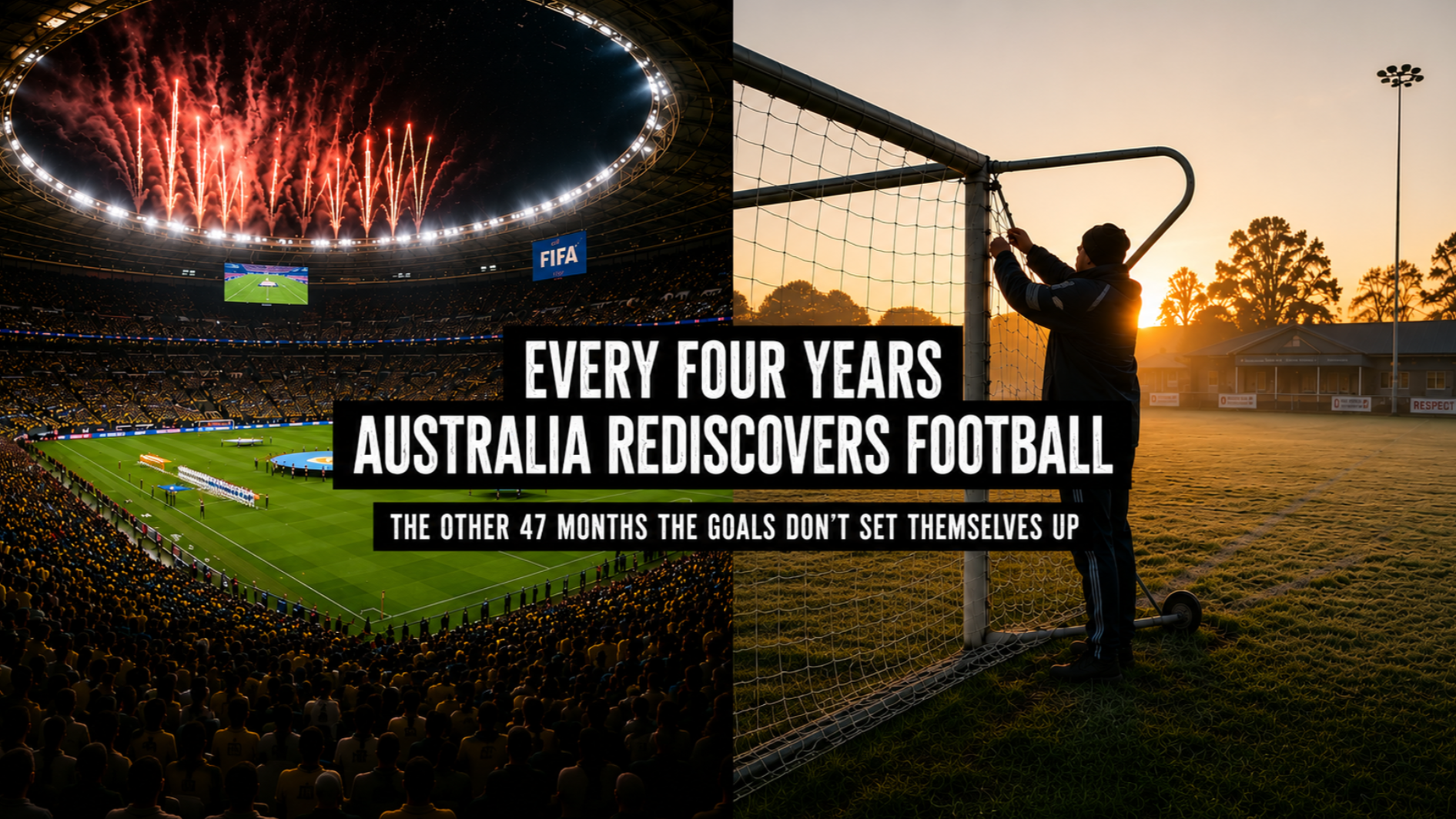
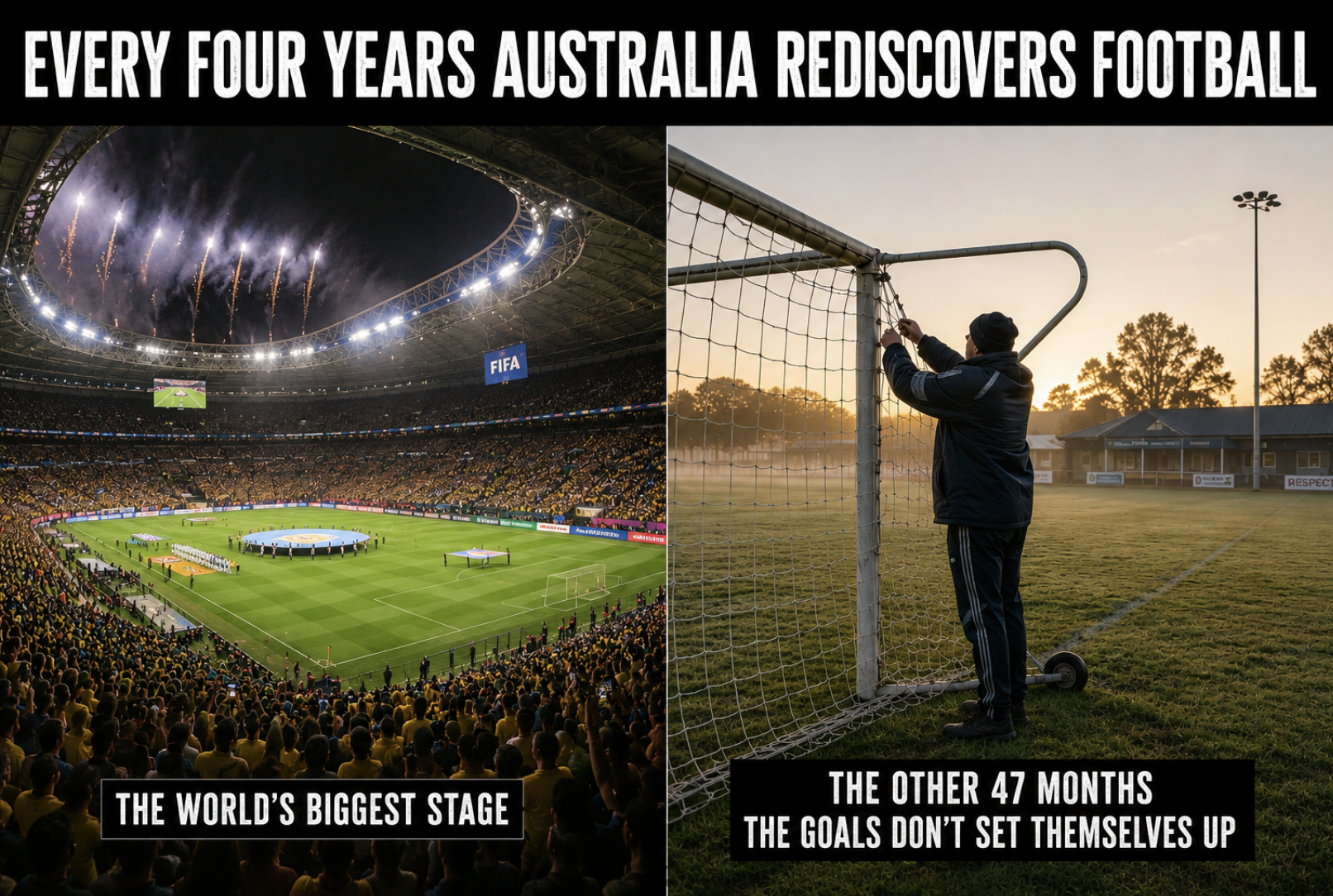
Every Four Years Australia Discovers Football
The FIFA Men's World Cup starts in 10 days.
Which means Australia is about to rediscover football.
Again.
This time I'm talking about the FIFA Men's World Cup.
The Women's World Cup deserves its own article, particularly after what the Matildas did to Australian sporting culture in 2023.
But for now, let's focus on the men.
People who haven't watched a match since the last Men's World Cup suddenly develop strong opinions about formations, selections and whether the Socceroos should play a back three.
As somebody who has spent the better part of twenty years standing beside football pitches, sitting through committee meetings, organising tournaments, arguing about facilities, marking fields and occasionally explaining offside to confused grandparents, I thought I should help.
What Is The FIFA Men's World Cup?
The FIFA Men's World Cup is the biggest sporting event on Earth.
Not one of the biggest.
The biggest.
For one month every four years, billions of people stop what they are doing to watch football.
The Men's World Cup Final attracts around 1.5 billion viewers.
That's enough people to fill the MCG about 15,000 times.
Which is why football people occasionally raise an eyebrow when somebody confidently announces that nobody watches football.
Football is the only sport where Australians regularly ask whether the world's most popular sport is actually popular.
Why Should I Care?
Because even if you don't like football, the World Cup is fascinating.
Countries stop.
Cities stop.
Workplaces stop.
Australian productivity definitely stops.
Particularly when the Socceroos are playing at three o'clock in the morning.
For one month football becomes impossible to ignore.
Which is ironic because football people spend the other forty-seven months trying to convince everyone it exists.
What Happens After The Draw?
Australia have been drawn with the United States, Paraguay and Türkiye.
For approximately seven minutes Australian football supporters discussed the draw sensibly.
Then somebody started calculating quarter-final scenarios.
By the end of the evening we had identified a route to the final.
This is another proud tradition of Australian football.
Hope is our strongest tactical weapon.
What Is A Group?
A group is the first stage of the tournament.
Australia will play:
• United States
• Paraguay
• Türkiye
Everybody plays everybody once.
The best teams progress.
The others spend four years explaining what went wrong.
Football people call this analysis.
The rest of us call it blaming the coach.
Sometimes they're the same thing.
Can Australia Get Out Of The Group?
Absolutely.
There are harder groups.
There are easier groups.
This one sits somewhere in the middle.
Nobody in Group D will be terrified of Australia.
Nobody in Group D will be delighted to play Australia either.
That is probably the most honest assessment.
The United States will fancy their chances.
Türkiye will fancy their chances.
Paraguay will fancy their chances.
Australia will definitely fancy their chances.
Possibly a little more than everybody else does.
What About New Zealand?
As somebody born in New Zealand, I should probably mention the All Whites.
New Zealand are my second team.
They are also the team Australians suddenly become very supportive of once the Socceroos have been eliminated.
Another proud trans-Tasman tradition.
The All Whites have drawn Germany, Colombia and Ghana.
Which football supporters politely describe as "challenging".
This is football language.
"Challenging" translates roughly to:
"Good luck with that."
Still, New Zealand supporters are currently doing exactly what Australian supporters are doing.
Studying the draw.
Calculating permutations.
Identifying pathways.
Convincing themselves there is a way through.
Because hope is not confined to Australia.
It is a shared trans-Tasman condition.
Besides, Australians and New Zealanders understand something many traditional football nations don't.
Nobody expects us to be there.
Which makes it a lot of fun when we are.
And if either Australia or New Zealand somehow makes a deep run into the tournament, millions of people on both sides of the Tasman will suddenly discover they have always been passionate football supporters.
Why Are Games On At Ridiculous Hours?
Because the World Cup is being hosted in North America.
Which means kick-off times are designed for North American audiences rather than people living in Hobart.
FIFA has stubbornly refused to consult Tasmanian football volunteers on this issue.
One of the strangest sights in football is watching somebody complain about an 8.30am junior kick-off and then voluntarily wake up at 2.47am to watch Australia play Paraguay.
Dogs will be confused.
Partners will be confused.
Children will be confused.
The football supporter will be sitting on the couch wrapped in a blanket shouting at the television as if this is perfectly normal behaviour.
Which, in football circles, it is.
Why Does Everybody Hate VAR?
VAR stands for Video Assistant Referee.
It was introduced to reduce controversial decisions.
Remarkably, it has created an entirely new category of controversial decisions.
This is quite an achievement.
Nobody likes VAR.
Everybody complains about VAR.
Nobody agrees on how to fix VAR.
Football has finally found something capable of uniting the entire world.
What Happens When The First Match Starts?
The first Australian goal will trigger scenes of national celebration.
The first Australian mistake will trigger demands for tactical changes.
The first Australian defeat will trigger demands for squad changes.
The second Australian defeat will trigger demands for coaching changes.
The third Australian defeat will trigger demands for structural reform of Australian football.
Football people move quickly.
Who Should I Pretend To Know?
Every World Cup requires a handful of names.
If you find yourself in a conversation and need to sound informed, try these:
"That Irankunda kid is exciting."
"Circati is going to be important."
"We look a different team with Souttar."
Then nod thoughtfully.
Nobody will question you.
In fact, if you can casually mention concerns about Australia's full-back depth, people may assume you've watched every qualifying match.
Use this power responsibly.
What About The Casual Football Experts?
Every World Cup produces thousands of them.
They emerge suddenly.
Usually from workplaces.
They have not watched football since the previous World Cup.
Within forty-eight hours they have strong opinions on formations, tactics and team selection.
By the quarter-finals they have disappeared again.
Like football-themed cicadas.
What About The Football Purists?
Every club has one.
Sometimes several.
They have watched every qualifier.
Every friendly.
Every youth international.
Every obscure livestream from somewhere in Asia filmed from what appears to be a nearby tree.
They are annoyed that casual fans suddenly care about football.
While simultaneously being delighted that casual fans suddenly care about football.
It is a complicated emotional state.
What Happens If Australia Wins?
The country will lose its collective mind.
Every politician will discover a lifelong passion for football.
Every media outlet will become a football expert.
Every sporting organisation will issue a congratulatory statement.
A taskforce will almost certainly be formed.
A review will probably be announced.
Someone will promise facilities.
Football people will smile politely.
We've seen this episode before.
The real challenge will be whether anybody remembers football still exists six months later.
What Happens When The World Cup Ends?
The casual experts disappear.
The politicians disappear.
The media attention disappears.
The football remains.
Because somewhere in Tasmania somebody still has to mark fields.
Somebody still has to coach Under 9s.
Somebody still has to organise registrations.
Somebody still has to unlock the clubrooms.
Somebody still has to put the nets up.
The Men's World Cup is football's biggest stage.
But the other forty-seven months between World Cups are kept alive by volunteers.
And somewhere on a cold Saturday morning, while the rest of the country has moved on to the next big thing, a volunteer will be standing in the rain wondering why they agreed to do this again.
Until kick-off.
Then they'll remember.
That's football.
Buying Content
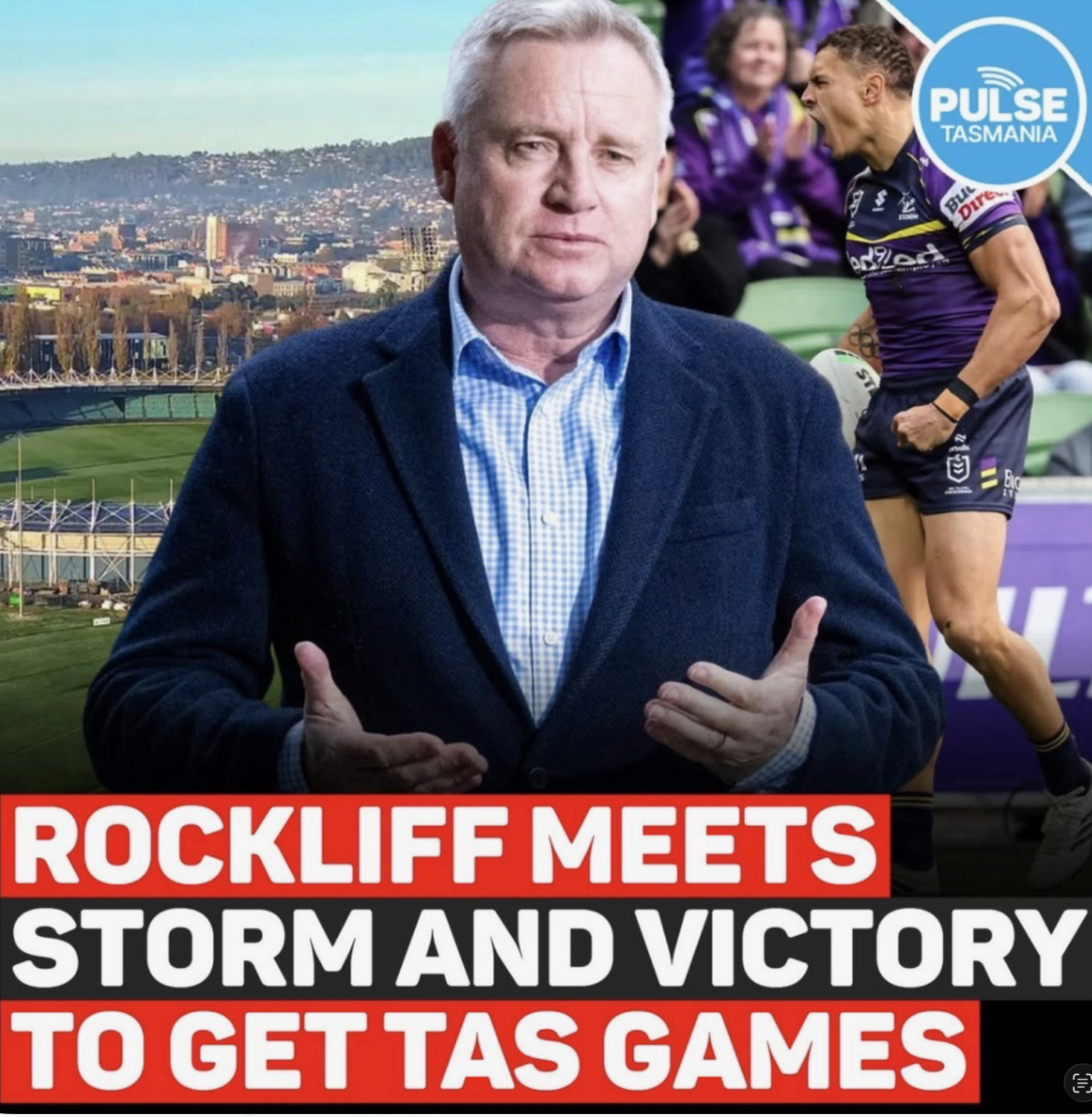
Photo Credit - Pulse Tasmania
Tasmanian football loves a silver bullet.
Not football itself.
Football people are generally too busy coaching, refereeing, marking lines, organising teams and trying to keep grounds open.
No, it is the people around football who seem to love silver bullets.
Every few years a new answer arrives.
A football precinct.
A Home of Football.
A national competition.
A new stadium.
A new strategy.
A new vision.
This week it was content.
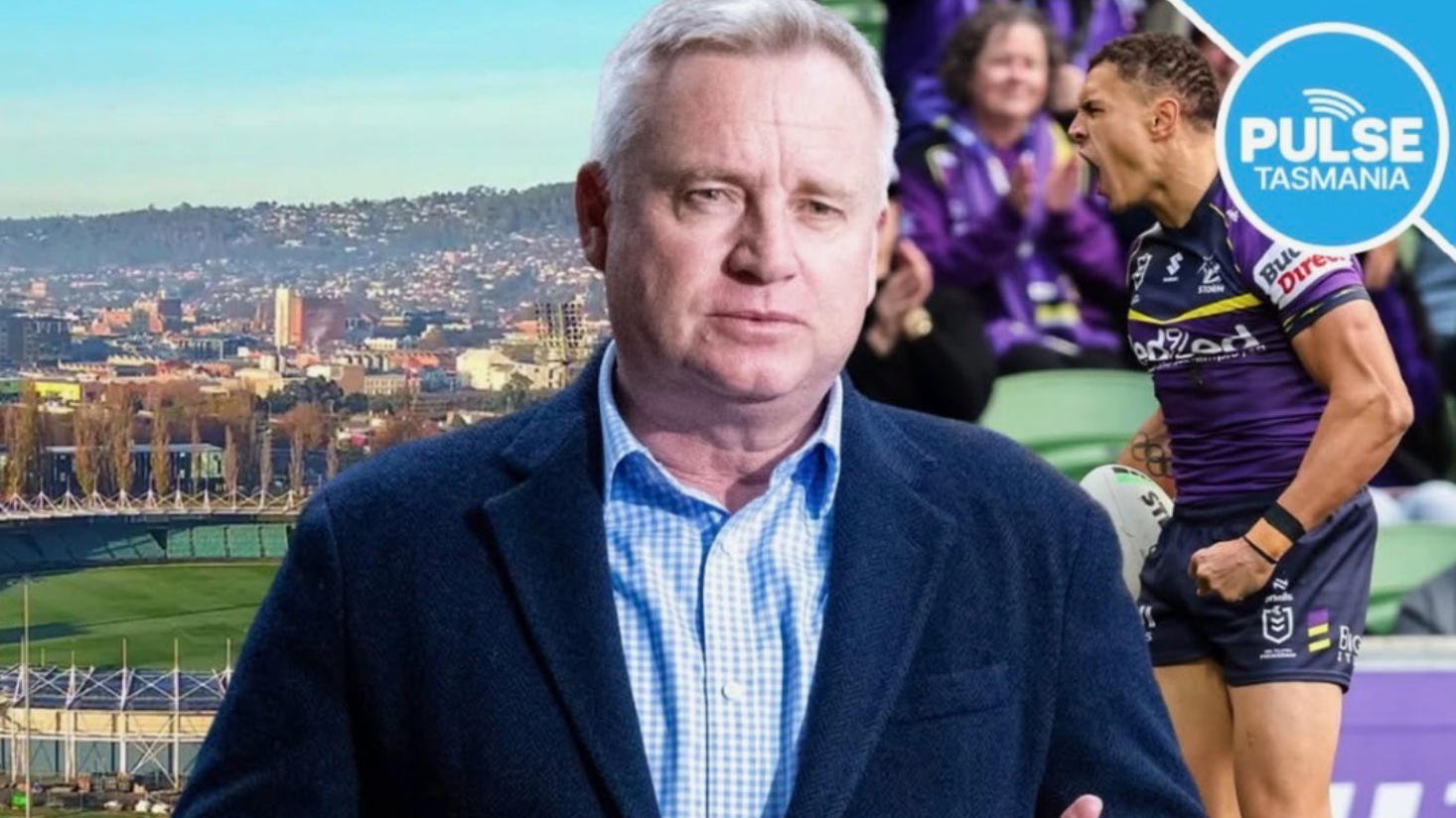
Speaking in Melbourne after meetings with Melbourne Victory and Melbourne Storm, Premier Jeremy Rockliff said:
"Certainly in that interim period we need good content."
And honestly, I have not stopped thinking about that sentence.
Not because it is wrong.
Because it accidentally reveals how sport is increasingly viewed.
A football match becomes content.
A rugby league match becomes content.
A concert becomes content.
A stadium becomes a content platform.
The public becomes an audience.
The objective becomes acquiring content.
I understand the logic.
What I am less sure about is whether it is a strategy.
Content 101
Let's start with something obvious.
Content is not free.
When governments talk about attracting content, they are usually talking about attracting events.
Events rarely arrive because organisers wake up one morning and decide Tasmania looks nice.
More often than not there are negotiations.
Venue deals.
Marketing support.
Government funding.
Event attraction packages.
Financial guarantees.
The details vary.
The principle does not.
Somebody pays.
Usually taxpayers become part of the equation.
That is not necessarily a criticism.
Governments fund events all the time.
The question is whether the return justifies the investment.
And every dollar spent attracting content is a dollar that cannot be spent somewhere else.
That is simply how budgets work.
We Have Bought Content Before
The funny thing about buying content is that Tasmania has already bought some.
Nearly half a million dollars worth of it.
In 2021 the Tasmanian Government committed $480,000 to bring Western United A-League matches to Tasmania.
At the time the language sounded familiar.
Growing football.
Elite pathways.
Community engagement.
Economic benefits.
Exposure to professional football.
The games were played.
The crowds attended.
The photos were taken.
The media releases were issued.
The content was consumed.
Five years later, a simple question remains.
What remains?
Not what happened.
What remains?
Can we point to a facility?
Can we point to additional football capacity?
Can we point to a lasting football asset?
Can we point to something permanent?
Because that is ultimately how public investment should be judged.
Not by attendance figures.
Not by social media posts.
Not by smiling politicians and ribbon cuttings.
By what is left behind after everybody goes home.
Perhaps there is a legacy.
Perhaps there is something obvious that I have missed.
But if nearly half a million dollars created a lasting football revolution in Tasmania, it has been remarkably well hidden.
I Have Heard This Before
Twenty years in football gives you a strange advantage.
You start recognising old conversations.
In 2018 I sat on the Tasmanian A-League Task Force.
I remember discussions about facilities.
I remember discussions about bringing elite football to Tasmania.
I remember discussions about Melbourne Storm.
I remember discussions about what Tasmania needed to become a destination for football and rugby.
At one point the answer was a rectangular venue.
Build the infrastructure and opportunities would follow.
That seemed sensible.
To be fair, this is not really about Jeremy Rockliff.
If anything, he has simply inherited Tasmania's favourite football tradition.
Looking for the next big thing.
I remember similar discussions during the Hodgman years.
Will Hodgman always struck me as someone who genuinely liked football. He was a Chelsea supporter and seemed more engaged with the game than many politicians before him.
But politics has its own league table.
And while Hodgman may have enjoyed Chelsea, the pull of securing Tasmania's own AFL team always appeared considerably stronger.
Football kept finding itself in the conversation.
AFL kept sitting at the top of the agenda.
Looking back, perhaps the only thing that has really changed is the branding.
The conversations remain remarkably familiar.
Then came football precincts.
Then came stadium debates.
Then came Home of Football discussions.
Now we appear to be discussing how to buy content.
Round and round we go.
The Week Football Stopped
Perhaps the timing is what struck me.
Last week much of football across southern Tasmania simply stopped.
Grounds closed.
Training was cancelled.
Junior matches were washed out.
Volunteers scrambled.
Clubs searched for alternatives.
Parents refreshed Dribl and checked their phones hoping for updates.
Thousands of players lost football.
The conversations in football last week were not about Melbourne Victory.
They were about drainage.
They were about lighting.
They were about surfaces.
They were about capacity.
How do we keep grounds open?
How do we create more opportunities to train?
How do we get through winter without losing weeks of football?
Those seem like football questions.
At exactly the same time Tasmania's sporting conversation shifted to buying content.
Neither conversation is wrong.
But one feels considerably closer to the reality experienced by most football people.
The Stadium Reality
There is another layer to this discussion.
York Park, now operating as UTAS Stadium, has just received a $130 million upgrade.
Macquarie Point is on its way.
Once governments invest that sort of money in stadiums, there is enormous pressure to ensure they look busy.
Empty stadiums invite questions.
Busy stadiums create headlines.
Which means the search for content never really ends.
In fact, it probably intensifies.
Because once a stadium is built, somebody has to fill it.
And if the events do not arrive naturally, governments often find themselves negotiating, attracting and purchasing content to make sure they do.
That is why Premier Rockliff's comments are so interesting.
They may not simply be about the next few years.
They may be a glimpse of the future.
A future where Tasmania is constantly searching for more events, more games and more content to justify the stadiums it has built.
The more money we spend on stadiums, the more pressure there is to buy content to justify them.
Which is how infrastructure projects can quietly become content acquisition projects.
Content Versus Capacity
A Storm game lasts eighty minutes.
An A-League game lasts ninety.
The headlines last a few days.
The photos last a little longer.
Then everybody moves on.
Capacity is different.
Capacity is a ground that stays open.
Capacity is lights that allow another training session.
Capacity is facilities that support thousands of players every week.
Capacity is boring.
Which is probably why politicians do not stand in front of it for photographs.
Nobody cuts a ribbon on a drainage pipe.
Nobody poses proudly beside improved subsoil.
Nobody launches a social media campaign celebrating a field that remained open after heavy rain.
Yet those things often matter far more than the content.
Imagine what $480,000 might buy today.
Drainage upgrades.
Lighting improvements.
Additional training capacity.
Synthetic surfaces.
Facility improvements.
The sort of investments that remain long after the final whistle.
Tasmanian Football's Favourite Administrative Activity
I sometimes wonder whether Tasmanian football's favourite administrative activity is chasing the next big thing.
Not building.
Chasing.
We are remarkably good at creating visions.
Master plans.
Strategies.
Task forces.
Working groups.
Consultations.
Announcements.
Launches.
Media releases.
Tasmanian football has a habit of confusing movement with progress.
We announce.
We launch.
We consult.
We strategise.
We rebrand.
Then we hold another meeting to discuss why nothing much seems to have changed.
That is why this latest discussion feels strangely familiar.
Not because Melbourne Victory is new.
Not because Melbourne Storm is new.
Not because attracting events is new.
Because we have been standing at this intersection before.
Many times.
Different Premier.
Different CEO.
Different stadium debate.
Same search for the next big thing.
Content Or Legacy?
Perhaps that is why the word content bothered me.
Content sounds modern.
Content sounds exciting.
Content sounds strategic.
But content is something you consume.
Football is something you build.
The content leaves.
The crowd leaves.
The cameras leave.
The headlines leave.
What remains is what we built while everybody was watching.
And after a week of closed grounds, cancelled training sessions and waterlogged surfaces, that feels like a far more important question than how much content we can buy.
Not what content we can attract.
What legacy we intend to leave behind.
Looking back, I am not sure we have been following a roadmap.
It sometimes feels more like one of those airport travelators.
There is plenty of movement.
Lots of announcements over the loudspeaker.
People appear to be heading somewhere important.
Yet every so often you look up and realise the view is remarkably familiar.
In 2018 I was sitting on the Tasmanian A-League Task Force discussing Melbourne Storm, elite football, facilities and attracting major events.
Today we are discussing Melbourne Storm, elite football, facilities and attracting major events.
At this rate, the next strategic plan could save time, money and consultant fees by simply photocopying the last one.
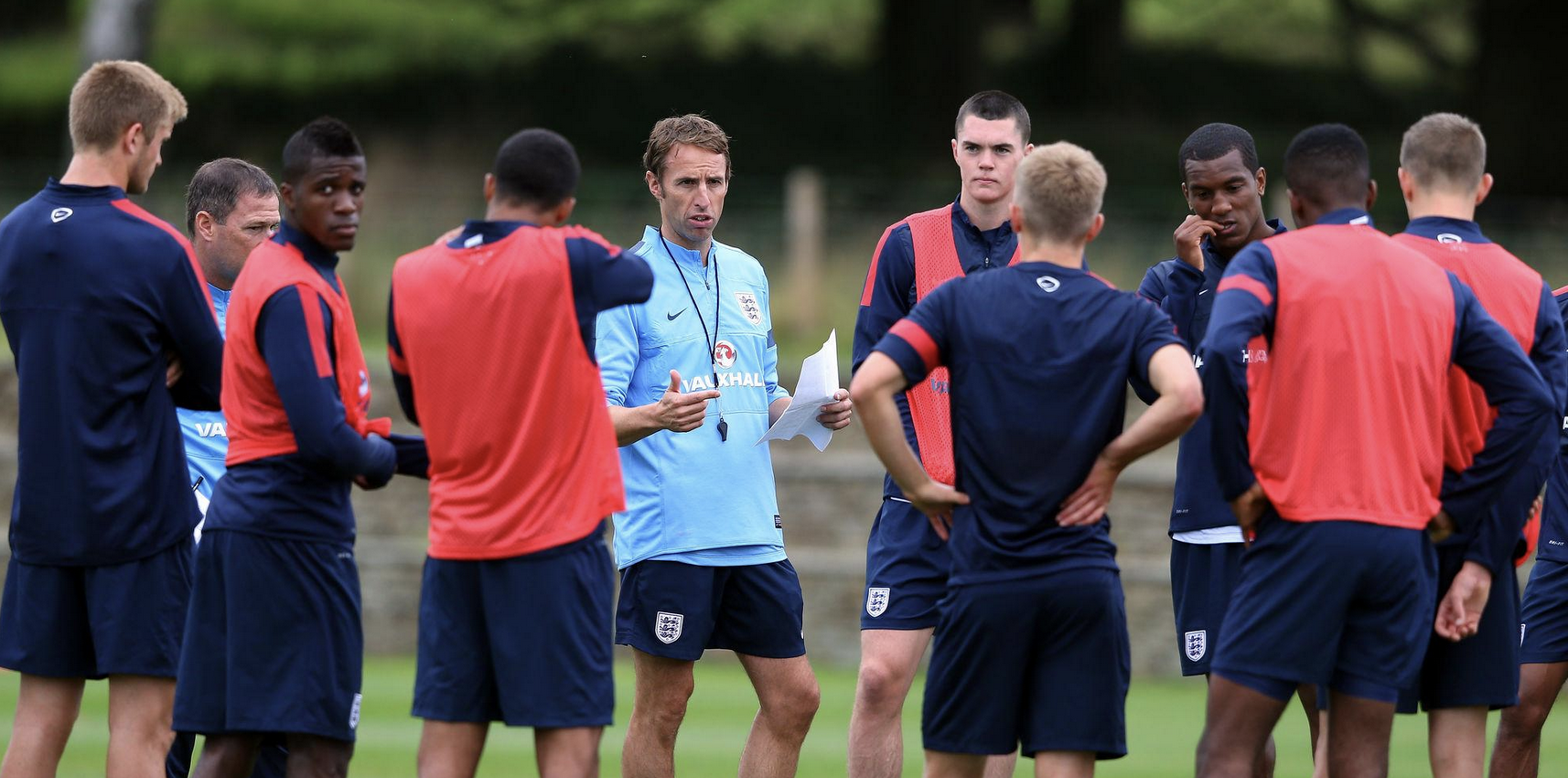
I Just Want Him To Keep Playing
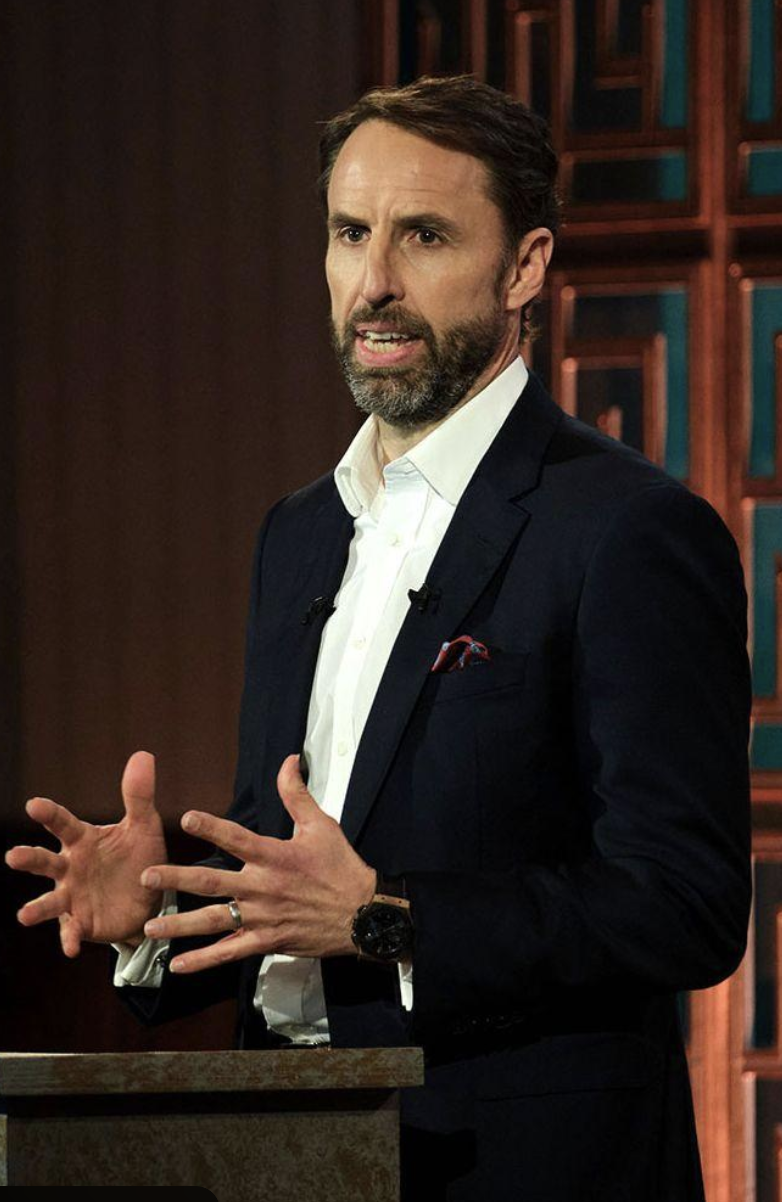
Gareth Southgate delivering the Dimbleby Lecture
Former England manager Gareth Southgate recently delivered the BBC's prestigious Richard Dimbleby Lecture.
Not about football tactics.
Not about England.
Not about penalty shootouts.
About boys.
He spoke about loneliness, belonging, resilience and the growing influence of online personalities on young men searching for direction and purpose.
He spoke about the decline of real-world experiences.
The decline of communities.
The decline of places where young people can fail, recover, learn and grow.
He has since expanded on those themes in a new BBC documentary, Changing the Game for Young Men.
As I listened to his lecture, I found myself thinking about something I have heard countless times over the past twenty years in grassroots football.
"I just want him to keep playing."
Parents say it all the time.
And what fascinates me is that they are rarely talking about football.
Not really.
A Blog About Boys
Before I go any further, this blog is primarily about boys.
Not because girls do not experience loneliness, anxiety, isolation or struggles with belonging.
They absolutely do.
But Southgate's lecture asks a specific question.
What is happening to boys and young men?
Why are so many struggling to find purpose, direction and connection?
And what happens when the search for those things increasingly takes place online?
Those questions are worth exploring.
More Than A Game
Southgate's central argument is not really about social media.
It is about what happens when real-world experiences are replaced by digital ones.
When belonging is replaced by followers.
When advice comes from people who do not know you.
When young men are connected to everybody but known by nobody.
Football offers something different.
Football knows your name.
Football expects you to turn up.
Football notices when you don't.
Football creates relationships that cannot be replicated through a screen.
That matters.
Perhaps now more than ever.
Followers Are Not Friends
One part of Southgate's lecture particularly resonated with me.
The distinction between attention, connection and belonging.
As strange as it sounds, I have learnt something similar through blogging.
Like many people, I started by paying attention to likes, comments and shares.
Those things feel important.
They feel like success.
Yet over the past six months my blog has generated more than 40,000 page views.
What I have learnt is that likes tell you very little.
Someone clicking "like" is not necessarily engaging.
Someone quietly reading every week probably is.
There is a difference between attention and connection.
And there is an even bigger difference between connection and belonging.
Southgate argues that too many boys are being taught to chase visibility.
Followers.
Status.
Recognition.
Attention.
Yet attention is not belonging.
A million followers cannot replace one genuine community.
Character Or Status?
This is perhaps the part of Southgate's message that struck me most.
Too many boys are being told that success looks like money.
Status.
Influence.
Winning.
Dominance.
Being noticed.
Southgate's argument is almost the opposite.
Character.
Integrity.
Humility.
Resilience.
Treating people well.
Learning from failure.
Becoming a decent man.
Those qualities rarely trend online.
Yet they matter enormously.
Football, at its best, teaches those lessons too.
Or at least it should.
The Difference Between Connection And Belonging
Young people today are more connected than any generation in history.
Yet many feel increasingly alone.
Belonging is different.
Belonging is when people notice you are missing.
Belonging is when somebody asks where you were on Tuesday night.
Belonging is when your absence matters.
For many young men, football clubs remain one of the few places where this still happens naturally.
You train with the same people.
Play with the same people.
Travel with the same people.
Win and lose with the same people.
Over time those relationships become part of your life.
Often a much bigger part than anyone realises.
Until they disappear.
Learning To Fail
One of Southgate's strongest themes is resilience.
The ability to fail.
Recover.
And try again.
Southgate understands this better than most.
His missed penalty at Euro 96 became one of the defining moments of English football.
For years he carried the disappointment publicly.
Yet he returned.
Learned.
Grew.
And eventually led England to some of its most successful periods in decades.
Football teaches that lesson every week.
Players lose finals.
Miss penalties.
Get dropped.
Make mistakes.
Experience disappointment.
Then they come back next week and do it again.
In a world increasingly designed to protect people from failure, football still teaches young people how to deal with it.
That may be one of its greatest gifts.
Let Them Solve Some Problems
Listening to Southgate, I also found myself thinking about something else.
Adults.
Parents.
Coaches.
Teachers.
All of us.
I sometimes wonder whether we are becoming too quick to step in.
Too quick to solve problems.
Too quick to remove discomfort.
Too quick to speak on behalf of young people.
I see it in football.
Parents contacting coaches when their teenager could make the call themselves.
Parents resolving conflicts their child could learn to navigate.
Parents protecting children from disappointment rather than helping them work through it.
The intention is love.
The outcome is not always growth.
Resilience is not something we teach through a lecture.
It is something we build through experience.
Football provides those experiences every week.
Why Parents Worry
Over the years I have watched parents become genuinely concerned when their son wants to stop playing.
Not because they dream of a professional football career.
Most know that is unlikely.
What worries them is the loss of something else.
The friendships.
The routine.
The mentors.
The connection.
The sense of belonging.
Many instinctively understand that football is providing something much bigger than football.
I have also seen parents remain connected to clubs long after their children have stopped playing.
If football was only about football, that would make little sense.
But football is often one of the last places where genuine community still exists.
And communities are difficult to leave.
The Things We Don't Measure
Football loves measuring things.
Goals.
Wins.
Trophies.
League tables.
Participation numbers.
Pathways.
Yet some of the most important outcomes never appear in a report.
The teenager who found confidence.
The young man who found purpose.
The player who discovered resilience.
The friendships that lasted for decades.
The family who found a community.
Those things are difficult to measure.
Yet they may be the most valuable things football produces.
Southgate Might Be Talking About Football After All
When Gareth Southgate talks about loneliness, belonging and the challenges facing young men, many people hear a discussion about social media.
I hear a reminder of something community sport has quietly understood for years.
People need purpose.
People need relationships.
People need role models.
People need places where they belong.
That is why parents so often say the same thing.
"I just want him to keep playing."
Because they understand something statistics never capture.
A tiny percentage of children will become professional footballers.
Almost all of them will become adults.
And sometimes the most important thing a football club gives them is not football at all.
It is belonging.
A number of people will probably ask where they can watch or listen to Southgate's lecture. At the time of writing it is available through BBC platforms in the UK, although I am not aware of an Australian broadcaster currently carrying it. Even if you cannot access the full lecture, the themes are worth exploring.
As I listened to Southgate speak, I found myself thinking about football clubs.
Perhaps he was talking about football after all.

The Radical Idea of Listening

Waiting For The Catch
I have spent enough years in football governance to become suspicious.
It is an occupational hazard.
When I read an announcement from a football federation, I often find myself looking for what is not being said as much as what is.
So when I read Capital Football's announcement this week about the election of a new Chair, I found myself waiting for the catch.
There wasn't one.
Instead, there was something far more surprising.
An invitation.
The newly elected Chair, Sarah Baker-Goldsmith, and Deputy Chair, Steve Rohan-Jones, announced an online community forum and asked a remarkably simple question:
"What do you think Capital Football should be working on this year?"
That was it.
No strategic roadmap.
No stakeholder engagement framework.
No future consultation process regarding the development of a consultation process.
Just a question.
I genuinely found myself reading the announcement twice.
Surely there had to be a complicated bit somewhere.

Just A Question
Where was the working group?
Where was the advisory panel?
Where was the steering committee overseeing the advisory panel?
Where was the stakeholder reference group providing guidance to the steering committee?
Where was the survey asking members whether they would like to participate in a future survey?
Where was the 47-page discussion paper released two days before the decision was made?
Instead, there was an email address.
Actually, there were two.
One to register.
One to submit questions.
There was a date.
There was a time.
There was an invitation to participate.
It felt strangely refreshing.
And perhaps that says something about football.
Because listening should not feel revolutionary.
It should be normal.
Yet somehow it increasingly feels like a novelty.
The Difference Was The First Question
The contrast between the two announcements last week is difficult to ignore.
In Tasmania, football elected a new President.
In Canberra, football elected a new Chair.
Both are important moments.
Both deserve recognition.
But what happened next was very different.
Capital Football almost immediately turned the conversation outward.
Before the congratulatory photos had even gone cold, members were being asked what football should be working on.
Think about that for a moment.
A newly elected board asking members what they think.
Not after the decision.
Not after implementation.
Not after six months of internal discussions.
At the beginning.
The first instinct appeared to be engagement.
The first instinct appeared to be listening.
What struck me most was not that Capital Football announced a new Chair.
Most organisations do that.
It was that almost immediately the conversation turned outward rather than inward.
Why Does This Feel So Unusual?
Consultation does not guarantee better decisions.
But refusing to consult almost guarantees cynicism.
Football people can usually tell the difference between a conversation and a conclusion.
One asks questions.
The other announces answers.
Most people do not expect to get their own way.
Most understand that leadership sometimes requires difficult decisions.
The frustration usually comes from something much simpler.
The feeling that the conversation finished before they even knew it had started.
The feeling that the decision was already made.
The feeling that consultation was something that happened somewhere else, with somebody else.
That is why the Capital Football announcement stood out.
Not because it promised anything.
Not because it solved anything.
Not because it launched a new strategy.
It simply asked a question.
And somehow that now feels unusual.
Leadership Or Distance?
This is not an argument for governance by Facebook comment section.
Boards still need to lead.
Administrations still need to make decisions.
Sometimes difficult decisions.
Sometimes unpopular decisions.
That is their job.
But there is a difference between leadership and distance.
There is a difference between consultation and announcement.
There is a difference between listening and broadcasting.
Too often football seems to skip straight to the final step.
The decision has been made.
The document has been written.
The media release is ready.
The implementation plan is underway.
Then somebody remembers to tell everybody else.
That is not consultation.
That is notification.
And football people know the difference.
Maybe This Is What Good Governance Looks Like
The cynic in me briefly wondered whether this is what happens when football elects a female Chair.
Women have spent generations being accused of talking too much.
Perhaps we also listen more.
Then again, that may be completely unfair.
Perhaps it has nothing to do with gender at all.
Perhaps it is simply what good governance looks like.
A board that understands it does not have all the answers.
A board that understands football knowledge does not magically begin at the boardroom door.
A board that is confident enough to ask questions before providing answers.
What struck me most about the announcement was not the election itself.
It was the assumption behind it.
The assumption that members might actually have something useful to say.
Imagine that.
Imagine That
What struck me about the Capital Football announcement was not the election.
It was the order of events.
Elect Chair.
Ask members.
It sounds so obvious when you write it down.
Which probably explains why it feels so unusual.
Imagine that.
A football organisation elects a new Chair and one of the first things it does is ask its members what they think.
Not after the announcement.
Not after the consultant has been appointed.
Not after the working group has met six times.
Before.
What do you think?
Four words.
No strategic framework required.
No governance review required.
No stakeholder engagement matrix required.
Just four words.
What do you think?
Perhaps the most revolutionary thing in football governance today is not a new competition, a new facility or a new strategic plan.
Perhaps it is simply the willingness to listen before speaking.
Who knew it could be so uncomplicated?

Football Gambling 101
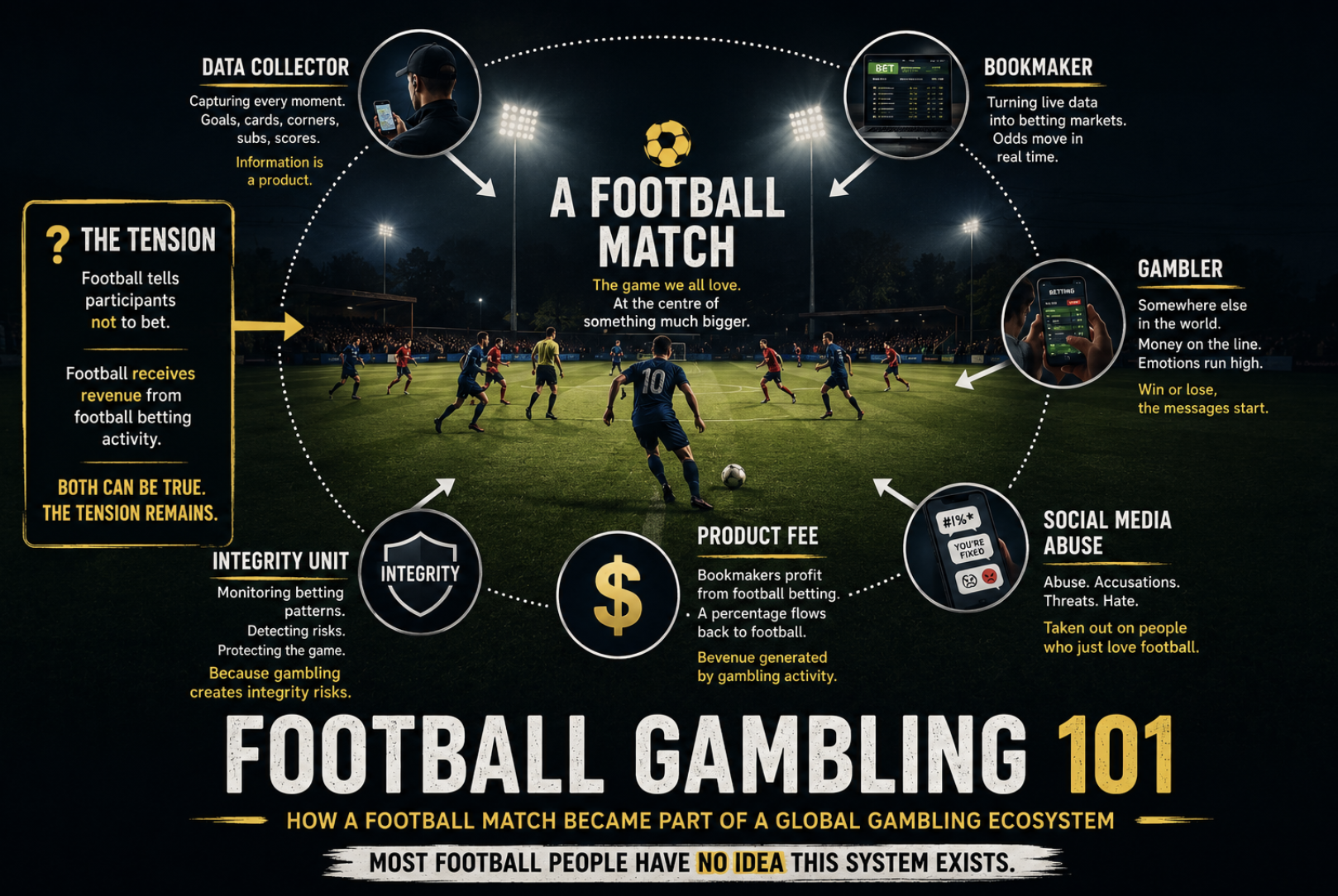
Or: How a football match in Tasmania became part of a global gambling ecosystem.
Yesterday I published a blog about the abuse football clubs receive from gamblers.
The messages.
The accusations.
The threats.
The endless claims of match fixing whenever somebody loses a bet.
I thought that was the story.
It turns out it was only the symptom.
Because once I started asking why those messages exist, I found myself following a trail that led through data collection, betting markets, integrity units, product-fee agreements and a financial relationship between football and gambling that most football people probably don't know exists.
If you had told me twenty years ago that a football match at Darcy Street would involve a data collector, a bookmaker, an integrity unit, a gambler in another country and a product-fee agreement flowing back to the governing body, I would have laughed.
Yet here we are.
The deeper I looked, the stranger it became.
Because once you start following the trail, you discover a football match isn't just a football match anymore.
There is an entire ecosystem sitting around it.
Most football people only ever see one small piece of it.
The players see the game.
The coach sees the tactics.
The supporters see the result.
The volunteer social media administrator sees the abuse.
But once you pull all the pieces together, the picture becomes extraordinary.
Let's break it down.
Step 1. The Football Match
This is the easy bit.
Twenty-two players.
Referees.
Coaches.
Parents.
Volunteers.
Supporters.
The thing most of us think football is.
A football match.
But that's only the beginning.
Step 2. The Data
Every football match creates data.
Goals.
Corners.
Yellow cards.
Red cards.
Substitutions.
Half-time scores.
Full-time scores.
Most of us think of this as football information.
To somebody else, it's a product.
Because information has value.
Especially when money is riding on it.
Step 3. The Person With The Earpiece (And Why Are They Here?)
If you've spent time around higher-level football, you've probably seen them.
A person sitting quietly.
Phone in hand.
Sometimes wearing an earpiece.
Sometimes entering information into a device.
Most football people assume they're a scout.
Sometimes they are.
Often they're collecting data.
The goal goes in.
The information is transmitted immediately.
A yellow card is shown.
The information is transmitted immediately.
The match becomes a stream of live information.
Not because somebody wants a match report.
Because somebody wants data.
Fast.
And the obvious question becomes:
Why?
Step 4. The Betting Market
Because data has value.
Bookmakers offer betting markets on football.
Results.
Goals.
Cards.
Corners.
Half-time scores.
Full-time scores.
The faster the information moves, the more valuable it becomes.
Which is why live data matters.
Because betting markets move in real time.
Step 5. The Gambler
Now we arrive at the person grassroots football knows very well.
The gambler.
The person sitting somewhere else in the world.
Watching scores.
Watching markets.
Watching outcomes.
Not because they care about the football club.
Because they have money riding on the result.
The favourite loses.
The messages start.
The goal doesn't come.
The messages start.
A teenager misses a penalty.
The messages start.
This is the part grassroots football sees.
The abuse.
The accusations.
The anger.
The social media messages.
The phone calls.
The claims of corruption and match fixing.
Not because people love football.
Because people lost money.
Step 6. The Integrity Unit
Football understands there are risks.
Match fixing.
Spot fixing.
Corruption.
Suspicious betting activity.
Competition manipulation.
That's why football has integrity departments.
Education programs.
Reporting systems.
Participant bans on betting.
Football Australia's Integrity Framework states that registered football participants must not bet on any football match or competition anywhere in Australia or anywhere else in the world.
Players cannot bet.
Coaches cannot bet.
Referees cannot bet.
Officials cannot bet.
Presidents cannot bet.
Board members cannot bet.
The message is clear.
Gambling creates integrity risks.
And football is right to take that seriously.
Step 7. Product Fees
This is where most people get lost.
I certainly did.
Let's slow down.
Imagine a bookmaker wants to offer betting on football.
The bookmaker is using football.
Football competitions.
Football results.
Football data.
Football players.
Football exists.
The bookmaker makes money because people bet on football.
So sporting bodies negotiate what are known as product-fee agreements.
Money flows back to the sport.
According to the ABC Four Corners investigation, Football Australia receives either:
1 per cent of annual football betting turnover in Australia, or
15 per cent of bookmaker profit,
whichever is higher.
Most people hear 1 per cent and think:
"That doesn't sound like much."
But here's the important part.
The fee is calculated on turnover.
Not profit.
Turnover is the total amount wagered.
Imagine 100,000 people place $100 worth of bets on football.
That's $10 million in betting turnover.
In that simple example, football's share at 1 per cent would be $100,000.
Now imagine that across:
The Socceroos
The Matildas
The A-League Men
The A-League Women
Australia Cup matches
NPL football
State leagues
International football bet on through Australian bookmakers
Across an entire year.
Suddenly we're not talking about pocket money.
We're talking about a genuine revenue stream.
Football Australia has described these product fees as a relatively small part of overall revenue.
Perhaps they are.
But unlike sponsorships, this revenue exists for one reason.
People are betting on football.
Step 8. The Tension
This is the part that made me stop.
Football tells players not to bet.
Football tells coaches not to bet.
Football tells referees not to bet.
Football tells officials not to bet.
Football tells presidents not to bet.
Football tells participants gambling threatens football integrity.
Then football receives revenue generated by football betting activity.
That doesn't automatically make anyone a hypocrite.
But it does create a tension.
Because football is simultaneously saying:
"Please don't bet on football."
And:
"Football receives money because people are betting on football."
Both things can be true.
But let's not pretend they sit comfortably beside each other.
That's not an accusation.
It's an observation.
What Has Football Become?
Twenty years ago a football match involved:
Players
Coaches
Referees
Parents
Volunteers
Supporters
Today it may also involve:
Data collectors
Live betting markets
Product-fee agreements
Integrity monitoring systems
Overseas gamblers
Social media abuse
Global wagering companies
And most people standing on the sideline have absolutely no idea.
That is not necessarily good.
It is not necessarily bad.
But it is certainly different.
The question is whether football people truly understand the system that now sits around the game.
Because once you start following the trail from a football match to a betting market, from a betting market to a product fee, from a product fee to an integrity unit, and from an integrity unit back to football itself, you realise something.
Modern football is no longer just football.
It has become part of something much bigger.
Most of us only ever see one small piece of it.
The player sees the game.
The coach sees the tactics.
The supporter sees the result.
The volunteer social media administrator sees the abuse.
The integrity unit sees the betting patterns.
The bookmaker sees the market.
The governing body sees the revenue.
Yet they are all looking at the same match.
The Question
Yesterday I thought I was writing about abusive messages sent to football clubs.
Instead, I found myself looking at data collection, betting markets, integrity systems, product-fee agreements and a financial relationship between football and gambling that most football people probably don't know exists.
A football match.
A data collector.
A bookmaker.
A gambler.
An integrity unit.
A product fee.
A social media administrator pressing delete.
They're all connected.
And once you see the whole picture, it's difficult to look at a football match in quite the same way again.
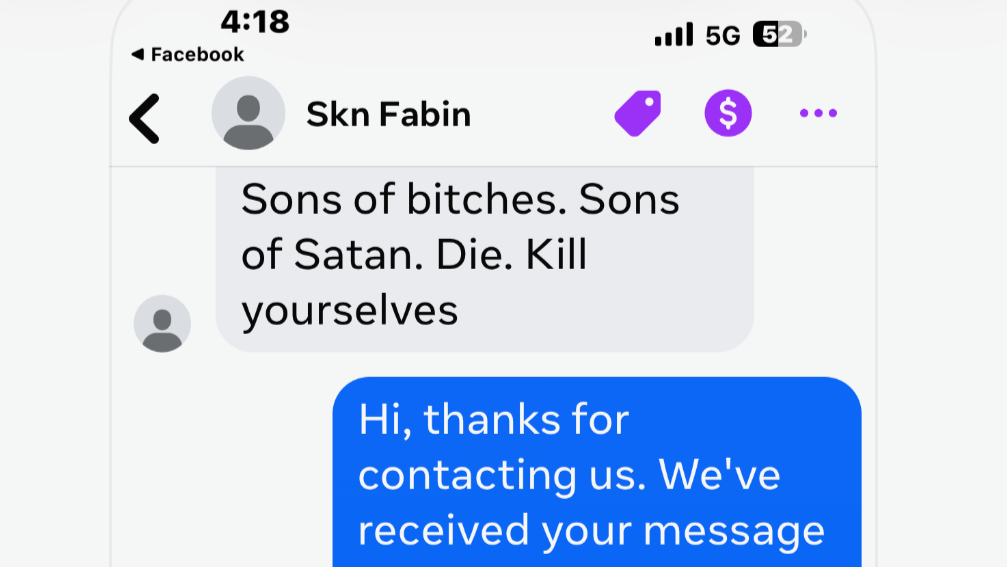
Sons of bitches. Sons of Satan. Die. Kill yourselves.
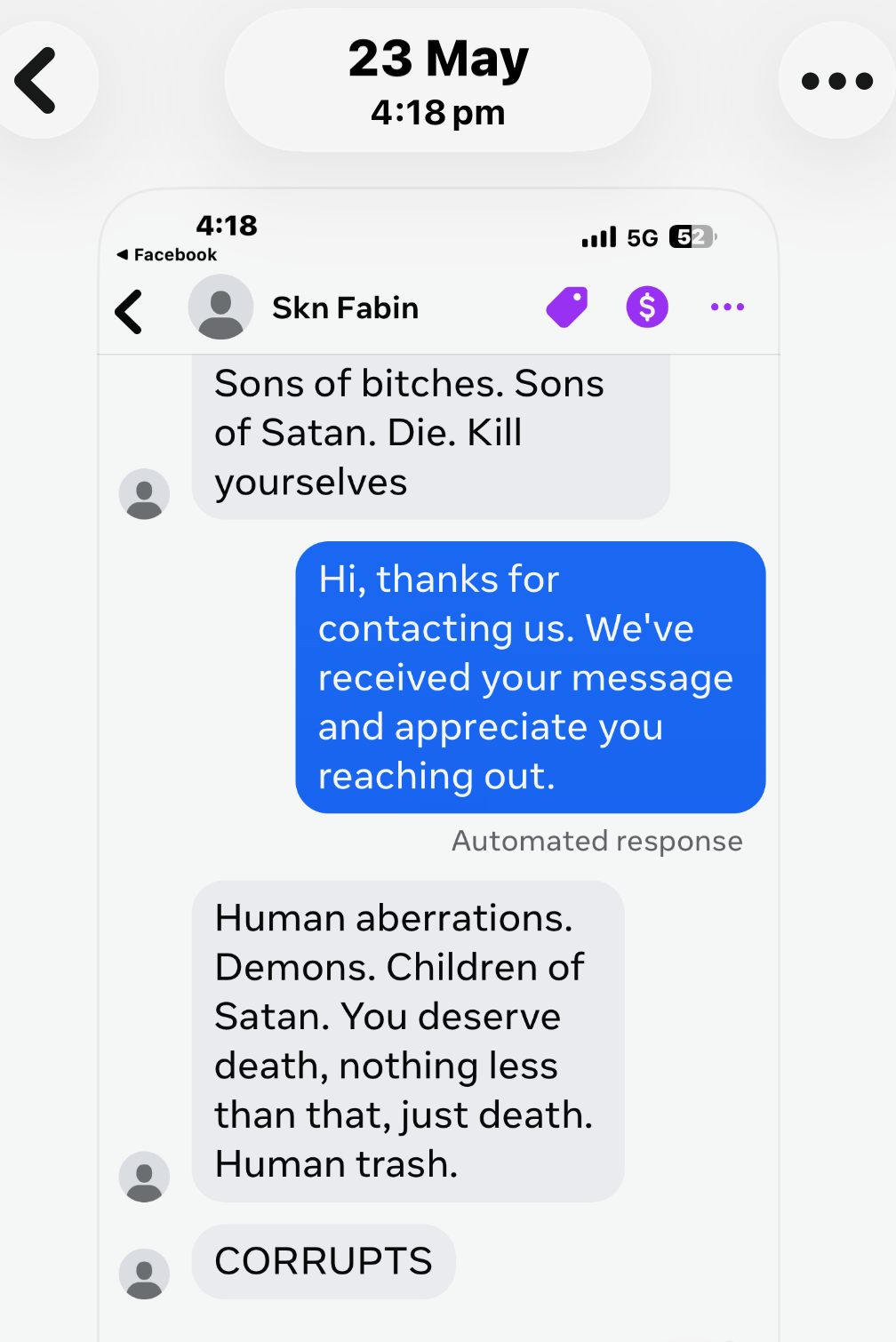
The hidden cost of football's relationship with gambling.
Sons of bitches. Sons of Satan. Die. Kill yourselves.
That message arrived on South Hobart Football Club's social media channels.
Not after a controversial political post.
Not after a religious debate.
Not after a war.
After a football match.
Because somebody lost a bet.
Most football supporters never see this side of the game.
They see the goals.
The saves.
The celebrations.
The team photos.
The highlights.
What they don't see is the inbox.
Every weekend football club social media administrators across Australia receive messages like these.
Abuse.
Threats.
Match-fixing accusations.
Profanity.
Sometimes death wishes.
And sometimes worse.
Not from rival supporters.
Not from disgruntled parents.
Not from opposition clubs.
From gamblers.
People on the other side of the world who have never heard of the players, never visited Tasmania and couldn't point to South Hobart on a map.
But they know the score.
Because they have money riding on it.
And when the result doesn't go their way, the messages start arriving.
"Match fixing."
"Fake football."
"Corrupt."
"Die."
"Kill yourselves."
This isn't unusual.
It isn't rare.
It isn't even memorable anymore.
That's probably the most disturbing part.
For many football club administrators, this has become normal.
Delete.
Block.
Delete.
Block.
Delete.
Block.
Modern football administration.
The Social Media Admin Nobody Talks About
Football talks a lot about players.
Coaches.
Referees.
Volunteers.
Club presidents.
Technical directors.
Development officers.
There is one role nobody talks about.
The social media admin.
Not because they aren't important.
Because nobody realises what they deal with.
Most people imagine football club social media involves team photos, score updates and celebrating goals.
Sometimes it does.
The rest of the time it can feel like moderating the fallout from a global gambling network.
Every football social media administrator reading this is probably nodding.
They know.
They've seen the messages.
They've deleted the comments.
They've blocked the accounts.
They've received the direct messages.
Some have received the phone calls.
This isn't a South Hobart story.
It's a football story.
The Other Crowd At The Game
Every football match has spectators.
Parents standing on the sideline.
Grandparents wrapped in scarves.
Volunteers running the canteen.
Supporters watching from behind the fence.
But there is another crowd watching football now.
An invisible crowd.
A crowd nobody invited.
People sitting behind betting apps all over the world.
People who couldn't tell you where Tasmania is.
People who don't care about South Hobart.
Or Glenorchy.
Or Devonport.
Or Kingborough.
Or any football club.
They care about one thing.
Their bet.
The players never see them.
The coaches never see them.
The volunteers only discover they exist when the abuse arrives.
"What Was The Half-Time Score?"
For years my phone number was publicly available through South Hobart Football Club.
The calls started arriving.
Usually from overseas.
Mostly Africa.
Sometimes Asia.
Occasionally Europe.
The questions were always the same.
"What was the halftime score?"
"What was the fulltime score?"
"Has the match finished?"
At first it seemed strange.
Then the pattern became obvious.
These people weren't football supporters.
They weren't journalists.
They weren't scouts.
They were gamblers.
To them, South Hobart Football Club wasn't a football club.
It was an information service.
A source of gambling data.
Think about that for a moment.
A volunteer-run football club in Tasmania had somehow become part of a global betting ecosystem.
Nobody discussed it.
Nobody agreed to it.
Nobody voted for it.
It simply happened.
A Missed Penalty In Hobart
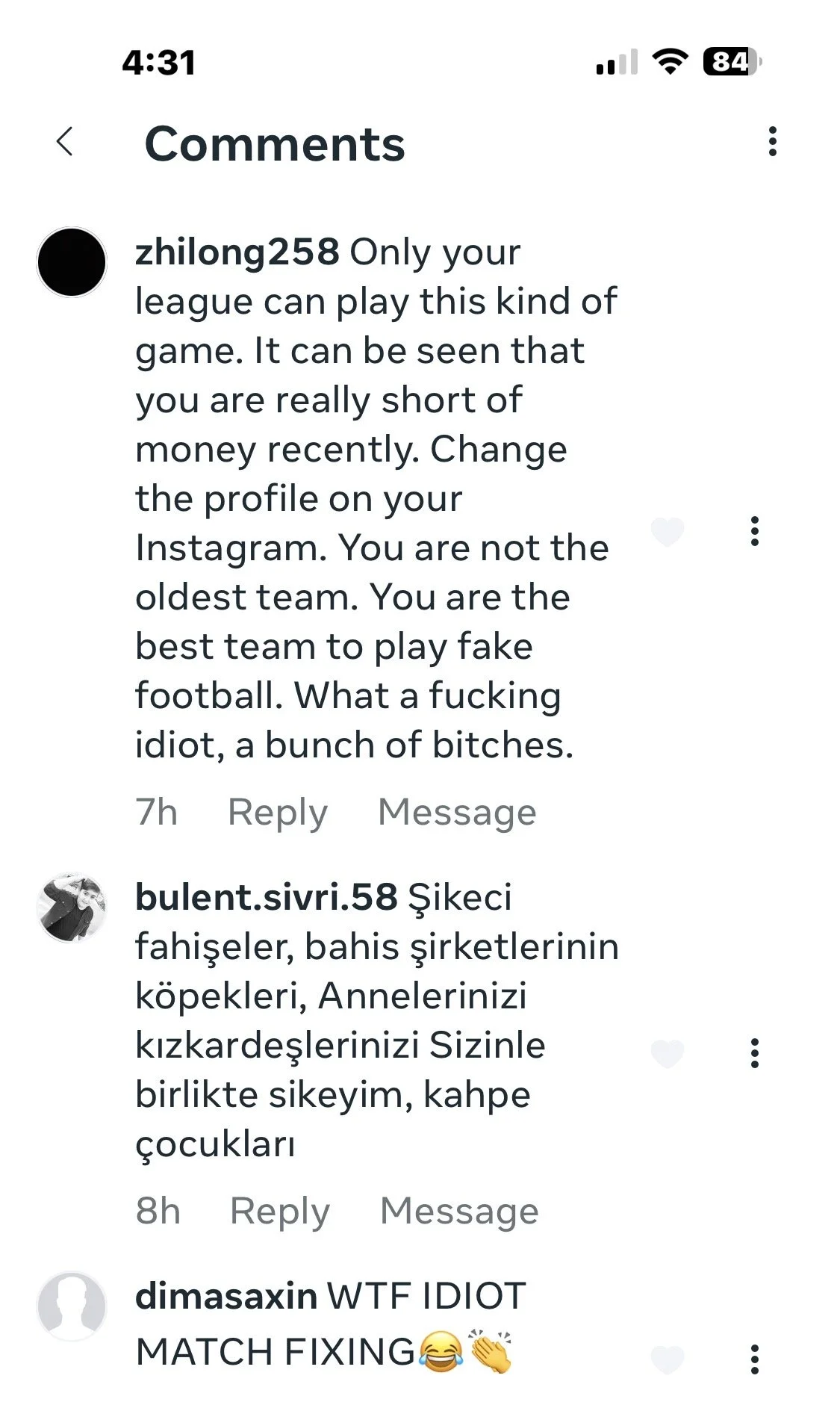
Somewhere along the way football stopped being just football.
A missed penalty in Hobart can now cost somebody money in another country.
A volunteer updating Facebook scores has unknowingly become part of a global gambling network.
A teenage goalkeeper can be accused of match fixing by somebody who has never heard of Tasmania.
A striker misses a chance.
A goalkeeper drops a cross.
A defender makes a mistake.
Normal football.
The sort of thing that happens thousands of times every weekend around the world.
Except now there is a financial consequence.
Somebody loses money.
And because social media has removed every barrier between frustration and abuse, the messages start arriving almost instantly.
If all of that sounds ridiculous, it's because it is.
The Great Match-Fixing Fantasy
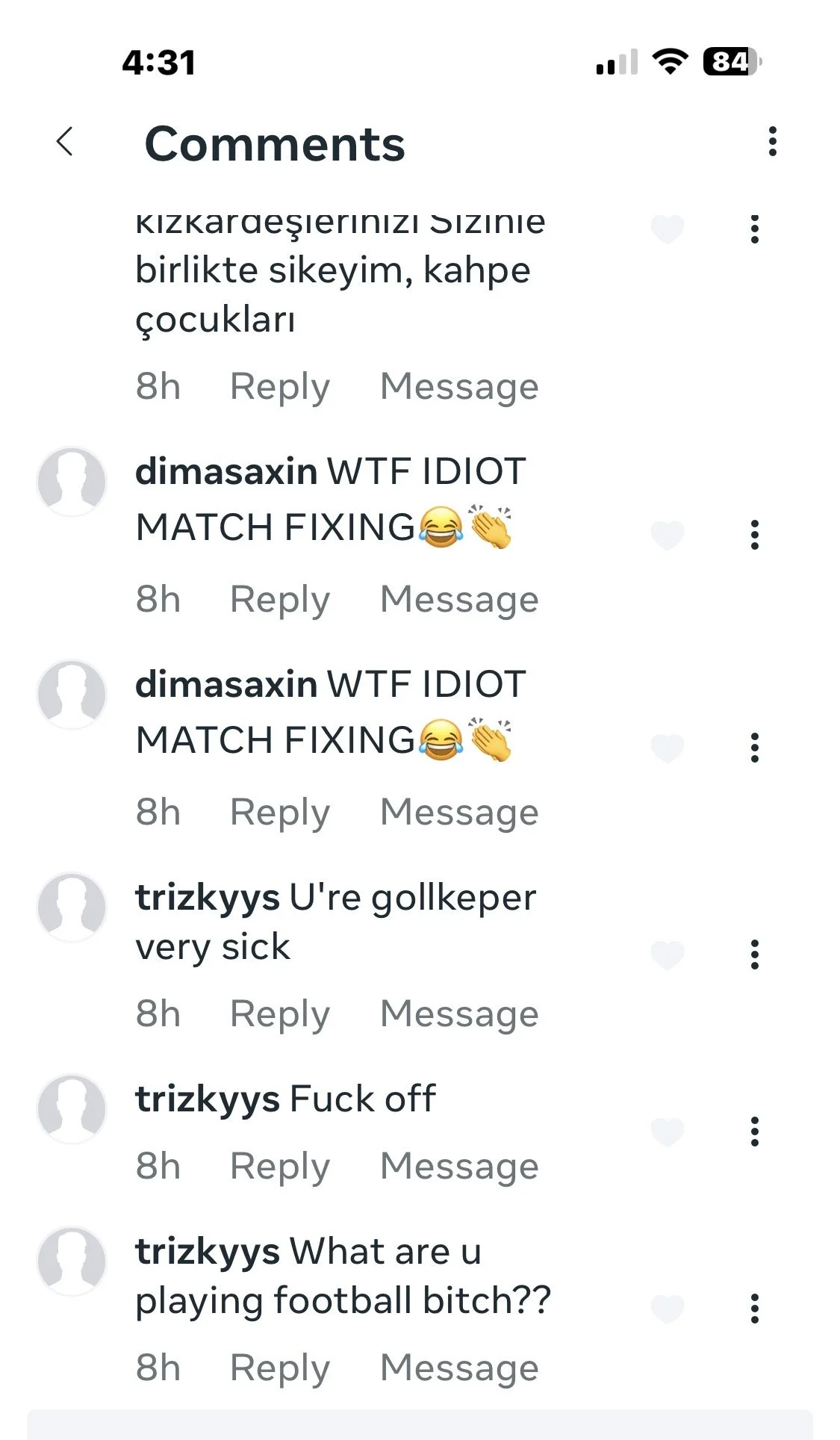
One of the most common accusations thrown at football clubs is match fixing.
A striker misses a chance.
Match fixing.
A goalkeeper makes a mistake.
Match fixing.
An underdog wins.
Match fixing.
A late goal changes the result.
Match fixing.
The irony is extraordinary.
Most community football clubs struggle to find enough volunteers to staff the barbecue.
Yet somewhere on the other side of the world somebody is convinced an elaborate international betting conspiracy is unfolding on a suburban football field in Tasmania.
Apparently a bunch of teenagers, volunteers and part-time coaches have masterminded a global operation.
The reality never seems to occur to them.
Football happened.
The gamblers lost.
Football's Forgotten Volunteers
Whenever gambling and sport are discussed, attention focuses on professional athletes.
Broadcast deals.
Advertising.
Sponsorships.
Tax revenue.
Professional sport.
Nobody talks about the volunteer sitting on their couch after dinner deleting messages from angry gamblers.
Nobody talks about the club administrator accused of match fixing because a teenager missed a chance.
Nobody talks about the parent updating scores.
Nobody talks about the social media admin checking notifications before bed.
Nobody talks about the people who absorb the consequences.
The people who never signed up for this.
Because every one of those messages lands somewhere.
Usually on the phone of a volunteer.
We Never Invited Them
Football clubs exist to serve their communities.
To provide opportunities for children.
To create friendships.
To build belonging.
To bring people together.
They do not exist to become customer service desks for global gambling markets.
Yet every weekend that is exactly what happens.
A missed penalty in Hobart.
A lost bet somewhere else in the world.
An abusive message arrives.
And another volunteer reaches for the block button.
Football talks constantly about safeguarding.
Respect.
Mental health.
Inclusion.
Positive environments.
All important conversations.
But perhaps it is time to talk about this as well.
Because somewhere along the way grassroots football acquired an audience it never asked for.
And every weekend that audience reminds us it is there.
Not with support.
Not with encouragement.
Not with a love of the game.
But with abuse, accusations and anger because somebody's bet didn't come off.
We never invited them.
Yet somehow they became part of football.

The World Cup Is Coming. Support Services Are Preparing

He Loves Football
Not casually.
Properly.
Still remembers Cahill against Japan.
Still talks about where he watched the Uruguay shootout.
Still has the old shirt in the cupboard.
His kids love it too.
World Cup nights are exciting in their house.
Late nights.
Pizza boxes.
Flags hanging over the couch.
School the next morning absolutely cooked.
It feels like family.
It feels like belonging.
It feels like Australia.
Until it doesn’t.
The Mood Starts To Change
He loves a drink during football too.
A few beers before kickoff.
A few more at half time.
Maybe something stronger after full time.
The game gets louder.
He gets louder.
The referee is a joke.
The coach is an idiot.
How the fuck do you miss that?
Everyone laughs at first.
Because this is normal, right?
This is what sport looks like.
Passion.
Emotion.
Intensity.
That is what we tell ourselves anyway.
Then his team loses.
The mood changes quickly after that.
He starts replaying moments in his head.
Gets stuck on decisions.
Starts muttering.
Starts snapping.
His partner says the wrong thing.
Or maybe nothing at all.
The children go quiet.
And suddenly the safest room in the house feels very small.
Their mother is already watching his face and trying to work out how bad the night is going to become.
Or quietly gathering the children together and running next door before things get worse.
And somewhere else across Australia another family is doing exactly the same thing while television commentators talk about atmosphere, tribalism and passion.
The neighbours probably hear it too.
Most pretend they do not.
The Statistic Behind Major Sporting Events
Now here is the confronting part.
Research around the world shows measurable spikes in domestic violence during major sporting events.
Not occasionally.
Predictably.
In Australia, research found domestic violence incidents increased by more than 40 percent during State of Origin periods in New South Wales.
In England, domestic abuse reports have repeatedly increased during major football tournaments involving the national team.
Police know this.
Shelters know this.
Crisis lines know this.
They literally prepare staffing around major sporting events because experience tells them what is coming.
Think about that for a moment.
The World Cup arrives and support services quietly brace themselves.
That should stop all of us in our tracks.
Football Is Not The Problem
Football is not causing domestic violence.
Rugby league is not causing domestic violence.
The World Cup is not causing domestic violence.
Abusive behaviour already exists long before kickoff.
But major sporting events can amplify environments already loaded with alcohol, gambling, emotional volatility, tribalism and ideas about masculinity that still confuse dominance, anger and intimidation with strength.
And maybe that is the conversation sport still struggles to have honestly.
Because we love the romance of sport.
The noise.
The passion.
The belonging.
The national pride.
The idea that sport brings people together.
And mostly it does.
But not always.
The Part We Prefer Not To See
That is the contradiction sitting underneath all of this.
For many children, World Cups become treasured memories.
The goals.
The noise.
The late nights.
Falling asleep on the couch in a football shirt.
But for some children, football nights mean something very different.
The yelling.
The smashed glass.
The fear.
The panic in their mother’s voice telling them to grab their shoes and get in the car.
That is part of the story too.
Just not the part we like putting in advertisements.
Sport Reflects Society
The truth is sport reflects society.
Sometimes the very best of it.
Sometimes the very worst.
And if we genuinely love sport, then we should be willing to look honestly at both.
Not defensively.
Not performatively.
Honestly.
Because the World Cup should be remembered for impossible goals, exhausted fans, communities gathering together and children dreaming about football.
Not for the silent statistic sitting underneath it all.
Somewhere tonight, while millions celebrate football, another child will be hiding in their bedroom waiting for the yelling to stop.
That is the World Cup memory some children carry for the rest of their lives.
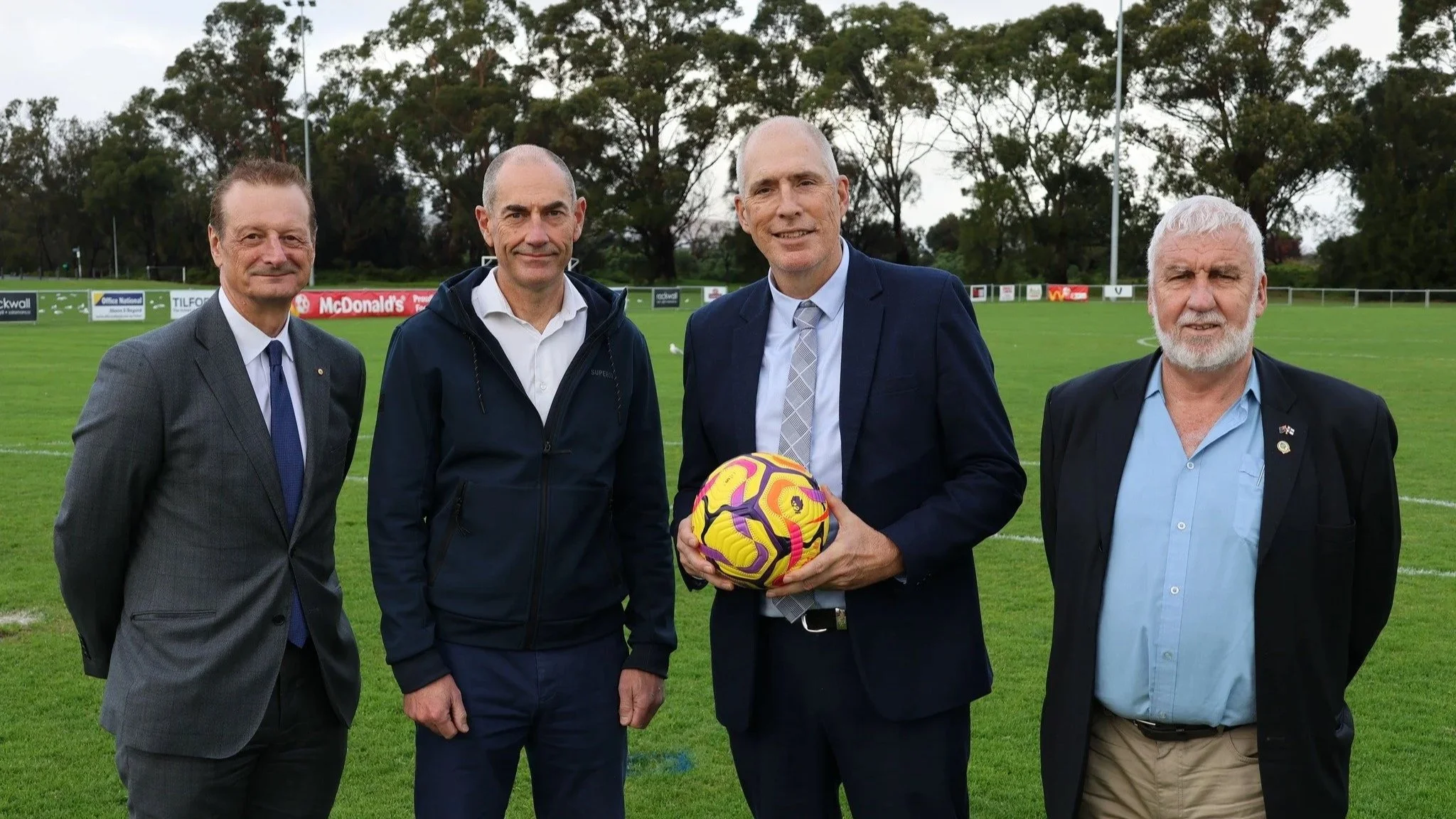
Triple Somersaults With Pike
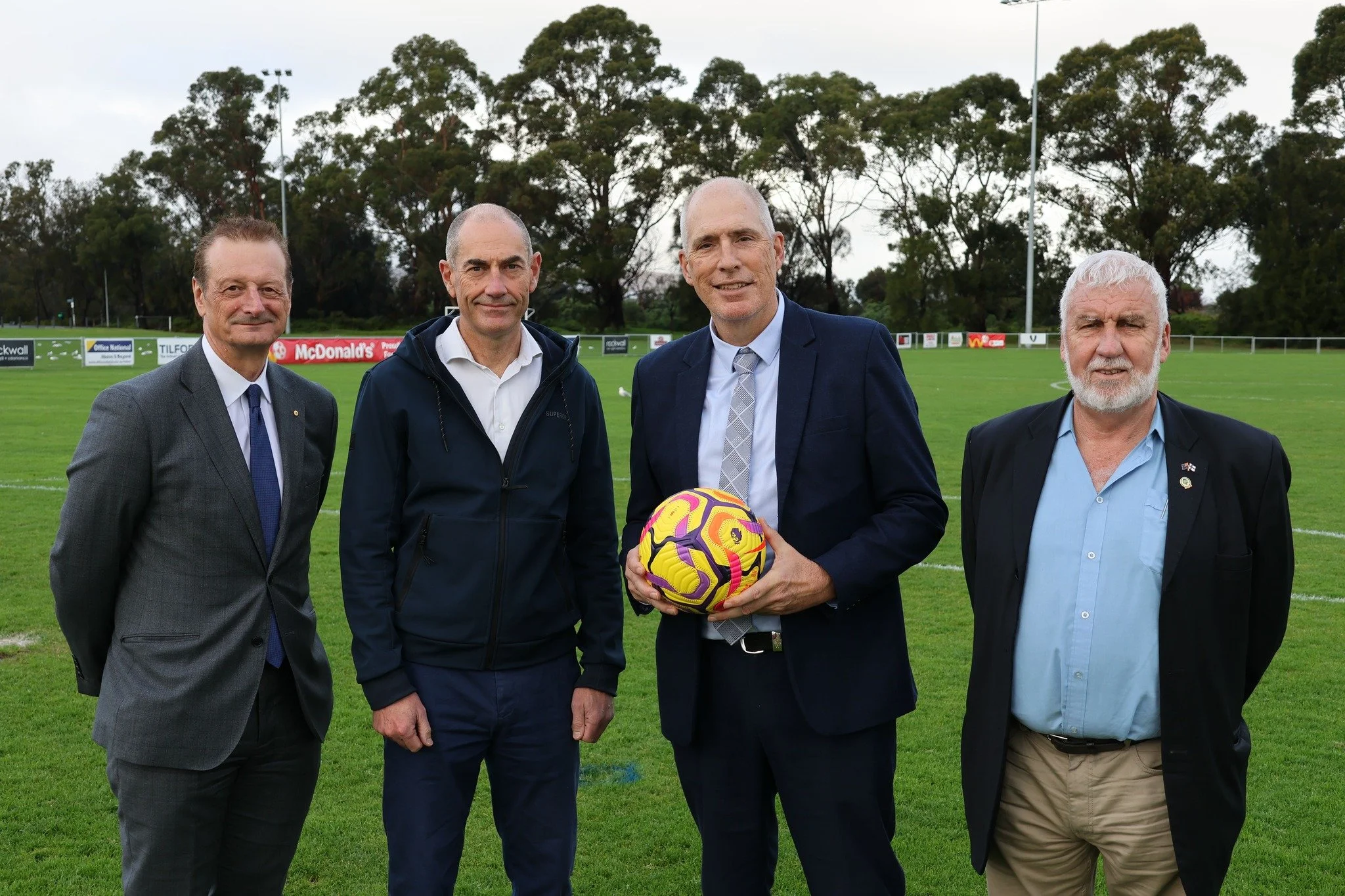
Football Tasmania Facebook photo shoot. Four men. Eight photos. One football. Tasmanian football once again being told to smile politely and be grateful
There is a particular tone in football governance that football people recognise immediately.
The staged optimism.
The carefully managed announcements.
The endless photos of men in jackets holding footballs while everyone is expected to smile gratefully for the cameras.
Tasmanian football knows this tone very well.
And perhaps that is why Football Tasmania’s latest strategic pivot has landed so awkwardly.
Because football people are increasingly tired of being treated like an audience rather than participants in their own game.
Yesterday we were effectively told the Tasmanian A-League dream is no longer the immediate priority.
Interesting.
Because many people distinctly remember being told the exact opposite for years.
In fact, Tasmanian football has spent the last few years performing enough strategic backflips to qualify for the Olympics.
One minute it is:
A-League franchise
Home of Football
regional hubs
transformational infrastructure
national pathways
Then another pivot.
Then another launch.
Then another carefully staged announcement cycle complete with smiling photos and strategic buzzwords.
Here we go again.
The Football Photo Shoot
Perhaps the funniest part of all this is the presentation.
Eight photos of four men standing around holding a football as though Tasmanian football has just cured a disease.
Look everybody.
A round ball.
Smile for the cameras.
Meanwhile football people across Tasmania are sitting there trying to work out whether they are supposed to celebrate the latest pivot or simply pretend they never heard the previous one.
Because this cycle is not new.
We have seen it before.
The Showgrounds project.
The Cambridge project.
Soccer precinct announcements.
Big promises.
Big language.
Big visions.
Then eventually the direction shifts again and everyone is expected to quietly move along to the next announcement cycle.
Football people are not stupid.
They are just exhausted.
Most clubs are too busy trying to find volunteers, pay electricity bills and get teams on the park to spend their lives decoding strategic language.
Please Clap Politely
That is probably the most frustrating part of modern football governance.
The paternal tone.
The feeling that football people should simply be grateful whenever somebody in a suit appears beside a football announcing another comparatively modest funding package.
Yesterday it was another announcement and another media opportunity.
Wonderful.
Fantastic.
Everybody clap politely.
Meanwhile football, the most played team sport in Tasmania, continues to operate in a constant state of scraping, fundraising, volunteering and patchwork survival while other sports discuss sums so large they barely feel real anymore.
Hundreds of millions.
Potentially billions.
And yet football is still somehow expected to behave like the grateful child at the table happy to receive whatever is handed down.
At some point people stop hearing leadership and start hearing political choreography.
The CEO Question
And perhaps this is partly why the latest backflip feels so jarring.
When Tony Pignata was appointed CEO, Football Tasmania publicly spoke about the need to elevate the sport in Tasmania, develop infrastructure and pursue future A-League men’s and women’s teams.
That was part of the pitch.
A highly experienced football administrator with deep A-League credentials arriving to help drive Tasmanian football toward a bigger future.
Now suddenly the A-League is “no longer an immediate priority”.
Football people are entitled to feel a little dizzy.
Because from the outside, the strategic direction increasingly resembles a series of triple somersaults with pike performed in mid-air while everybody else is left trying to work out where the landing spot is actually supposed to be.
Football People Can Feel It
This is the thing administrators sometimes misunderstand.
Football people can feel when they are being managed.
They can feel when language is carefully constructed to soften strategic reversals.
They can feel when announcements are more about optics than substance.
And they can certainly feel when priorities appear to change every couple of years while everybody pretends this was always the plan.
That is why frustration around the latest Football Tasmania comments has spread so quickly.
Not simply because people disagree.
But because the football community is increasingly tired of feeling like it is constantly being spun.
Clubs Are The Game
And underneath all of this sits a fairly basic point.
Football Tasmania is a member organisation.
Its members are the clubs.
The clubs are not external stakeholders.
They are not customers.
They are the game itself.
Which means football people are entitled to ask questions when strategic directions keep shifting.
They are entitled to expect honesty.
Consistency.
Transparency.
And perhaps most importantly, a little less political theatre.
Because eventually football communities stop believing the announcements.
And start recognising the choreography.
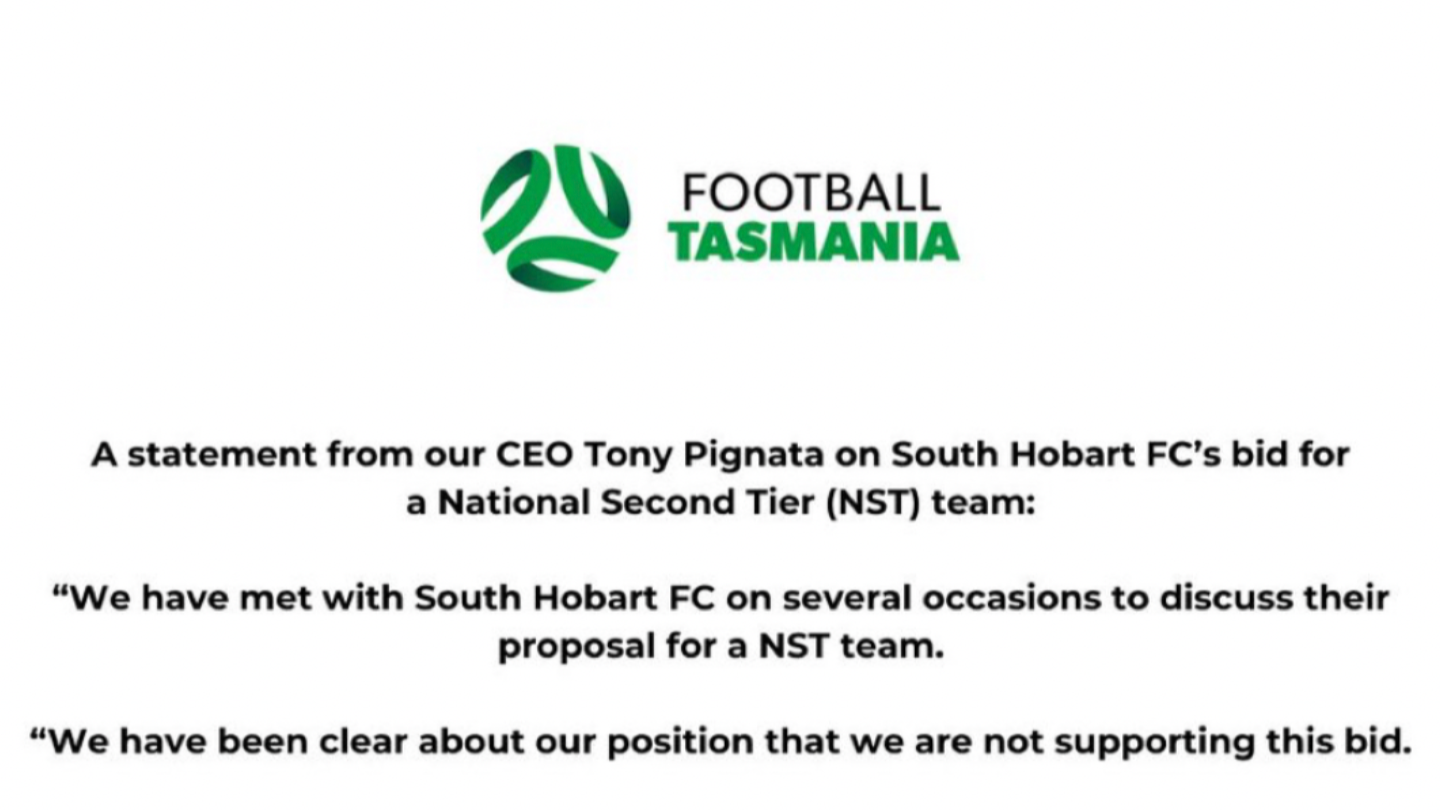
Remember March 1, 2024
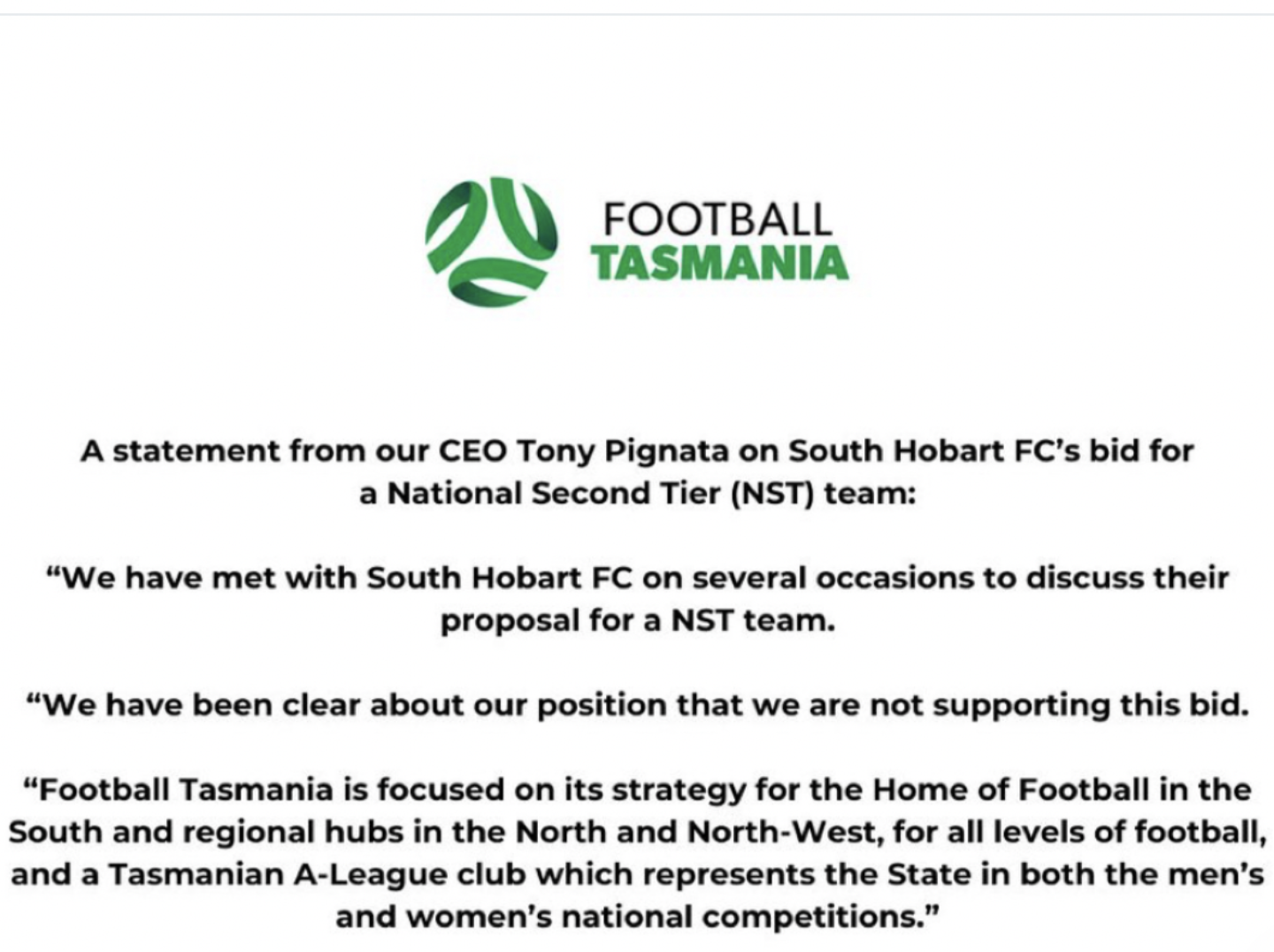
Remember the date.
March 1, 2024.
A day that may ultimately go down as one of the most extraordinary moments in recent Tasmanian football history.
The day Football Tasmania publicly distanced itself from the national ambitions of one of its own member clubs.
Not a rival organisation.
Not a competing code.
Not an external private venture.
One of its own clubs.
After two years of work behind the scenes, South Hobart FC’s pursuit of the National Second Tier was met with this statement from Football Tasmania:
“We have been clear about our position that we are not supporting this bid.”
That sentence travelled far beyond Tasmania.
And people noticed.
Not because everybody suddenly became a South Hobart supporter.
But because football people instinctively believe in ambition.
They believe in clubs striving for more.
They believe in pathways.
They believe in football earning its place.
At the time, Football Tasmania’s position was very clear.
The strategic priority was:
a Home of Football
regional infrastructure
and ultimately an A-League franchise representing Tasmania.
That was the vision.
That was the justification for publicly refusing support for a member club pursuing entry into a national competition.
Fast forward to today.
Now we hear:
“Tasmanian A-League teams are no longer an immediate priority for the organisation.”
Sorry… what?
So the strategic priority that justified publicly distancing the federation from South Hobart’s NST ambitions is now no longer the immediate priority?
Well fuck me.
Because that is not a minor adjustment.
That is a fundamental shift in strategic direction.
And football people are entitled to ask difficult questions about that.
Because this is not just about South Hobart.
It is about governance consistency.
Strategic clarity.
And what role a federation is actually supposed to play.
Are federations there to encourage ambitious clubs?
Or manage them?
Are they custodians of pathways?
Or gatekeepers of preferred models?
Because over the past two years, the messaging has often felt less like:
“How do we help football grow?”
and more like:
“How do we control the direction football grows in?”
What followed the March 1 statement was remarkable.
The backlash was not limited to South Hobart people or Tasmanian football supporters.
Journalists.
Historic clubs.
NST advocates.
Respected football voices from around Australia openly questioned why a member federation would publicly distance itself from one of its own clubs pursuing national ambition.
That reaction mattered.
Because it showed this was never viewed simply as a local Tasmanian disagreement.
It became symbolic of a much larger football debate about:
aspiration
club identity
football pyramids
and whether federations exist to encourage ambitious clubs or control the direction ambition is allowed to take.
And perhaps that is why the statement still lingers today.
Because football people can understand neutrality.
They can understand:
“We are not funding this.”
“We are focused elsewhere.”
“We are not directly involved.”
What many struggled to understand was:
“We are not supporting this bid.”
Those words mattered.
Especially to the many volunteers, supporters, administrators and football people who had spent years working quietly behind the scenes trying to build something ambitious from Tasmania.
To many involved, it felt like two years of grassroots football work being publicly dismissed by the very federation meant to represent the game.
The irony now is impossible to ignore.
Because if the A-League franchise strategy is suddenly no longer the immediate priority, then the obvious question becomes:
Why was it important enough to publicly distance the federation from South Hobart’s NST ambitions in the first place?
That question is not going away.
Nor should it.
Because football deserves consistency.
Football deserves honesty.
And ambitious clubs deserve better than being treated like political inconveniences for daring to dream bigger than the system expected them to.

The $37 Million Game: Inside Today’s Football Australia AGM

The $37 Million Question
Today, while most of Australian football is focused on fixtures, ladders and weekend football, one of the most important governance battles in years will quietly unfold inside Football Australia’s AGM.
Most people will never watch it.
Most people will never read the constitution.
Most people will not even know it is happening.
But hidden inside today’s meeting are questions about power, money and who controls the future of football in this country.
And once you understand the basics, the whole thing suddenly starts looking less like sport administration and more like House of Cards with shin pads.
Start With The Money
Because this is the key.
Football Australia reportedly received more than $37 million in grant revenue. At the same time, reports suggest the organisation is heading toward a loss of around $15.3 million. The Australian Sports Commission alone reportedly contributed around $5.3 million in high performance funding. (espn.com.au)
Those are not tiny community sport numbers anymore.
That is serious public money.
And once public money starts flowing at this scale, governments stop viewing football as simply a sport.
It becomes a publicly funded institution expected to meet modern governance standards.
Which is why this sentence matters so much:
“The Australian Sports Commission is effectively saying:
‘If public money is flowing through your organisation at this scale, your governance must meet modern standards.’”
And there it is.
The entire battle in one sentence.
Football Governance 101
Here is the simple version.
Football Australia currently has two types of directors:
elected directors,
and appointed directors.
That distinction is massive.
Elected Directors
Elected directors are voted in by football stakeholders.
Meaning various parts of football:
Member Federations,
A-League interests,
player representatives,
women’s football representatives,
all become part of the political process.
You need support.
You need alliances.
You need votes.
Which means elected boards can become heavily political.
Not necessarily corrupt.
Not necessarily evil.
Just political.
Appointed Directors
Appointed directors are different.
They are usually selected because they bring specific expertise:
finance,
governance,
legal,
commercial strategy,
government relations,
risk management.
The theory is that appointed directors are more independent and less tied to football factions and voting blocs.
And right now the Australian Sports Commission wants more of them.
Why This Is Becoming A Fight
At present, Football Australia’s constitution reportedly allows:
up to 6 elected directors,
and 3 appointed directors.
The ASC wants stronger governance compliance and a higher percentage of appointed independent directors.
Translation?
Less football politics.
More corporate governance.
Or depending on your perspective:
better oversight,
OR less football control.
And this is where things become properly Machiavellian.
Because constitutional reform requires large voting majorities.
Meaning voting blocs suddenly become incredibly powerful.
The A-League interests reportedly hold enough voting power to heavily influence or potentially block reform.
So suddenly football governance becomes:
negotiations,
strategic withdrawals,
alliances,
influence,
leverage,
and positioning.
Not on the pitch.
In the boardroom.
Then Comes The Gender Debate
And layered over the top of all this is gender reform.
Because modern governance standards increasingly require stronger gender balance on boards and committees.
Again, that should not be controversial in 2026.
And yet football still manages to make it awkward.
Because football loves saying:
“We support women’s football.”
The harder conversation is:
“Who actually shares power?”
That is where institutions become uncomfortable.
Because governance structures tend to favour:
existing networks,
long-term relationships,
and the people already sitting in the room.
Football is hardly alone there.
But football certainly has perfected the art of discussing progress while moving at glacial pace.
Welcome To The Political Nest Of Vipers
Which brings us to Tasmania.
Because our new Football Tasmania President Chris Brookwell is walking directly into this environment.
Not just fixtures and pathways.
National governance reform.
Political voting blocs.
Funding pressure.
Professional game influence.
Gender reform.
Financial instability.
And the really fascinating part?
Every stakeholder genuinely believes they are protecting football.
The professional game.
The grassroots game.
Government agencies.
Independent directors.
Traditional football powerbrokers.
Everyone believes they are acting in the best interests of the sport.
Which is probably what makes football governance so complicated.
And so dangerous.
Because underneath all the language about reform and governance sits the oldest force in politics:
Power.
Who has it.
Who keeps it.
Who wants more of it.
And, perhaps most importantly in modern football:
Who controls the money.
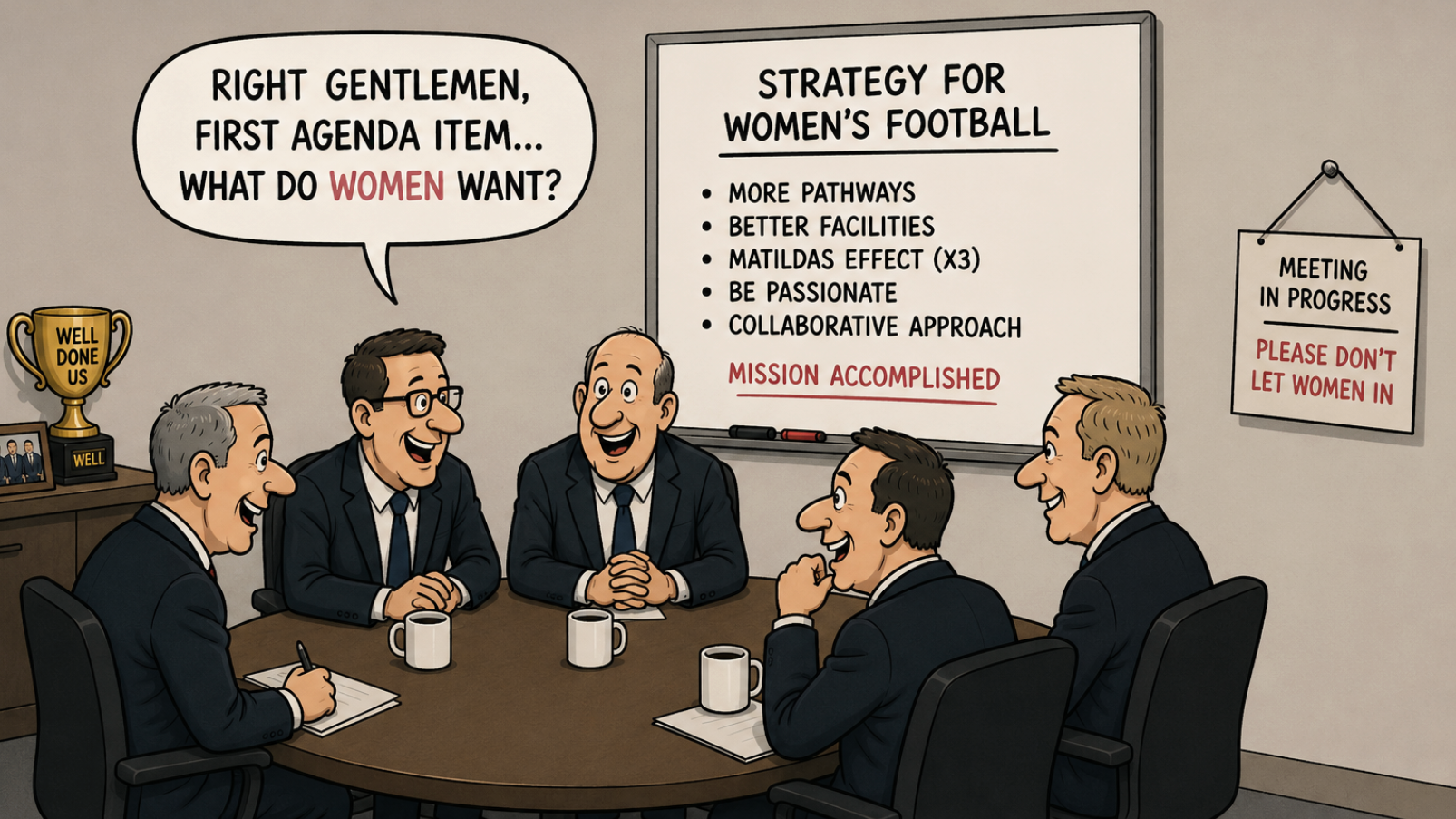
The Gentlemen’s Working Group For Women’s Football
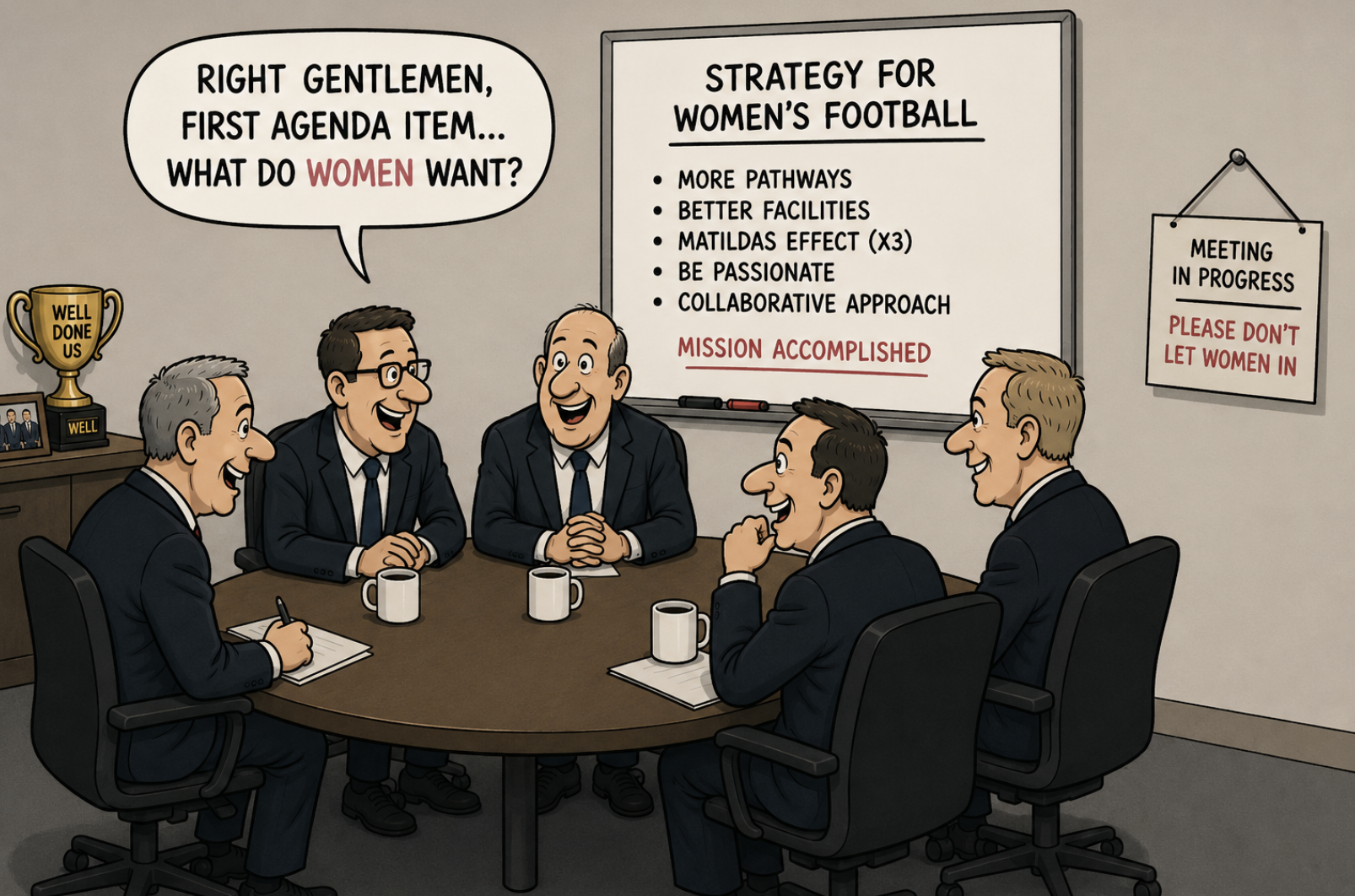
Or: The Chosen Ones, Part II
A few women have contacted me privately since my earlier piece about “The Chosen Ones.”
Not angrily.
Not dramatically.
More with that familiar tone women in football often develop over time.
Half amused.
Half exhausted.
Entirely unsurprised.
Because what struck them was not necessarily the individuals selected for the new working group.
It was the blindness of the selection itself.
The unconsciousness of it.
The complete inability to look at a room shaping the future of women’s football and think:
“Hang on a minute.
Does this perhaps look slightly insane?”
That is the fascinating part.
Not some secret anti-women agenda conducted under candlelight in the Football Tasmania offices.
Just institutional muscle memory.
Football governance instinctively recreating the same kinds of rooms it has always created.
And then acting startled when women quietly point it out.
A Proud Historical Tradition
To be fair, men explaining women to women is hardly new territory historically.
Men decided whether women could vote.
Men decided whether married women should continue working.
Men debated reproductive rights.
Men decided whether women could own property.
Men decided what constituted “appropriate female behaviour.”
Men once banned women’s football entirely because apparently the female body might collapse somewhere around the edge of the penalty box.
And now:
men form strategic working groups to determine the future direction of women’s football.
Progress truly is a magnificent thing to witness.
The Modern Football Administrator
Modern football absolutely adores women’s football.
It loves:
Women and Girls strategies,
participation targets,
Matildas branding,
government grants,
empowerment messaging,
diversity panels,
inclusive pathway graphics,
and LinkedIn posts containing phrases like:
“creating meaningful opportunities.”
Football is extremely comfortable promoting women’s football.
It is still slightly less comfortable surrendering control of it.
That is the awkward little detail sitting quietly underneath all of this.
Because every now and then football accidentally reveals that beneath the glossy messaging and strategy documents, the actual decision-making structures still look suspiciously like the organising committee for a suburban bowls club raffle in 1986.
Every major Matildas tournament is also traditionally followed by approximately six weeks of deep institutional respect for women’s football.
The Summoning Of The Chosen Ones
One of football governance’s great traditions is the mysterious emergence of “representatives.”
Nobody is ever entirely sure how it happens.
Perhaps smoke appears from the Football Tasmania offices.
Perhaps a sacred governance scroll is consulted.
Perhaps robes are involved.
Perhaps Gary simply knows a bloke.
Regardless, the chosen representatives emerge to shape the future direction of women’s football.
Women themselves remain somewhat optional to the process.
And again, the remarkable thing was not that men were involved.
Men absolutely should be involved in women’s football.
The remarkable thing was that apparently nobody assembling the room stopped for even three seconds and thought:
“This may look slightly ridiculous.”
That is the blindness women keep describing to me.
Not hatred.
Not exclusion.
Recognition.
Immediate recognition.
Because institutions tend to reveal themselves most honestly in what they do automatically.
Without reflection.
Without pause.
Without anybody saying:
“Perhaps we should rethink this before publishing the email.”
The Optics Olympics
What makes all this even more extraordinary is the timing.
Because Australian sport is currently under enormous pressure around gender equity, governance standards and female representation.
National sporting organisations are increasingly expected to demonstrate genuine diversity in leadership structures as part of modern governance expectations and Australian Sports Commission funding pressure.
Which makes football’s ongoing ability to accidentally assemble rooms full of men discussing women’s football genuinely magnificent satire.
You honestly could not script it better.
At precisely the same moment Football Australia is under pressure around board composition and governance expectations, football somehow still keeps producing committees that look like the annual general meeting of a trout fishing association.
One hilariously controversial observation floating around football circles recently suggested that perhaps half the Football Australia board could simply identify as women to guarantee Sports Commission funding.
Apparently this would also assist with governance compliance.
Modern football administration truly is innovative.
Football loves appearing progressive.
Structural change is where everybody suddenly requests another consultation paper.
The Official Women’s Football Working Group
You can almost picture the opening meeting.
“Right gentlemen, first agenda item:
What exactly do women want?”
A thoughtful silence.
Barry adjusts his glasses.
“Well personally, I think they’d probably like pathways.”
The room nods thoughtfully.
Another breakthrough for women’s football.
Barry then proposes facilities.
The room agrees this is advanced thinking.
Minutes recorded.
Action item noted.
The meeting is declared a tremendous success despite the absence of actual women.
Stakeholder engagement outcomes are considered highly satisfactory.
A diversity outcome is noted in principle.
Terms Of Reference
Draft Terms Of Reference For The Advancement Of Women’s Football
Women’s football shall be fully supported in principle.
Female perspectives may be considered where operationally convenient.
At least one woman may be consulted once major decisions have already been made.
The phrase “Matildas effect” must appear no fewer than three times per meeting.
Any woman expressing structural concerns shall immediately be described as “passionate”.
Governance discussions shall remain collaborative, respectful and overwhelmingly male.
Female lived experience may be acknowledged retrospectively.
The group is expected to consult women once the strategic direction of women’s football has already been strategically directed.
Football reserves the right to congratulate itself extensively for all progress achieved.
The Familiar Room
And honestly, this is not even really about Tasmania.
That is the revealing part.
Football all over the world still occasionally produces rooms that look remarkably familiar.
Men talking.
Women listening.
Everybody acting slightly confused about why women sometimes feel disconnected from decision-making.
Not because anybody intended harm.
That is almost what makes it worse.
Because football governance keeps quietly telling on itself.
Not in speeches.
Not in Women and Girls strategies.
Not in empowerment campaigns.
In who gets invited into the room before everyone else even knows there is a room.
Women’s football continues to grow rapidly.
Women’s influence over women’s football appears to be progressing at a slightly more traditional pace.
A working group will no doubt be formed to investigate this further.

The Accountant Takes the Chair

Today at 12.11pm Football Tasmania formally confirmed there will be only one nomination for President at tomorrow night’s AGM.
Chris Brookwell.
No election battle.
No competing visions.
No dramatic late challenger emerging from the shadows.
Just one nomination quietly landing in members’ inboxes on a Tuesday afternoon.
And with that, Tasmanian football appears set to enter a very different era of leadership.
Because Chris Brookwell is not the stereotypical football strongman, political operator or high-profile football personality.
In fact, perhaps the strangest thing of all was this:
I could barely even find a photograph of the incoming President of Football Tasmania.
In the modern age of branding, self-promotion and carefully curated public profiles, that feels unusual.
There are governance bios.
Corporate headshots.
LinkedIn traces.
Board references.
But very little football theatre.
And maybe that fits the moment perfectly.
Because Chris Brookwell does not appear to be arriving as a football celebrity or political operator.
He appears to be arriving as something else entirely.
A governance chair stepping quietly into one of the more difficult volunteer roles in Tasmanian sport.
A Different Type of Football Leader
Brookwell’s public biography reads more like the board papers of a government business enterprise than the back page of the sports section.
Chartered Accountant.
Former EY executive.
Former CFO at TasRacing.
Governance qualifications.
Oxford executive strategy studies.
Chair of Football Tasmania’s Finance and Risk Management Committee.
This is not football theatre.
This is governance.
And honestly, maybe that reflects modern football administration more than many people would like to admit.
Because the modern game increasingly revolves around:
risk,
finance,
compliance,
facilities,
government relationships,
participation numbers,
insurance,
strategy documents,
and organisational sustainability.
The game many people still romantically imagine from the terraces and touchlines now spends an enormous amount of its time inside spreadsheets, constitutions and board papers.
Chris Brookwell’s background fits that world very comfortably.
But Is He A Football Person?
That is probably the obvious question many within the game will ask.
The answer appears to be yes, although perhaps not in the traditional sense.
Brookwell has been involved coaching and volunteering at Kingborough Lions. Football Tasmania’s own biography notes his involvement at grassroots level and his family also appears connected to junior football structures through the club.
His son Harry also played and coached at South Hobart and, in my experience, is a genuinely lovely young man.
That matters.
Because while Brookwell’s public profile is heavily governance and finance focused, there are clearly real football connections sitting underneath it too.
This is not a complete outsider arriving from nowhere.
The more accurate description may be a governance person who has entered football through volunteering, coaching and community involvement rather than through football politics or football fame.
And honestly, that may actually reflect modern football leadership more than people realise.
The Silence Matters Too
But perhaps the most revealing thing about today was not who nominated.
It was who didn’t.
Because for all the endless discussions surrounding football governance, when the moment arrived to actually take the chair, only one person put their hand up.
That says something.
Maybe members are content with continuity.
Maybe people are exhausted.
Maybe football governance has simply become too difficult, too thankless and too exposed for many to genuinely want the role.
Leadership in football is a strange thing.
Whatever you do, someone thinks you should have done the opposite. It does not make you popular. It certainly does not make you universally liked. Mostly, it just paints a very large target on your back.
A bit like a football version of crossbar challenge.
Except instead of aiming for the crossbar, everyone lines up taking shots at the Chair.
And now it is Chris Brookwell’s turn.
The Real Job Starts Now
Will four years volunteering as Chair of Football Tasmania turn his hair grey?
Possibly.
Will he get ambushed at junior games on cold Saturday mornings by people wanting to explain why everything in Tasmanian football is broken?
Almost certainly.
Because football leadership in Tasmania is not really lived in boardrooms or annual reports.
It lives beside muddy pitches, under leaking shelters, in canteens, on touchlines and in car parks after games.
That is where football people decide whether you are actually listening.
And over the next four years Tasmanian football is about to find out exactly what sort of leader Chris Brookwell will be.

The Night Before The Reveal - It’s All Going Pear Shaped at FA HQ

On the eve of Football Tasmania’s AGM, where the great reveal of our glorious leader for the next four years will finally occur, things at Football Australia HQ are going decidedly pear shaped.
And whether people like it or not, that matters to all of us.
Because while Tasmanian football often feels consumed by its own local politics, personalities and power struggles, the reality is that Football Australia still sits above the entire structure:
governance,
pathways,
funding,
national strategy,
participation systems,
and ultimately the broader direction of the game.
And right now the national governing body appears to be under extraordinary pressure.
Which means whoever emerges tomorrow night as Football Tasmania’s leader will immediately step into one of the most turbulent periods Australian football governance has faced in years.
The Headlines Keep Coming
Over the past fortnight the headlines have come relentlessly.
A reported $15.3 million loss.
More than 20% of staff facing redundancy.
Questions around APL debt arrangements and governance influence.
Three Football Australia board candidates withdrawing before election.
And now reports of an internal culture review describing Football Australia as “toxic, chaotic and negative”.
This is no longer just a football finance story.
It is starting to look like an organisation under pressure:
financially,
culturally,
politically,
and structurally.
And perhaps the most concerning part of all is that none of this feels entirely new.
Australian football has an extraordinary ability to repeatedly arrive at moments of:
crisis,
restructure,
governance reform,
“alignment”,
fresh leadership,
and promises of a reset.
Only for the same tensions to eventually reappear in slightly different forms.
At some point the game has to ask itself a very uncomfortable question:
Why does Australian football keep circling back to instability despite periods of enormous opportunity?
“Toxic, Chaotic and Negative”
The details emerging from the reported internal review are especially confronting.
Staff reportedly described Football Australia as:
hierarchical,
bureaucratic,
egotistical,
gruelling,
and unprofessional.
There were allegations of:
favouritism,
low psychological safety,
avoidance culture,
“meetings about meetings”,
and decisions made on “opinion not evidence”.
Whether entirely fair or not, it paints the picture of an organisation struggling internally while simultaneously trying to project stability externally.
And honestly, there is something deeper sitting underneath all this.
The language now coming from different parts of Australian football increasingly sounds exhausted.
Not simply frustrated.
Exhausted.
Journalists.
Supporters.
Former officials.
Fans.
Administrators.
Grassroots volunteers.
Different people with very different agendas are all starting to circle around similar themes:
politics,
fragmentation,
distrust,
blurred accountability,
and power struggles.
That usually means something bigger is happening.
The Voting Blocks
And now, right in the middle of all this turmoil, comes the Football Australia AGM.
The governance mechanics matter here.
A lot.
Because Football Australia’s Congress is ultimately controlled through voting blocs:
Member Federations,
A-League clubs,
the Women’s Council,
and the PFA.
The Member Federations collectively still hold the majority voting power.
Which suddenly makes tomorrow’s Football Tasmania AGM feel even more significant.
Because whoever takes over locally immediately inherits influence within one of the most important voting blocs in Australian football.
And right now the pressure around those voting blocs is intensifying rapidly.
Following the withdrawal of Mark Schwarzer, Christine Holman and Cathy McGuane, the remaining Football Australia board candidates now all appear aligned with A-League interests.
That has triggered growing public debate around the future balance of power inside Australian football.
Will the Member Federations continue to collectively hold the line against growing professional game influence?
Or are we watching the gradual consolidation of A-League influence inside the national governing body itself?
Because if Football Australia is simultaneously posting massive losses, cutting staff and facing scrutiny around financial arrangements linked to the professional game, ordinary football people are inevitably going to ask difficult questions.
Grassroots football families already pay enormous registration costs.
Community clubs fight constantly for facilities and funding.
Volunteers hold the game together every weekend.
So when headlines emerge suggesting millions linked to the professional game have become the subject of settlements, restructures or financial “clarifications”, people naturally start questioning where the priorities of the game truly sit.
That is no longer some abstract governance discussion.
It sits right at the centre of where Australian football may be heading next.
Who Actually Controls The Game?
And hanging over all of it remains the unresolved question Australian football never quite seems able to answer cleanly:
Who actually controls the game?
The unbundling of the A-Leagues was supposed to create clarity and independence between the professional game and the governing body.
Instead, the lines increasingly appear blurred.
And beneath all of that sits another tension Australian football still seems unable to resolve cleanly:
Who is the game actually being governed for?
The whole football pyramid?
Grassroots participation?
The professional leagues?
Commercial growth?
National teams?
Community football?
Too often Australian football feels like a sport trying to be:
a community game,
an elite pathway,
a commercial entertainment product,
a FIFA bureaucracy,
and a social institution
all at the same time.
That creates constant tension.
The Biggest Sport, Yet Constantly Fragile
This is perhaps the strangest contradiction of all.
Football is the biggest participation sport in the country.
The Matildas transformed the sporting landscape.
Participation continues to grow.
Governments want to invest.
Football is culturally stronger than it has been in decades.
Yet institutionally the game often feels remarkably fragile.
That is extraordinary.
Most sports decline culturally before they decline institutionally.
Australian football sometimes appears to be doing the reverse:
culturally growing,
while institutionally wobling underneath it.
That should probably concern everyone involved in the game.
Why This Matters In Tasmania
For ordinary football people this can all feel very distant from muddy boots, volunteer coaches, canteens and Sunday mornings.
But governance matters.
Because eventually governance decisions shape:
registration costs,
development pathways,
facilities,
investment,
competitions,
and the overall direction of the game.
Tomorrow night Tasmania will get its own answers about who will lead the local game for the next four years.
But nationally, Australian football still appears to be searching for much bigger ones.
And right now, the warning lights inside Australian football are flashing everywhere.

AGM Week: The Great Reveal

Got to love the new graphic capacity of AI!
Who is getting excited?
It is AGM week.
Tasmanian football’s own leadership spectacular is almost upon us.
After several weeks of whispers, coffee shop intelligence briefings, sideline diplomacy, constitutional interpretations, proxy mathematics and “sources close to the situation”, we are finally about to discover who wants to lead Football Tasmania for the next four years.
Well… probably about 24 hours before the AGM.
Apparently that is considered more than enough time to decide who should oversee the future of football in Tasmania.
Because nothing says healthy modern governance quite like unveiling leadership candidates at almost the exact moment voting begins.
To be fair, maybe this is all part of the excitement.
Maybe Football Tasmania has simply pioneered a new governance format.
Less “member engagement”.
More surprise elimination reality show.
Because the whole thing currently feels less like a sporting election and more like an old game show nobody fully understands the rules to.
“Behind Curtain A is a candidate who believes in governance reform, strategic alignment, stakeholder engagement and sustainable pathways.”
“Behind Curtain B enjoys football sustainability, community consultation and perhaps a quiet bit of gardening.”
“And behind Curtain C… honestly we are still waiting for the nomination paperwork to clear.”
Cue awkward applause.
Some suspense music from 1987.
A volunteer nervously holding an envelope near the stage.
Somebody whispering “have they got the numbers?”
Then Tasmanian football collectively gets 24 hours to decide whether the future of the game feels inspiring, terrifying or mildly confusing.
Fait accompli.
There’s your AGM phrase of the week.
Democracy, But Make It Secretive
I still find it extraordinary that in 2026 we can buy a toaster online and spend three weeks reading customer reviews, comparison articles and watching YouTube unboxings…
…but the leadership of football in Tasmania can effectively be decided with less scrutiny than choosing a new kettle.
The clubs and Associations and their members fund the game.
The volunteers hold the game together with zip ties, raffle books and toasted sandwiches.
The members technically own the game.
Yet somehow the process of selecting the people steering the entire sport still feels oddly mysterious.
Who is standing?
What do they actually believe?
What would they genuinely change?
What is their vision for the future of the game?
Who knows.
Perhaps there will be white smoke released from outside the AGM venue once a decision has finally been reached.
Or grey smoke if someone is still counting proxies in the Salamanca Inn car park.
At this point Tasmanian football governance feels only a few steps away from a full Vatican-style leadership selection process.
Locked doors.
Whispered conversations.
Careful numbers counting.
People emerging from meetings saying things like:
“There is a strong feeling in the room.”
“We’ve had some constructive conversations.”
And somewhere outside, ordinary football people are still just trying to work out who is actually running the sport.
The 24-Hour Candidate Deep Dive
One of my favourite parts of AGM season is the completely serious expectation that members can fully absorb a candidacy overnight.
“Here are the nominations.”
“Oh okay.”
“Voting tomorrow.”
Excellent.
No meaningful time for discussion.
No proper opportunity for clubs to digest the direction of the people asking to lead the sport.
Just enough time for football people across Tasmania to quietly start ringing each other.
“So… what have you heard?”
“Does anyone actually know this person?”
“Who’s backing them?”
“Are they aligned with certain clubs?”
“Are they truly independent?”
“Has anyone checked the constitution?”
Somewhere across Tasmania right now, football people are pretending not to care while simultaneously trying to work out who has the numbers.
Does Anyone Actually Know The Board?
And here is the awkward question.
How many football people in Tasmania could actually name the current Football Tasmania board?
Not just the President.
The board.
Honestly, has anyone actually read the board bios?
Because if somebody can potentially become President this week and large sections of the football community are still saying “wait… who is that?”, then maybe that tells us something too.
Not necessarily about the individual.
But about the disconnect between governance and the everyday football community.
Football Tasmania can sometimes feel a bit like one of those mysterious upper floors in an office building where ordinary people assume important things are happening but nobody is entirely sure what they are.
The board appears during AGM week, constitutional discussions and major announcements, then quietly disappears back into the governance mist for another year.
Meanwhile the rest of football keeps rolling on underneath it all.
Wet grounds.
Volunteer exhaustion.
Parents appealing under-10 offside decisions like they are appearing before the High Court.
Committee members desperately searching for canteen volunteers at 10pm on a Thursday night.
You know… football.
And sometimes it genuinely feels like the people governing football and the people carrying football exist in completely different universes connected only by the occasional PDF statement and a strategic plan nobody fully read.
Yes, I Thought About Standing
I did briefly toy with standing myself.
Which certainly would have added some entertainment value to proceedings.
And I genuinely appreciate the people who encouraged me, contacted me and believed I could contribute.
That support meant more than people probably realise.
But the reality is I have stepped away from enough governance recently to know my own limits.
Family matters.
MSS matters.
CRJFA matters.
My own peace matters.
Besides, if I actually got elected, I would probably end up having to write about myself and the shite job people thought I was doing.
That feels awkward.
It is difficult to aggressively analyse governance decisions when you are the governance decision.
Although, to be fair, plenty of people would probably still volunteer to help with the criticism.
So instead I remain where I currently sit.
Inside the room through CRJFA.
Outside the big table.
Close enough to see how the machine works.
Far enough away to still say what I think.
Which, honestly, is probably the most interesting seat in the house anyway.
So unless I suddenly drop dead, I will still be here.
Writing.
Observing.
Revealing.
Sharing.
Asking awkward questions.
And occasionally annoying people sitting around the big table.
Because Football Tasmania is not some secret society requiring a special handshake and whispered passwords to enter the room.
It is supposed to be a member organisation.
A football organisation.
Built for the people actually participating in the game.
Which means asking questions should not feel rebellious.
Transparency should not feel threatening.
And ordinary football people should not feel like outsiders peering through the window trying to work out what is happening inside their own sport.
Anyway.
Enjoy the big reveal.
May the envelopes be dramatic, the smoke signals visible and the constitutional interpretations plentiful.

RIP The Volunteer

National Volunteer Week Feels Slightly Absurd
Today is the final day of National Volunteer Week.
Which honestly feels slightly absurd in modern football.
We celebrate volunteers while simultaneously building systems that are slowly crushing them.
This week I met with Michele from Football Tasmania Wise on CRJFA business. Michele is a wise, experienced woman who has spent 15 years working in football administration and our conversation kept circling back to the same thing:
The same tired people are now holding entire clubs together.
In many community clubs, if two or three key volunteers walked away tomorrow, the entire operation would wobble.
Not dramatically.
Quietly.
One exhausted volunteer at a time.
The Club Culture We Used To Know
Gone are the days of dad playing senior football while mum worked in the canteen and the kids kicked a ball behind the goals until dark.
Football clubs once felt like extended families.
People stayed all day.
Children grew up at grounds.
Parents naturally drifted into helping because they were already there.
The club was part of life.
Now football often feels like another tightly scheduled appointment squeezed into an already impossible week.
Drop the child off.
Pick them up.
Rush to the next thing.
Not because people are selfish.
Because modern life is expensive and exhausting.
Children once grew up belonging to clubs.
Now many simply attend them.
And that matters because belonging creates volunteers.
Consumption creates customers.
Maybe Grassroots Was Never Quite The Utopia We Pretend
I write a lot about grassroots football like it is some kind of warm community utopia.
The canteen.
The committee.
The volunteers.
People helping because they love the game.
And yes, at times it absolutely felt like that.
But lately I have found myself looking back differently.
Twenty years of volunteering.
Twenty years of meetings, emails, politics, organising, stress, weekends and responsibility.
And honestly?
I am not even sure how I feel about it anymore.
And no, this is not the point where I ask people to say “thank you for your service” or tell volunteers how wonderful they are.
Plenty of people have done extraordinary things for their clubs over decades.
That is not really my point.
My point is that community sport has quietly become dependent on a relatively small number of people carrying extraordinary loads for very long periods of time while everyone else simply accepted that the work would somehow keep getting done.
And eventually you look back after twenty years and wonder:
Was this actually sustainable?
Did people genuinely value the work?
Or did many simply think:
“Great. Someone else is doing it so I don’t have to.”
That is the uncomfortable question sitting underneath community sport.
Because football often romanticises volunteerism while quietly relying on the same people over and over again until they burn out.
Community sport often relied on a relatively small number of people carrying extraordinary workloads while everyone else simply enjoyed the product.
And the work of volunteers is often only truly noticed once it stops being done.
Two Incomes And No Spare Capacity
Housing costs have exploded across Australia.
The cost of living keeps rising.
For many families, two incomes are no longer a choice, they are survival.
And when both parents are working, spare time disappears.
By the time families juggle work, school, shopping, cooking, traffic, bills and simply trying to survive their own week, there is very little left in the tank.
Volunteerism once relied on spare capacity.
Modern life has stripped much of it away.
Football Quietly Became A Job
At the same time volunteering itself has changed completely.
Once upon a time you simply helped.
Now you onboard.
Now volunteers need:
Working With Vulnerable People checks
Child safety training
Online induction modules
Governance understanding
Risk management awareness
Registration systems
Incident reporting
Parent communication
Emails
Committee meetings
And yes, most of these reforms came from genuine failures, risks or tragedies. None appeared from nowhere.
Child safety matters.
Good governance matters.
Safe environments matter.
But collectively they are creating something football is refusing to properly confront:
We are asking volunteers to operate inside increasingly professionalised systems without professional support.
Some volunteers are now effectively doing semi-professional administrative jobs after full days of work.
Registrars.
Treasurers.
Ground coordinators.
Junior convenors.
Presidents.
Many community clubs would simply collapse tomorrow if those people stopped.
The Risk-Reward Equation Has Changed
There is another shift too.
People are frightened of getting it wrong.
A volunteer coach or committee member now worries:
What if I breach policy?
What if a parent complains?
What if I miss a compliance step?
What if I say the wrong thing?
What if I get accused of something?
The joy of helping has slowly been replaced by the fear of making mistakes.
The risk-reward equation of volunteering has changed completely.
The Emotional Exhaustion Nobody Talks About
Many volunteers now carry constant low-level guilt.
Guilt for not helping enough.
Guilt for missing messages.
Guilt for saying no.
Guilt for stepping down.
The emotional load is enormous.
Most are not leaving because they stopped caring.
They are leaving because they are tired.
And quietly, many long-term volunteers no longer feel valued.
They feel utilised.
The Irony Nobody Wants To Admit
I have sat through volunteering workshops in Tasmania with volunteers from my own club spending hours trying to work out how to recruit more volunteers.
Think about that for a moment.
Volunteers volunteering their time to attend workshops about how to convince other exhausted people to volunteer their time.
The irony is almost unbearable.
You sit in rooms watching glazed eyes slowly drift toward the exit while everyone talks about “engagement strategies” and “volunteer pathways” and “building capacity”.
But deep down most people already know the truth.
The problem is not recruitment strategy.
The problem is capacity.
People are tired.
Modern life has consumed the spare hours community sport once depended on.
You cannot endlessly professionalise volunteer roles while simultaneously wondering why fewer people are putting their hands up.
At some point the entire model starts collapsing under the weight of its own expectations.
And quietly, I think many people in community sport already know it.
The Endless Performance Of Community Sport
This week, clubs all over the country posted nicely framed graphics thanking volunteers.
And ironically, there is a good chance some exhausted volunteer stayed up late making those graphics because it felt like something the club should do.
The irony never really stops.
And to be clear, this is not mocking those volunteers.
Quite the opposite.
It is recognising how modern community sport now operates through an endless stream of emotional and administrative labour that somebody always has to carry.
Female Football Week.
Volunteer Week.
Mental Health Round.
Respect campaigns.
Social media expectations.
Acknowledgement posts.
Community obligations.
Again, none of these things are bad in themselves.
But collectively they become another exhausting layer of work added onto people already struggling to keep clubs functioning.
The expectation to constantly publicly demonstrate values has itself become another volunteer task.
Sometimes I think community sport now spends almost as much time performing community as it does actually living it.
And underneath it all are the same tired people quietly making sure everything happens because they feel responsible.
That feeling of responsibility is powerful.
But it is also dangerous.
Because eventually responsibility turns into obligation.
And obligation slowly turns into exhaustion.
The Disappearance Of Belonging
Clubs used to be social centres.
People stayed after games.
Shared meals.
Watched senior football.
Had a drink together.
Children played together for hours.
Now grounds empty quickly.
Because everyone has somewhere else to be.
Volunteers were once created by connection and belonging.
Modern life increasingly runs on convenience and efficiency instead.
Uber.
Food delivery.
Streaming.
Online shopping.
Sport is now one of the last parts of society still heavily dependent on collective unpaid effort.
And the tension is starting to show.
The Warning Sign Michele Mentioned
One thing Michele mentioned stayed with me.
She spoke about one of the biggest Little Athletics centres stopping because there were simply not enough volunteers left to run it.
That should terrify every sporting organisation in Australia.
Because when one of the biggest Little Athletics centres can no longer survive because there are not enough volunteers, this is no longer isolated burnout.
It is systemic.
The same warning signs are appearing everywhere:
empty committee rooms
clubs begging for team managers
difficulty recruiting referees
the same six people doing everything
burnout hidden behind smiles and duty
Community sport is slowly leaning harder and harder on fewer and fewer people.
That is not sustainable.
The Invisible Labour Behind Junior Sport
If parents could actually see the amount of work required just to put teams onto a field every weekend, they would probably understand that community sport offers extraordinary value for money.
Fixtures.
Registrations.
Ground bookings.
Uniforms.
Insurance.
Lighting.
Referees.
Equipment.
Wet weather plans.
Communication.
Compliance.
Scheduling.
Safety.
Most of it is done quietly by volunteers who simply love their clubs and want football to happen for children.
Parents often look at fees and wonder where the money goes.
The real question is this:
What would those fees look like if every volunteer role suddenly had to be paid?
The User-Pays Future
At Morton’s Soccer School we employ more than 50 casual staff, many of them young.
They are not there because they feel virtuous.
They are not there because they want the emotional reward of volunteering.
They are there because it is work and they are being paid.
And maybe that is not some terrible cultural decline.
Maybe that is simply where modern society is heading.
People increasingly expect labour to be compensated.
Time has become too valuable.
Life has become too expensive.
And goodwill alone no longer sustains large sporting organisations the way it once did.
That may sound cold.
But honestly, I think much of community sport is already drifting in that direction whether we want to admit it or not.
If volunteering keeps collapsing, sport will eventually move fully toward user-pays systems.
Not because clubs want it to.
Because they may have no alternative.
If people no longer volunteer, clubs will either:
reduce what they offer
or pay people to do the work
And when that happens, costs rise sharply.
Parents stop belonging to clubs and start consuming them as services.
Community becomes transaction.
The Real Crisis
Football talks endlessly about participation numbers.
But perhaps the real crisis in community sport is not participation.
It is labour.
Because children can only play if somebody is still willing to organise it.
The future of community sport may not depend on how many children want to play.
It may depend on whether anybody is still willing to run it.

The Chosen Ones

The Email
An email arrived in my inbox today.
Anonymous source.
One of the strange things about stepping away from formal governance roles is that people suddenly feel safer sending you things. Safer forwarding concerns privately that they would never raise publicly.
Because I am no longer President of South Hobart.
No longer on the Board.
No longer sitting inside official structures.
So now things just quietly arrive.
And yes, I know exactly what some people think every time I write one of these pieces.
“Oh here she goes again.”
“Always causing trouble.”
“Always speaking up.”
But if football people continue anonymously sending concerns to the same handful of loud voices, maybe the bigger issue is not the people speaking.
Maybe it is the culture that makes others reluctant to.
A Step In The Right Direction
The email came from Football Tasmania CEO Tony Pignata to NPL and WSL club presidents announcing the formation of a new NPL/WSL Working Group.
The purpose sounds reasonable enough.
“The purpose of the group is to create a collaborative forum where key projects, current issues within the NPL/WSL, the future direction of the leagues, and opportunities to improve all aspects of the NPL and WSL competitions can be openly discussed.”
Honestly?
No issue with that at all.
In fact, I have been calling for exactly this kind of thing for years.
I constantly write about Football Tasmania needing to ask clubs what they think.
About reconnecting governance with grassroots football.
About clubs wanting a genuine voice.
About football people wanting to feel heard before decisions are made.
So this is, in theory, a step in the right direction.
But then the obvious question becomes:
If you genuinely want clubs to feel heard, why begin by making everybody wonder how the room was selected?
The Wording Matters
Because the email then moves from “discussion” into something far more significant.
“The working group will engage with all clubs throughout the process and will represent the collective interests of the clubs in discussions and decision-making relating to the NPL and WSL competitions.”
That wording matters.
Represent the collective interests of the clubs.
Decision-making.
Those are not casual phrases.
And naturally some pretty obvious questions follow.
Why these four presidents?
What was the process?
Were clubs asked for nominations?
Was there a vote?
Did clubs know this group was even being formed?
Why did Football Tasmania choose them?
Because that is essentially what has happened here.
Football Tasmania has hand-picked four club presidents to represent everybody else.
Maybe there are perfectly logical reasons behind the selections.
But if so, explain them.
That is what transparency looks like.
Seatgate
Honestly, the whole thing has a slight Seatgate energy to it.
The lucky recipients are announced.
Everyone else looks around wondering how the seats were allocated.
Who knew about it.
Who got the tap on the shoulder.
Who was already in the room before everyone else even knew there was a room.
And that matters because football governance is not just about intentions.
It is about legitimacy.
Transparency.
Trust in process.
Particularly in Tasmanian football where many clubs already feel major conversations happen in small circles before broader consultation begins.
The Tap On The Shoulder
And this is really the question sitting underneath the whole thing.
Who chose these four?
Seriously.
What was the criteria?
Geography?
Club size?
NPL success?
WSL involvement?
Good administrators?
Availability?
People unlikely to rock the boat?
People Football Tasmania already works well with?
People seen as “safe”?
Friendly fire?
What exactly?
Because if clubs are supposedly being represented collectively, surely the process for selecting the representatives matters enormously.
And maybe there was a logical process.
But if there was, it has not been explained.
That is the problem.
Because in the absence of transparency, football people do what football people always do:
They speculate.
And in Tasmanian football, speculation spreads faster than a wet winter rumour at a canteen.
So now everyone immediately starts analysing:
which clubs got representation
which clubs did not
which personalities are considered “constructive”
which clubs are viewed as difficult
who is seen as aligned with FT
who regularly challenges FT
whether northern and southern football are balanced
whether WSL concerns will genuinely be heard
whether stronger clubs dominate the conversation
whether smaller clubs feel invisible again
That is not because football people are paranoid.
It is because representation itself is political.
Particularly in a small football ecosystem where relationships and access matter so much.
And honestly, this is why process matters more than personalities.
Because the moment Football Tasmania hand-picks representatives instead of creating an open nomination or election process, the conversation shifts away from:
“How do we improve the leagues?”
And towards:
“Why them?”
That is avoidable.
That is the frustrating part.
Consultation Or Managed Feedback?
The irony is that the email repeatedly talks about collaboration and engagement.
Yet the structure itself appears to have been created before engaging with the clubs it now claims to represent.
That is the uncomfortable part.
Because consultation after the representatives are already chosen can start to feel less like collaboration and more like managed feedback.
And on a forensic read of the email, there is another issue.
There is actually no explanation of what this group formally is.
Not really.
No terms of reference.
No explanation of authority.
No clarity around whether this is advisory or decision-making.
No explanation of how members are selected or replaced.
No indication of term length.
No mention of whether minutes or recommendations will be shared with clubs.
No explanation of whether clubs get a say on proposals before anything progresses.
Just:
“The working group has now been established.”
Done.
Decided.
Announced.
That is why this risks being set up to fail before it even begins.
Not because involving clubs is wrong.
Quite the opposite.
It is because the process itself lacks transparency.
And when transparency is missing, football people immediately start filling the gaps themselves.
The Politics Of Representation
Structure without process quickly becomes politics.
And in Tasmanian football, politics is rarely about formal power.
It is about access.
Relationships.
Who gets information first.
Who gets heard.
Who gets invited into the room.
So when four clubs are selected, every other club immediately starts mentally mapping:
north/south balance
bigger clubs/smaller clubs
established clubs/emerging clubs
clubs aligned with FT
clubs often critical of FT
NPL priorities vs WSL priorities
That is inevitable.
Because representation in football is never neutral.
The Missing Perspective
And then there is another detail quietly sitting in the email.
This is supposedly an NPL and WSL Working Group.
Men’s and women’s football.
Yet among the selected club presidents representing the future direction of both competitions:
Not one woman.
Now to be fair, there may well be female representation from Football Tasmania itself within the broader discussions.
But that is not quite the same thing as lived clubland experience.
The experience of trying to build women’s football from inside clubs.
Finding coaches.
Retaining teenage girls.
Fighting for changeroom space.
Balancing budgets.
Managing volunteers.
Negotiating training access.
Building pathways.
Trying to make women’s football feel genuinely valued inside football culture.
That perspective matters.
Football loves promoting women’s football in strategy documents and social media graphics.
But when influence and access are being allocated, the room still somehow ends up looking very familiar.
This Was Avoidable
And the frustrating thing is this was probably easily avoidable.
Football Tasmania could have:
called for nominations
explained the selection criteria
allowed clubs to elect representatives
rotated positions annually
created clearer north/south or NPL/WSL representation structures
Transparency would probably have removed half the politics immediately.
Instead, the process itself has become the story.
Hang On A Minute
And football has a habit of accidentally revealing its real power structures in moments exactly like this.
Small moments.
Emails.
Committees.
Working groups.
Quiet selections.
The kinds of things most people skim past.
Until somebody awkwardly points at them and says:
“Hang on a minute.”