
The Man in the Middle
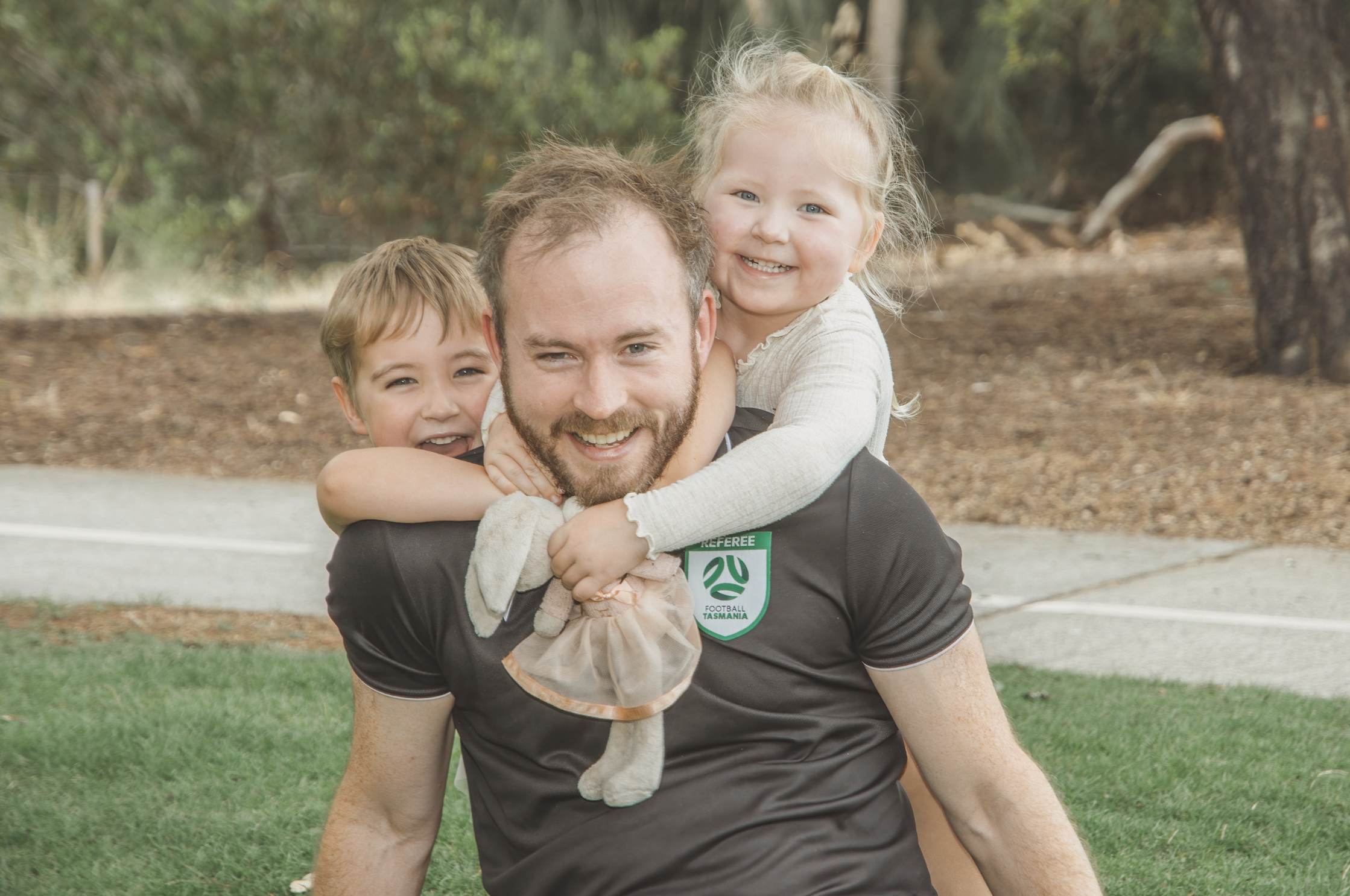
Brenton Kopra with his beautiful children - photographed by Nikki Long
There are people in football you think you know.
Players. Coaches. Presidents. The loud ones. The visible ones.
And then there are referees.
You see them every week. You have opinions about them, usually strong ones. But if we’re honest, most of us wouldn’t recognise them at the supermarket, wouldn’t know what they do for work, wouldn’t know anything about their lives away from the pitch.
Brenton Kopra is one of the most recognisable referees in Tasmanian football. Eight-time Referee of the Year, the last five back-to-back, a detail he quietly corrected when he sent his answers through.
And yet, like most referees, he’s largely unknown.
Growing up competitive, but quiet
Brenton grew up in South Hobart before moving up the hill to Ridgeway, a place he still describes as a little hidden away. His parents are still there.
He and his younger brother were heavily into sport, playing a wide range of games and spending hours at both houses in the backyard, football, both codes and cricket. Summers were often spent at the family shack on Bruny Island, where they would play cricket in the neighbour’s backyard for days on end.
They were competitive then, and still are now. A workplace strengths assessment years later simply confirmed it, his number one trait came out as “Competition”.
Away from sport, he was a quiet kid who did well at school. Despite that, he built strong friendships, many of which have lasted from primary school through to college. These days those friendships look a little different, less time at the pub, more time catching up at kids’ birthday parties.
The people who shaped him
He points first to his parents.
A lot of his personality traits and principles come from them. He and his brother both picked up their love of sport from their dad, who always focused more on enjoying the game than worrying about winning or losing, something he admits didn’t always stick at the time. From that upbringing came high standards, a willingness to take on challenges, and a strong sense of fairness.
In refereeing, his early influences came from those around him. He started a couple of years after Ivan Jozeljic and Adrian Lockley, and in his first seasons they would referee together at Northern Suburbs juniors at Weily Park. He looked up to both of them and learned a lot from them. Adrian’s refereeing career was cut short by injury, but he moved into coaching and still picks up things Brenton can work on when he watches his games. He also speaks about it being great to see Ivan back refereeing after taking time away.
He has always learned best by watching others, taking note of what they do well and applying it. As he progressed into assistant refereeing at senior level, he learned from the leading referees at the time, particularly Kim Barker and the way he managed players, while also taking aspects from Ivan, Craig Phillips and Sean Collins.
A decision that wasn’t meant to be big
Refereeing wasn’t a plan.
He started at 14 because a mate was doing the course, and he went along with him. It was also the first time he had worked to earn money.
The shift came a few years later. In his third season, he was selected to attend the boys youth national championships in Coffs Harbour. He found himself well behind many of the other referees at the tournament in terms of development, some of whom were refereeing in the A-League a season or two later. That experience stayed with him. It was probably the first time he started to take refereeing more seriously.
At 18, after finishing college, he took a gap year, working for six months to save before travelling to Europe for another six. In the half-season before he left, he made his debut as a referee in the Southern Premier League, which was the top level in Tasmania at the time, and managed eight or nine senior matches while still playing a level or two below.
While in England, he saw a number of Chelsea matches, including one against Manchester United at Old Trafford. Chelsea were well beaten, but what stayed with him was the atmosphere, close to 70,000 United supporters, loud and hostile to both the opposition and the referees.
It was there that the shift became clear. He realised there was no chance he would become a professional footballer, but that refereeing at that level might be possible.
When he returned home and started university, something had to give. A night job made it difficult to commit to training as a player, so he made the decision to focus solely on refereeing. He did return to playing a few years later, spending some seasons with Peninsula Pirates in the social leagues, and has continued to play futsal on and off with the same group of mates he has had since his teenage years.
Letting the game breathe
Having played the game shaped how he referees, but he is careful not to make it a simple answer. It helps in different ways depending on how long someone has played and at what level.
For him, it influenced his approach early. When he started refereeing, he tried to officiate in the way he would have wanted to be refereed as a player. He disliked referees who gave too many free kicks and interrupted the game unnecessarily, and that fed directly into his natural style of allowing the game to flow where possible.
He also recognises that players who come into refereeing after longer careers at higher levels often have an advantage early. They tend to read the game more quickly, move more naturally around the pitch, understand team tactics, and have a better feel for how to manage players.
The night it became real
His first real “this is serious” moment came a little later.
He had made his Southern Premier League debut in 2008, but that had come quickly, after only refereeing his first reserves match the week before due to a shortage of referees. After returning from Europe in 2009, he spent most of that season and the start of 2010 back in the reserves before working his way into regular senior appointments.
In the final round of the 2010 season, he was assigned Hobart Zebras against Olympia.
The stakes were clear. Olympia had one of the biggest supporter bases in the league but were battling relegation. The night before, Taroona had picked up a point, leaving Olympia needing at least a draw to stay up.
He remembers people wishing him luck in a way that suggested they were glad it wasn’t them in the middle. He also remembers seeing Olympia coach Chris Hey in the car park at KGV, visibly nervous, as they wished each other well.
The game itself was frantic. Played on a freezing night, at a relentless pace, players were going down with cramp from around the hour mark. Olympia led twice, Zebras pegged them back twice.
As Olympia supporters began calling for the final whistle, he looked at his watch and realised there were still eight or nine minutes to play because of stoppages. Using a traditional stopwatch at the time, he admits he didn’t really have a clear sense of how long had elapsed, only that there was still plenty left. He also remembers thinking that if Zebras scored a late winner, there might be a riot.
In the end, it finished 2–2. Olympia survived. Fans flooded the pitch and set off fireworks after the final whistle.
Looking back now, he sees things he would do better. But at the time, it gave him confidence that he could handle the pressure and expectation of senior football, and it remains one of his career highlights.
He also notes, quietly, that it is good to have promotion and relegation back in the NPL.
Pressure, instinct, and staying in the moment
Pressure is not something he feels he has had to learn.
Even at school, he was someone who thrived in exams, and in his working life colleagues often comment on how relaxed he seems when deadlines are tight or problems need solving.
His approach to refereeing follows a similar pattern. Preparation during the week is thorough, building an understanding of both teams, their tactics and potential flashpoints. But in the lead-up to a game, he deliberately switches off.
The night before and the morning of a match are about staying relaxed and arriving mentally fresh. He keeps that approach through the warm-up, only really switching on when giving final instructions to his refereeing team and walking out.
He believes that if you spend the whole morning thinking about the game, you can tire yourself out mentally before it even begins.
Once the match starts, it becomes rhythm. Movement, communication and decision making, often instinctive rather than overthought.
When it comes to big decisions, he leans on something he was told early in his development. A referee coach once said that he performs best when he does not overthink things, and that has shaped how he approaches decision making.
He describes himself as instinctive. In many situations, he sees something once and has an immediate sense of the correct decision.
Not every decision is that straightforward. Some fall into grey areas of interpretation, or occur when the referee is not perfectly positioned. In those moments, the approach becomes more methodical, working through the relevant laws and, importantly, using the input of the other officials.
The key, he says, is trusting that process and not second guessing yourself simply because the moment feels big.
For penalties, his focus is always on the defender. Attackers will try to sell contact, but the decision comes down to whether the defender’s actions were reasonable and whether an infringement has actually occurred.
For discipline, the challenge is different. After heavy tackles, players and crowds will often apply pressure, particularly at higher levels where teams actively try to get key opponents cautioned early. His instinct is to use cards as a last resort. The more frequently they are used, the less impact they have.
Instead, he is constantly asking himself whether there is another way to manage the situation.
To maintain concentration, particularly after big decisions, he relies on simple triggers, movement and voice. By focusing on those fundamentals, he is able to bring his attention back to what is happening in front of him, rather than dwelling on what has already happened. Without that reset, referees can easily compound mistakes by losing concentration and carrying one decision into the next.
The work no one sees
He believes one of the biggest misunderstandings about refereeing is how little of the job people actually see.
Most players and supporters remember only a couple of key moments in a match, a penalty, a red card, a decision that goes one way or the other. But the role extends well beyond those moments.
During the week there is physical training, online coaching sessions, match preparation and review.
Before a game, there are instructions to the officiating team, the warm-up, and a range of small but important tasks, checking match balls, pitches, team sheets and player equipment, all of which help ensure the game runs smoothly.
During the match itself, movement, communication with the other officials, and management of players are all happening constantly under the surface.
In his view, the best referees are the ones who do all of those things well, so that when the key moments arrive, they are in the best possible position to make the right decision.
Managing people, not just decisions
His approach to managing players is built on respect and trust.
He aims to be respectful in how he deals with players, with the expectation that respect is given in return. When that line is crossed, whether it is directed at him or at the game itself, he responds strongly.
For him, managing players is about being human. It is about building relationships, not just during the 90 minutes of a match, but before and after as well.
Having played the game himself, he understands what he describes as “white line fever”, the frustration and emotion that comes with wanting to win.
He believes modern players respond best to referees who show understanding, explain decisions, and use empathy where appropriate. Combined with consistency in decision making, that builds trust.
When players trust the referee, they are more willing to let him deal with situations when they feel wronged. Without that trust, they are more likely to take matters into their own hands.
There is also a practical reality in a league like Tasmania’s. You see the same teams regularly, so it is important to leave what happens on the pitch each week behind and move on.
Criticism, and not taking yourself too seriously
His approach to criticism is grounded in something simple.
He takes the job seriously, but not himself too seriously.
He describes himself as calm in stressful situations, and one of the things he consciously does during matches is remind himself to smile when things get intense. Sometimes a smile, a laugh, or even just a look can take the edge out of a situation.
He also enjoys it. The challenge, the difficult moments, and the fact that he has a front row seat to the game. At times, he says, it is important to remember that it is just a game and that he is out there to enjoy it.
He is realistic about the role. He knows he will never leave a game with two completely happy teams. If everyone agreed on every decision, there would be no need for a referee at all.
With experience, criticism becomes more predictable. At junior level, it might come out of nowhere. At NPL level, he says you can assume that most decisions will be questioned by someone.
The key is being able to shut that out and stay focused on what comes next, the next decision, and the one after.
When it goes wrong
Not every memory is a positive one.
He points to one match in the national NPL finals series, around 2014, as the worst game he can remember.
Pre-match, he had planned to referee in his natural style and let the game flow, but he admits he stuck to that approach too doggedly when the early signs suggested he needed to step in more strongly.
The game escalated. He never felt fully in control, with multiple melees across the 90 minutes.
He then compounded that by overthinking a relatively straightforward decision late in the match and getting it wrong. The one saving grace, he says, was that it did not affect the outcome.
It is one of the few times he has been genuinely disappointed with his performance in a big game.
What made it harder was that it was the final match of the season, leaving months to reflect on it.
The lessons from that game have stayed with him.
Read the signs early and referee the game in front of you, not the one you planned.
Trust your instinct, rather than overthinking decisions that do not need it.
They are points he still emphasises in his pre-match instructions to his assistant referees and fourth official today.
The games that test you
He sees two distinct types of difficult matches.
The first are the physical battles, where tackles keep flying in and the game takes on a life of its own. He talks about matches where cards stop working as a deterrent and the refereeing team can feel like passengers in a war between the teams.
One example that stands out is an early NPL match between Devonport and Olympia. A night game that escalated into a fight in the second half, with two red cards and around ten yellow cards. Those types of matches are less common now, something he attributes partly to changes in the game and partly to his own development as a player manager.
More often now, he finds the most difficult matches are not the most physical, but the ones with the highest stakes. Games at the top end of the table where the tension is constant.
In those matches, the challenge is different. There may be fewer heavy tackles, but there is a constant stream of verbals, players lobbying for decisions, pushing for opponents to be cautioned, and creating confrontations after almost every challenge.
They are the games where you come off the pitch feeling like you have been working the entire time, even if it might not look that way from the stands.
Staying grounded
He is not someone who tends to carry games with him after the final whistle.
He says his wife can rarely tell whether he has had an easy or difficult match.
Part of that comes down to having multiple outlets. Between family life, work, refereeing and running, there is always something else to focus on.
That does not mean the game is forgotten.
Like most referees, he reviews key incidents as soon as possible and, if the match was particularly busy, will often watch the full game back. If he wants a second opinion, he will send clips to Nathan, and there is also a group chat among NPL referees where videos are shared and discussed.
It is a process of understanding decisions, learning from them, and then moving on.
Moments that matter
One of the moments he is most proud of came recently.
Last year, he made his debut as referee in the national rounds of both the Australia Cup and the Australian Championship.
But for him, it was not just about the level. It was about who he shared it with. On both occasions, the entire officiating team was Tasmanian, something he believes is rare, if not the first time in a long time at that level.
Those matches were shared with Tom, Claire, Josh and Nathan, a group he says had spoken about the possibility beforehand and would love the opportunity to experience again.
The Australian Championship match carried another milestone. It was the first time both of his children had been in the crowd watching him referee, even if part of the occasion involved them sneaking off to the playground next door.
Finding the humour
He admits there have been plenty of moments over the years.
He does not take himself too seriously, and if something is genuinely funny, he is more than happy to laugh.
One example stands out. During a match, while opposition players were complaining about decisions, one player kept walking past him saying things like, “you can’t let them talk to you like that”, something that sounds supportive, but is often just an attempt to influence the referee.
Later in the game, that same player lost the ball and wanted a free kick. When it was not given, he grabbed his opponent, who broke free and started moving up the field. As Brenton followed play and called “advantage”, the player, still frustrated, ran alongside him yelling, “f**k you Kopra!!!”.
A few minutes later, once things had settled, they both laughed about it.
Another moment that stayed with him came from Beau Blizzard, who, late in a match at South Hobart with his team leading in stoppage time, walked past and sighed loudly, “I didn’t want to get drunk tonight”.
Still chasing something
What still drives him is simple.
The possibility that there is still something more.
He is still hopeful of refereeing in the A-League one day. As he puts it, the door feels slightly ajar, and he is doing everything he can to try and stick his foot in it.
He is realistic. He knows he is not getting any younger, but believes that if he can stay fit, healthy and keep improving, there is no reason he cannot continue to develop well into his 40s.
There have been some opportunities in recent years, and he feels the current direction of refereeing in Australia suits his natural style. He was pleased with his performances when given the chance and is focused on closing the remaining gaps so that if another opportunity comes, he is ready to take it.
He also understands the pathway. A decade ago, after time in the national referee talent programs, he reached the point where those who had not progressed were sent back to their member federations to continue developing and prove they were ready to step up.
From Tasmania, that is not easy. The level of football is different, and the gap to the A-League is significant. Many referees step away at that point.
He made a different decision. To keep going, as long as he still enjoyed it, and to keep challenging himself to improve.
But the reality around him has changed.
His children are getting older. Weekend sport is coming. Travel demands have increased, with more northern teams and a largely southern-based referee panel.
The season itself is long, stretching from NPL friendlies in January through to national competitions in November or December, before it begins again.
For now, that balance is manageable, because the goal is still there.
But he is clear.
If that door closes, it is something he will have to reassess.
Why he still walks out
Away from football, life is centred around family.
He speaks about how much he enjoys fatherhood and the time they spend together, and describes his wife Ella as his best friend, someone he has always shared most of his interests with.
Sport is not always one of them, although there is one exception. After taking her to a Tasmania JackJumpers game in their first season, they are now regulars, and he jokes that she is more invested than he is.
Running has also become a big part of his life. What started as a way to stay fit for refereeing has grown into something more, with events like the Gone Nuts 100km in Stanley, the Cradle Mountain Run, Bruny Ultra and the Kunanyi Mountain Run becoming regular challenges in recent years.
But it is still football that draws him back.
Not just the big games, but the variety and unpredictability of it all.
In Tasmania, he says, referees are lucky to work across a wide range of teams and venues, often in some of the most picturesque settings in the country. And no two weeks ever feel quite the same.
One week might be a Southern Championship match at Warrior Park, a freezing night, a handful of spectators, and one of the best goals he has seen in a seven-goal game.
A few days later, it might be the biggest match of his career in front of 2,000 people in the Australia Cup.
Or a night at Clare Street in driving rain, struggling to stay on his feet and handing spare tops to a young assistant referee at half time to keep them warm.
Or a trip to Launceston, combining a match with a day out with family and catching up with people like Ross Logan.
It is that mix, the challenge, the unpredictability, and the people, that keeps him coming back.
Not just for the biggest games, but for everything in between.
The people we don’t see
We spend a lot of time in football talking about players and coaches.
We don’t spend much time talking about referees like this.
Not as people.
Not as parents, workers, competitors, and individuals trying to balance ambition with life.
Brenton Kopra has spent years in the middle of the game, often only noticed when something goes wrong.
A quiet kid from South Hobart who followed a mate into refereeing and never really left.
Still competitive. Still improving. Still chasing something just out of reach.
And still, every weekend, walking onto a pitch with a whistle in his hand, exactly where he wants to be.
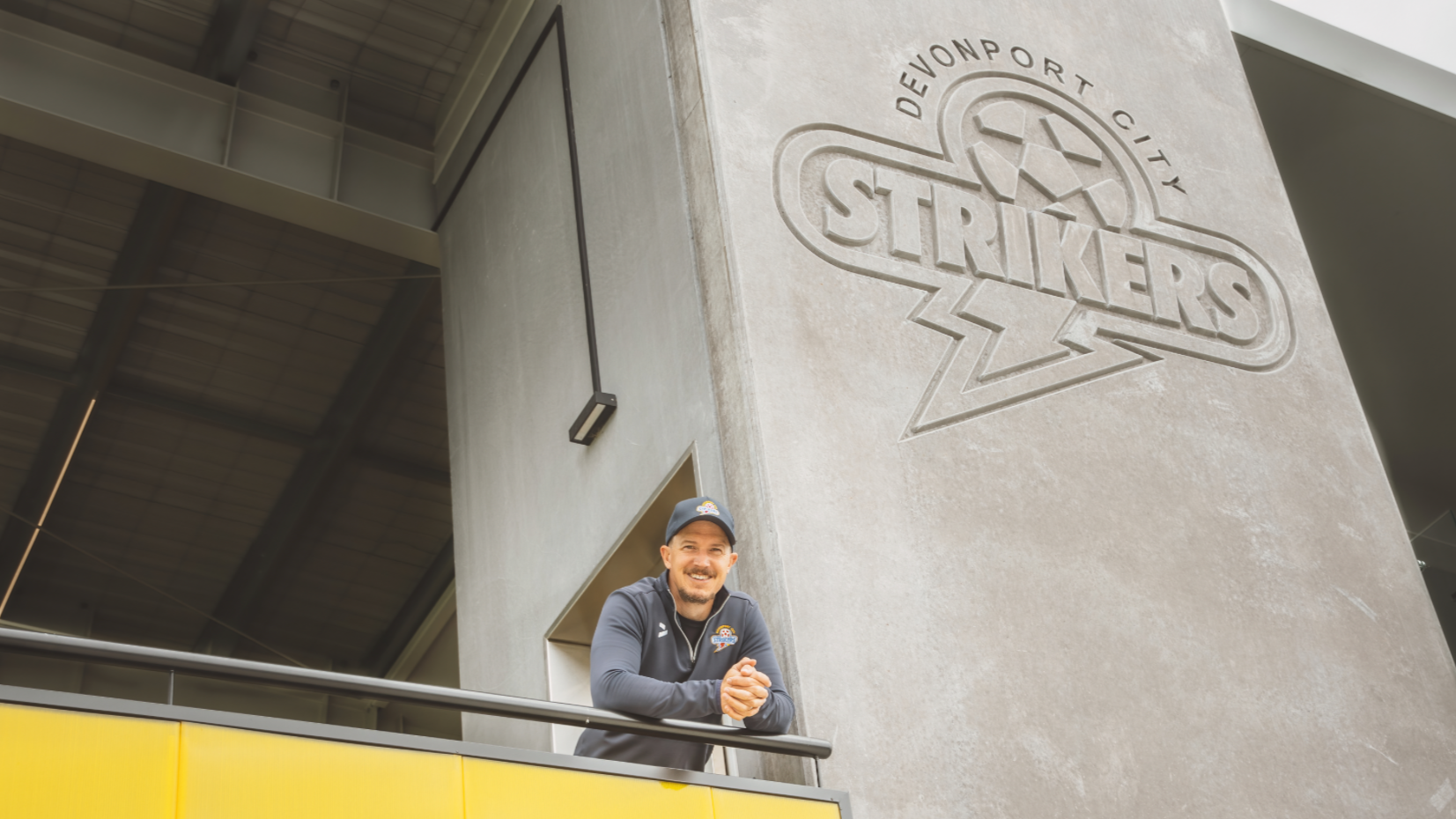
Tom Ballantyne, The Work Behind the Sideline
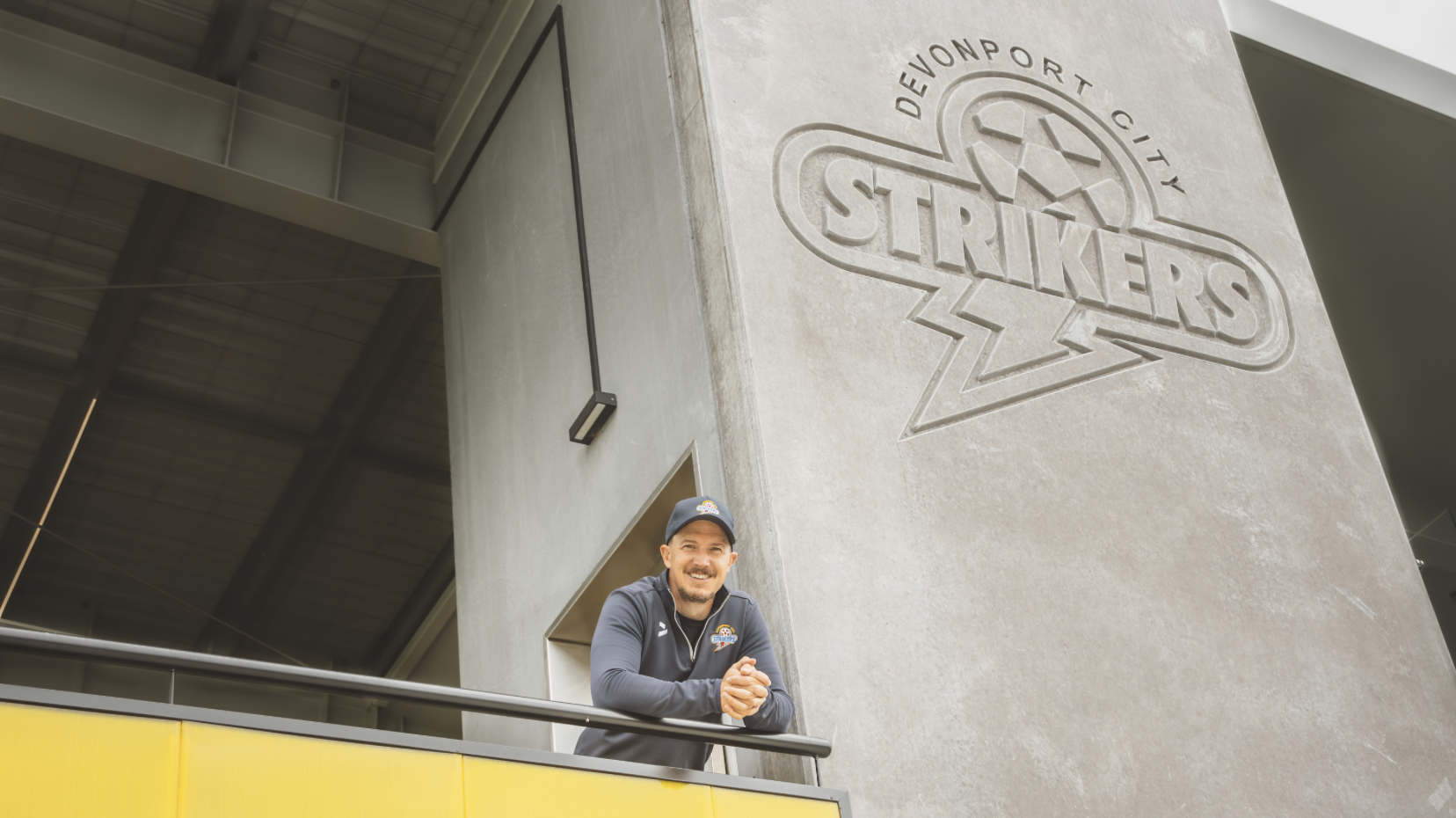
Tom Ballantyne photographed by Nikki Long
Tom Ballantyne is not a coach who spends much time explaining himself.
He is intense on the sideline. He is direct. He is, by his own admission, deeply private. And in a football community that often forms quick opinions, he is a figure who can divide them.
From the sideline, he has always seemed tough, driven, something of an enigma.
Results at Devonport under Ballantyne have been consistently strong, including a dominant title-winning first season and sustained success across both the men’s and women’s programs.
But beyond the touchline, and beyond the noise, there is a different picture. One shaped by family, by an almost complete immersion in the game, and by a simple, uncompromising view of the job.
Winning matters. Standards matter. And what happens inside the group matters far more than what is said outside it.
In his own words, this is how he sees it.
Who is Tom Ballantyne away from football?
In the very short time that I am away from football, I try and spend all of it with my family.
I am a deeply private person, which is why my answers will most likely be short and concise.
Family, pressure and perspective
Yes, I am a husband and dad, but football is football and family is family.
Any head coach will tell you that it is a seven-day-a-week role, with coaching, relationships, conversations, reviewing games, planning, and everything in between. Double that with NPL and WSL, plus my role with Melbourne Victory, and it gets hectic.
Family life can help with the pressures of everything. I come home to two young children, one of which has zero care about whether the teams have won or lost that day, just that dad’s home.
Switching off
Short answer, no.
It’s laughable, but watching other football.
Early influences
My parents and family. They both worked very hard.
I was fortunate to travel and have some incredible experiences when I was young.
Why coaching
I’ve been obsessed with football for as long as I can remember. My mother has always told me that as soon as I could walk, I was kicking a football.
When I played growing up, I was always interested in the ‘why’ with regards to sessions and tactics and was always questioning my coaches from an early age.
I spent time as a volunteer coaching and through that met some amazing people who kept challenging me to do more and encouraging me to take any opportunities that came my way.
There was a period of around four years in the UK where I said yes to every opportunity. By the end of that period, I was pretty much full-time. I guess that’s when it hit that I could do something I genuinely love as a job.
Coaching philosophy
My job is to win games. Let’s face it, if I stopped winning games altogether, I wouldn’t have a job.
But beyond winning, it’s about trying to help players become the best they can be, as well as develop and grow as people.
Through the game, I’ve not deliberately set out to make friends, but I’ve ended up with a trail of people at previous clubs that I remain in contact with. They reach out to me for advice 14 years on, and at least five of my previous players are now coaching themselves.
Sideline intensity
Winning the game is going through my head. I’m not really thinking about what other people are thinking of me.
All coaches are intense in their own ways and all trying to battle and help their team in the moment. We are all trying to get a result, protect our players and manage the situation. Our intensity just comes across in different ways.
How players see him
I didn’t know how to answer this question, so I reached out to a former player who is now coaching himself.
“Away from match day emotion, I think the boys would describe him as professional, organised and extremely knowledgeable about the game.
He’s technically very strong and his preparation is always spot on. Every session had purpose, every game plan was clear, and he communicates it in a way that makes sense, so as players you always feel like you’re going into games prepared.
What I respected most was the balance struck. We worked closely together and had a strong relationship, but there was always a clear boundary between friendship and professionalism. When it came to football, standards were standards. He demanded a lot, but he was fair and consistent, and you always knew where you stood.
I think the group would say he backs his players, empowers his leaders, and creates an environment built on accountability and respect. He cares about winning, but he also cares about developing players and building a strong culture.”
To be honest, this wasn’t the response I was expecting from this individual, as we had numerous quite heated discussions over the years.
Standards and growth
As a coach, I have a few non-negotiables. They are respect, hard work and attitude.
If anything, over the years my belief in those has only become stronger. The teams that have been successful have all had those traits.
Intensity and pressure
It comes from my desire to win, plain and simple.
Coaching men and women
I don’t think many people realise, but I’ve coached women’s football on and off since 2009, more often than not in conjunction with a men’s team.
There’s a quote I saw many years ago by Mia Hamm, that women athletes should be coached like men but treated like women. This is how I’ve worked with the teams ever since.
Just like the men, the women are there to play football and to win. The coaching of the football is the same across both leagues. The difference is in the communication and language used.
Difficult conversations
No, my approach hasn’t really changed.
I remember when I first coached a senior team and had to drop a player that was older than me. It was a hard conversation, but they need to be had.
Some would say ‘tough love’, but wherever possible I’ve always tried to provide honest feedback, even if it’s not received well at the time.
The environment he describes is one built on standards and consistency. At Devonport, that has translated into sustained success.
Devonport Strikers
Relentless drive to improve on and off the field.
Advice to young coaches
Coaching courses don’t teach you about the sacrifices, loneliness and pressure that you have to face. They don’t teach you about people management.
Being a head coach is 80% HR and 20% X’s and O’s.
I would encourage young coaches to watch as many sessions as they can, listen to how coaches coach, read and listen to podcasts from people in different fields that might have crossover.
I have just finished a book by Brené Brown and have now started one by Will Storr on The Science of Storytelling.
Steal ideas, make them your own, and be brave enough to experiment.
What people might not see
To be honest, I’m not worried about what other teams and opposition players think.
Inside the walls of the “Portress”, the players know the real me.
Closing
His answers do not try to soften that picture.
They are short. Direct. At times, deliberately guarded. But they are also consistent.
A coach driven by winning. Grounded, in his own way, by family. And largely uninterested in how he is perceived beyond the players and staff he works with every day.
Perhaps that is why he can seem difficult to read from the outside.
Or perhaps the answers say exactly what they need to.
Eight Bloody One: The Monty Python Story Behind Barnstoneworth United
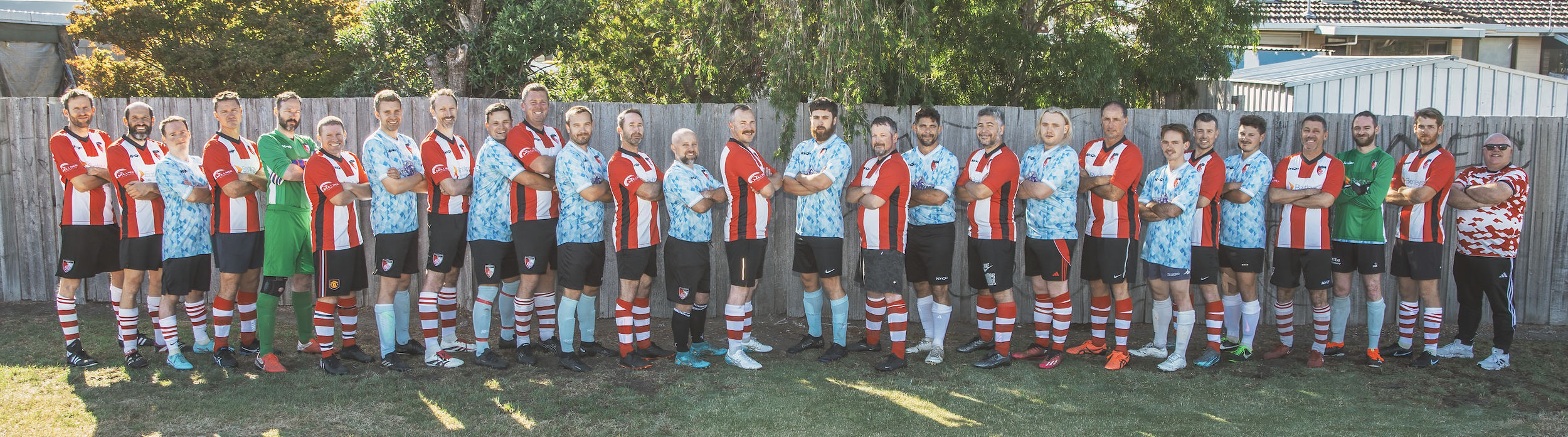
Photo credit: Nikki Long
A Hobart football club built on mateship, social football and the magic of the Lakoseljac Cup.
Some football clubs begin with big ambitions.
Others begin with a joke that refuses to disappear.
Barnstoneworth United belongs firmly in the second category.
In Hobart football circles the name alone often stops people in their tracks. Opponents regularly ask the same question.
Where on earth did that name come from?
The answer, like many good football stories, involves a group of mates, a British comedy sketch and a club that never took itself too seriously.
Thirty years later it is still going strong.
And on a Friday night in the Lakoseljac Cup the small social club from Wentworth Park produced one of the most memorable results in its history.
But to understand Barnstoneworth United, you have to start with Monty Python.
Golden Gordon and the birth of Barnstoneworth
The origins of Barnstoneworth United do not lie in Tasmania at all.
They begin with a British comedy series called Ripping Yarns, written by Michael Palin and Terry Jones of Monty Python fame, which ran from 1976 to 1979.
One episode, Golden Gordon, featured a fictional football club from Huddersfield in 1935.
Barnstoneworth United had once played in the top league but had fallen spectacularly, losing every game in the bottom division.
Their biggest supporter was Gordon Ottershaw, played by Michael Palin.
After every defeat he would return home furious and smash the furniture in frustration, much to the despair of his long suffering wife and son.
After one particularly brutal defeat Gordon delivers the unforgettable line.
“Eight bloody one! And even that were an own goal!”
Eventually the club is set to be sold off to a scrap dealer and the upcoming match against Denley Moor is meant to be the club’s final game.
In desperation Gordon tracks down the legendary players from the 1922 team.
As the match approaches kick off there are only four players available and just three pairs of shorts between them.
Then, in true football fairy tale fashion, the old legends arrive just in time and Barnstoneworth United turn back the clock and win.
The inspiration for the story came from Huddersfield Town’s decline in the 1970s when Ripping Yarns was being filmed.
For Chris Scholefield, one of Barnstoneworth Hobart’s long time custodians, the connection goes even further.
One of his prized possessions is an old Barnstoneworth playing shirt signed by Sir Michael Palin himself during a visit to Hobart.
Palin left a message that captures the spirit of the club perfectly.
“Remember the score, 8 bloody 1! It’s not the shorts that matter, it’s what’s in them that counts! All the best, Gordon Ottershaw.”
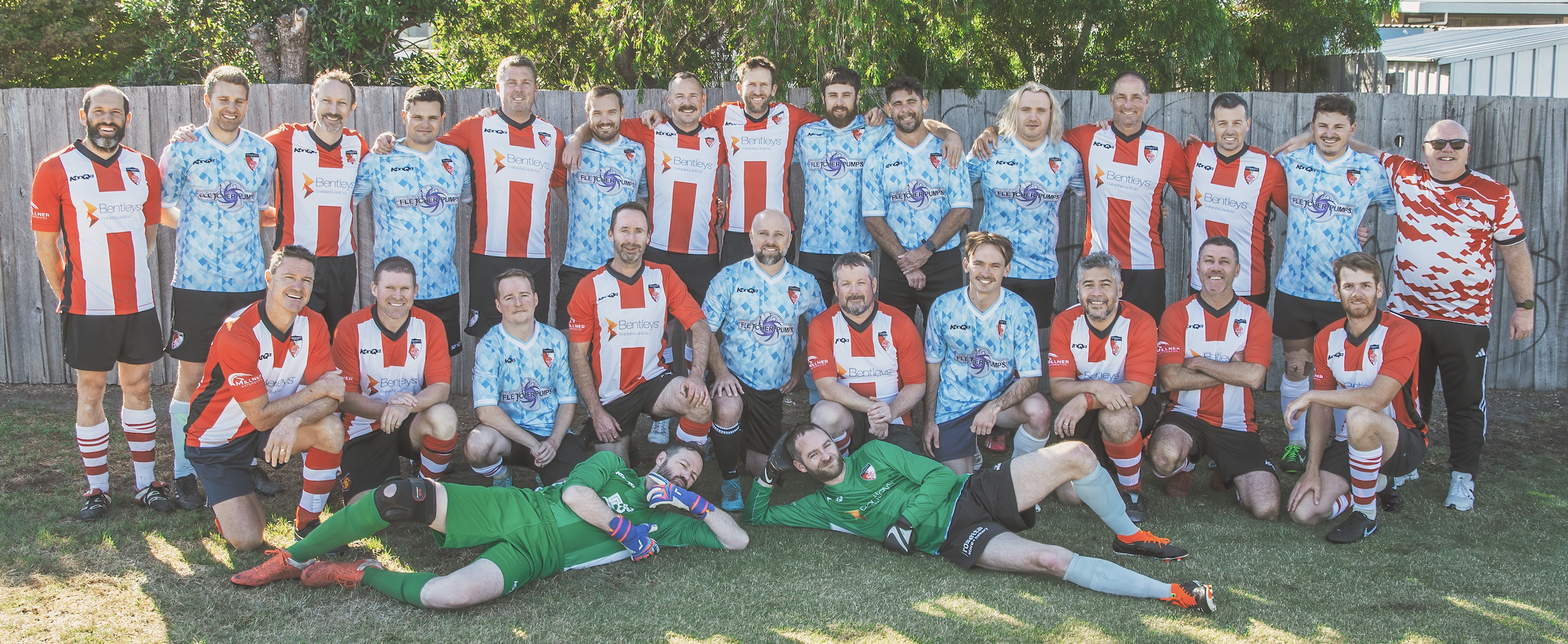
Photo credit: Nikki Long
From mates and beers to a football club
Barnstoneworth United began in Hobart around thirty years ago.
The driving force behind the club was the legendary Chris Hindmarch, known to most simply as Hiney.
Hindmarch had come to Tasmania from Wolverhampton and played for Caledonians for many years through the 1970s and 80s.
Eventually he and a group of football mates decided to start something of their own.
The founding group included Greg McGuire, George Kalis, Phil Boulter, Simon Hansen, Tim Morris and Brent Kenna.
Many of the original players had come through clubs such as Phoenix Rovers, Clarence United and Caledonians, bringing together a group of footballers who had been around Hobart football for years.
Wentworth Park quickly became the club’s spiritual home.
From the very beginning the idea was simple.
A group of good mates who wanted a kick and a few beers after the game.
That philosophy has never really changed.
Football without the win at all cost mentality
Barnstoneworth United does not pretend to be something it isn’t.
There is no win at all cost mentality.
The club’s ethos revolves around something much simpler.
Acceptance. Mateship. A love of football.
“We wish for all of our teams to be successful,” Chris explains.
“But football is just a game. It is never about the W and L count. Barney is about enjoying the game and developing treasured friendships and memories.”
Training, it should be said, is optional.
The club usually runs a pre season but once the season begins players largely keep themselves fit in their own way.
Part of the club’s philosophy is simple.
Stay in our lane.
Barnstoneworth has always preferred steady survival over grand ambition and over three decades it has quietly outlasted many bigger clubs that have come and gone.
A strange mix of quality and chaos
For a club built around mates and beers, Barnstoneworth has attracted some very serious footballers over the years.
Several players have NPL and Championship experience.
Chris casually mentions names that will be familiar to Tasmanian football followers.
Hugh Ludford.
Matty Lewis.
Chris Hunt.
Along with players from Clarence Zebras such as Sam Hills and Jeremy Price.
Others have arrived from interstate, overseas or simply through friendship connections.
Sometimes a player just turns up and asks if they can join.
They are always welcomed.
To maintain the balance between experienced players and those simply looking for a game, the club introduced a third team in recent years.
The introduction of a third team ensured players of all levels could still enjoy meaningful time on the pitch.
Success, songs and social football
Despite its relaxed approach, Barnstoneworth has enjoyed considerable success in the Social Leagues, particularly over the past six years.
But results have never been the real point.
Winning is nice of course.
Mostly because it means the players get to belt out the club song afterwards.
With enthusiasm.
The magic of the Cup
Entering the Lakoseljac Cup as a Social League club tends to provoke a particular reaction.
Somewhere between amusement and bewilderment.
But Barnstoneworth never entered the competition as a novelty.
Chris and the players have always taken it seriously.
They wanted to test themselves against the best teams in the state.
At first they knew the likely outcome.
One match. Perhaps a trip north. Maybe a clash with an NPL team.
But slowly something began to change.
With each appearance the team gained experience.
A game plan developed.
The squad found the right balance between youth and experience.
Belief began to grow.
Ironically it was a 3–0 loss to eventual cup winners South Hobart last year that convinced the players they were closer than many realised.
They had the right ingredients.
All they needed was the right night.
A night to remember
That night arrived on a Friday night in the Lakoseljac Cup.
From the opening whistle Barnstoneworth refused to be intimidated.
They pressed hard, chased every ball and gave their Championship opponent no time to settle.
Suddenly they were two goals ahead.
Even when Hobart fought back to level the game at 2–2 there was no panic.
The players simply kept attacking.
When Barnstoneworth scored again and then added a fourth, belief swept through the team.
This might actually happen.
The most remarkable detail?
The cup squad had not trained together once before the match.
Yet the players produced ninety minutes of disciplined, relentless football.
By the ninety fifth minute Chris admits he was screaming silently for the referee to blow the whistle.
When it finally came, the moment felt enormous.
One of the finest victories in the club’s history.
The characters of Barney
Like all good football clubs, Barnstoneworth runs on personalities.
On that Friday night skipper Matt Hope was the heartbeat of the team.
A passionate leader who wears his heart on his sleeve and inspires teammates to run through the proverbial brick wall.
He is also capable of delivering rousing team talks that combine tactics, humour and intensity.
Yianni Anagnostis brings a different kind of energy.
A confident player and a true larrikin whose positivity lifts the dressing room.
But Chris insists the strength of the club goes deeper than individuals.
Across all three squads the players genuinely enjoy each other’s company.
Everyone contributes.
Everyone belongs.
SchoBall
Chris describes his coaching role with typical understatement.
He does not try to teach experienced players how to “suck eggs”.
Instead he focuses on tactics.
Developing a game plan.
Selecting the players who might suit a particular opponent.
Sometimes trusting a gut feeling.
From the sideline he is vocal and relentlessly positive.
But like most grassroots football volunteers he also does everything else.
Kit man.
Ground set up.
The first person there putting up the nets so the players can simply arrive and play.
The team’s playing style has earned a nickname from some of the cheekier players.
“SchoBall.”
Possession based football, played to feet, with quick movement and an attacking mindset.
When you have players of quality, Chris says, you might as well let them play.
A Hobart football family
Barnstoneworth clubs now exist in Melbourne and Orange as well.
But the Hobart version remains proudly local.
Chris describes it as part of a small group of niche clubs within Tasmanian football.
Clubs that exist primarily for the community they represent.
Except in this case the community is a collection of mates and families that has grown over time.
Some of the younger players now pulling on the shirt are the sons of men who started the club.
Football, as it so often does, runs through generations.
The fly in the ointment
For Championship clubs the Lakoseljac Cup offers a chance to test themselves against NPL opposition.
For Barnstoneworth the motivation is slightly different.
They see themselves as the fly in the ointment.
A small social club running on the sniff of an oily rag and a collectively big heart.
But on the right day they believe they can light things up and compete with anyone.
That is the magic of the Cup.
The underdog always has a chance.
A future built on steady steps
Thirty years after it began, Barnstoneworth United is still growing.
The club now fields three teams.
Young players are emerging under the leadership of Matt Hope.
There are dreams of one day starting a women’s social team as well.
Growth, however, is always measured.
The club has never wanted to expand too quickly and lose the culture that makes it special.
Chris admits he sometimes imagines a Wrexham style story.
Although he doubts Ryan Reynolds will be investing in Barnstoneworth any time soon.
Still, he has his own dream.
If he ever wins Powerball, he has promised his wife he might indulge in a little twisted philanthropy.
Building Barnstoneworth its own ground and clubrooms.
Just part of the furniture
Chris Scholefield himself has become part of the club’s fabric.
He has played more than 400 games for Barnstoneworth.
Before that he began his football at South Hobart in 1986 before moving to University in 1990.
After several years overseas he returned to Tasmania and joined Barnstoneworth in 2000 alongside a group of former teammates.
Around 2006 the older generation of the club made a decision.
Chris, they concluded, would be the least likely person to say no to running the club.
He has been president ever since.
“Barney is part of my DNA,” he says.
“I couldn’t imagine life without this brilliant club and the people who make it what it is.”
Monty Python and the Life of Barnstoneworth
When asked what a Monty Python film about the club might be called, Chris does not hesitate.
“Monty Python and the Life of Barnstoneworth.”
Or perhaps.
“Barnstoneworth United and the Holy Goal.”
And if the story continues the way it has so far, a sequel might be inevitable.
“The Knights Who Say Knee Injury.”
Which, if you think about it, might be the most accurate football title of them all.

Gediminas “Gedi” Krusa – From Lithuania to Launceston
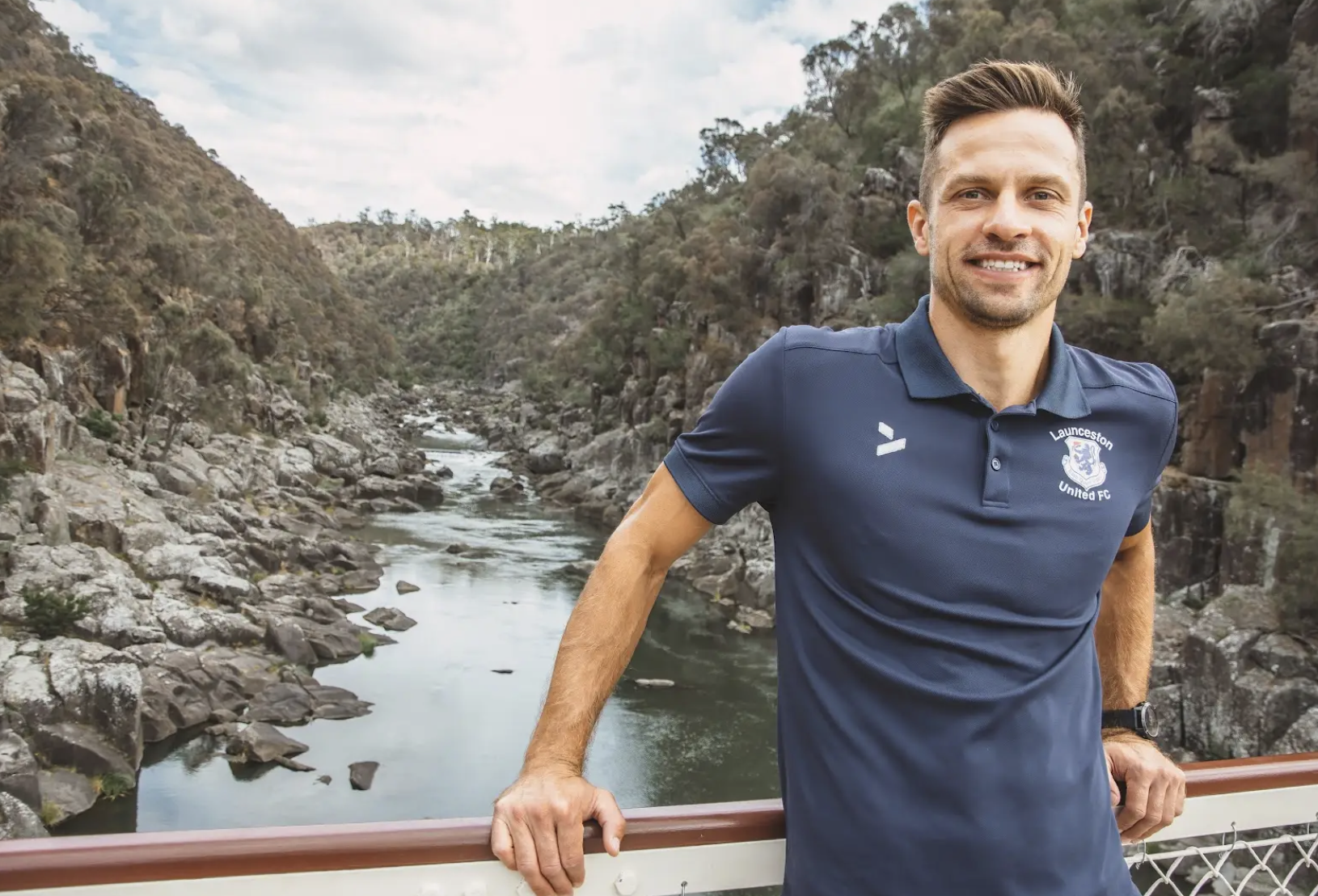
Gedi photographed by Nikki Long
Tasmanian football has a habit of collecting stories from around the world.
Gediminas “Gedi” Krusa arrived from Lithuania eight years ago expecting a short adventure. Instead he found a home, a family and a place in the game in northern Tasmania.
After playing across several clubs in the state, Krusa now leads Launceston United in the NPL while still balancing life as both a player and a coach.
His journey has taken him from European professional football to Tasmania’s north, where his first training sessions were at Valley Road in Devonport, and now into coaching in Launceston.
A childhood built around football
Like many footballers, his relationship with the game started early.
“I started playing in kindergarten when I was four years old and since then the only sport I trained for was football,” he says.
“My mum tried to push me into dancing once when I was in Grade 1 at school. I remember there were tears involved because the only thing I wanted to do was play football.”
That early obsession eventually became a professional career in Europe before a twist of circumstance brought him to Tasmania.
An unexpected journey to Tasmania
“There was a moment in my professional career when I was around 26 or 27 when I was coming back from a bad injury and looking at my options. I realised that at that age my career probably wouldn’t go any further up, so I started thinking about what I would like to do after football.”
He enrolled at university while still playing and began planning for life beyond the pitch. Then an unexpected conversation changed the direction of his life.
“One of my best friends who was also a player mentioned that he was thinking about going to Australia to see the other side of the world and still play football.”
“The funny thing is he never ended up coming. But a couple of months later I was already training at Valley Road, Devonport.”
Eight years later Tasmania is firmly home.
“I can call Tasmania my home away from home and I am very grateful to have two beautiful daughters and my partner here with me.”
Adapting to Tasmanian football
Krusa has since played for several clubs in the north of the state, experiences he says shaped both his understanding of the game and how football operates in a community setting.
“In total I played for four Tasmanian clubs, three of them in Launceston,” he explains.
“That experience helped me adapt to a very different playing style. Football here is much more direct and transitional, with less emphasis on tactics compared to Europe.”
But the biggest adjustment was cultural rather than tactical.
“From a coach’s point of view it gave me a very good understanding of how clubs operate at this level. When you are working in a community club you need to manage players and people very differently than you would in a professional setup.”
From player to coach
The move from player to coach came gradually rather than through a single decision.
“I think it happened naturally. When you reach a certain age in your career you start to see the game differently and realise you have knowledge to give.”
Krusa admits the transition has brought its own challenges, particularly as he continues to play while coaching.
“During games my brain sometimes operates too much like a coach, thinking about positions and structure, instead of focusing purely on my role as a player.”
He also spends much of his time working with younger players through academy coaching.
“Planning sessions and coaching youth players and senior players on the same day is very different.”
Life away from football
Away from football, life is centred firmly around family.
“Probably half of my time is taken by my two beautiful daughters. They definitely keep me on my toes.”
Living in Launceston means beach trips require some planning, but weekends often involve exploring northern Tasmania.
“I love nature, so we spend a lot of time in parks, wineries and the bush.”
Another passion is tennis.
“I try to get to the Australian Open in Melbourne each year.”
Football is a simple game
As both a midfielder and now a coach, Krusa believes football’s complexity is often misunderstood.
“I always remind players that football is a very simple game,” he says.
“When I was a teenager I loved having many touches, doing skills and playing beautifully. But with experience and different coaches I realised the difference is made by the basic elements of the game.”
“If we do the basics well, and do them quickly, the difference in quality will come very soon.”
A European perspective on Tasmanian football
Having experienced both European and Tasmanian football environments, Krusa speaks candidly about the challenges facing the game locally.
“Coming from a professional setup, unfortunately almost everything in Tasmanian football is still behind,” he says.
“The infrastructure is one of the biggest issues. NPL matches are often the second or third game scheduled on the day, which means the pitch is rarely in the condition it should be for top football.”
“We still need improvement in many areas to reach even mainland Australian standards, let alone European levels.”
But he is also quick to recognise the strengths of the Tasmanian football community.
“I love the involvement of females in the game here. The participation numbers are fantastic.”
“And I value the work of volunteers enormously, because without them Tasmanian football simply wouldn’t survive.”
Building a team at Launceston United
As a coach, Krusa places emphasis on discipline, chemistry and understanding the players in front of you.
“Football philosophy always depends on the players you have, their qualities, their style and their characteristics.”
“The best coach is the one who gets the most out of every individual player so that the whole picture works together.”
That philosophy now underpins his work at Launceston United, where he holds the dual role of NPL head coach and technical director.
“Before joining United I didn’t know what to expect, or how people would welcome me because I didn’t know many people at the club,” he says.
“But everyone has been incredibly welcoming, which makes it much easier to set and work towards goals.”
His first focus has been raising the physical standards of the team.
“To compete with the top clubs we needed to become stronger physically. That is the foundation of any team.”
From there the aim is to build a side that is aggressive without the ball and creative with it.
“We will go into every game to compete for points, not simply to avoid being beaten heavily.”
Developing Tasmanian players
Krusa remains passionate about youth development, although he believes geography remains a major challenge for Tasmanian players.
“There are many talented young players in Tasmania, but a combination of factors makes it difficult for them to reach higher levels.”
One piece of advice he gives regularly is confronting but realistic.
“I often recommend that talented players leave Tasmania early, ideally between 14 and 16 years old.”
“The longer they stay, the harder it becomes to bridge the gap with stronger competitions.”
He believes the state also needs stronger support structures for coaches.
“Support, education, mentoring and pathways are all important,” he says.
“If coaching could provide a meaningful income, competition between coaches would increase and that would raise standards.”
Lessons from the coaches who shaped him
Mentors have played an important role in his own development.
“I’ve worked with many excellent coaches during my career,” he says.
“One of my teenage coaches didn’t allow me to take more than one touch in training because I always wanted to do too much. That helped me enormously later in my career.”
Despite the intensity of football, Krusa says perspective remains important.
“My family helps me step away from football when I need to.”
Looking ahead
Looking to the future, he admits the path is not entirely mapped out.
“I’m not sure whether I want to chase a professional coaching career,” he says.
“I live a great life in Tasmania, and that would probably mean leaving the state.”
For now his ambition is clear.
“If I am given enough time I want to see Launceston United become one of the top teams not only in Launceston but in the whole state.”
A simple hope
And when it comes to legacy, the answer is simple.
“I would love if people said that Gedi is a nice and genuine person.”

Jan Stewart, Kingborough Lions Football Club

Jan Stewart photographed by Nikki Long
Football Faces Tasmania, recorded 2022
Why Jan matters
I used to see Jan most weekends at football.
She is one of those people who just makes you feel good. Always friendly. Always caring. The kind of person you naturally drift toward because her energy is calm, warm and genuine.
Football clubs run on people like that.
I do not think Jan is coaching at the moment, which honestly makes me a little sad. Because she is one of the kindest people I think I have known in football and that kindness is not softness, it is strength. The girls who come through coaches like Jan learn more than football, they learn belief.
Jan Stewart is one of those people who makes football feel safe.
Not safe in a soft way. Safe in the way that makes you try again. Safe enough to be new. Safe enough to be awkward. Safe enough to learn in public. Safe enough to be brave.
Football is damn lucky to have her and so are the girls coming through who do not yet know what they are capable of.
This is a Football Faces Tasmania story from 2022. Jan wrote it herself, straight from the heart. I am publishing it now so it has a permanent home.
Jan’s story, in her words
Some years ago now, I came into the game as a football mum.
My son was 7 at the time. My 10 year old daughter was watching his training session from the sidelines and said, “Mum, can I play?”
I laughed warmly.
“Girls do not play football,” I responded.
Two weeks later she was registered in a mixed team, and now at 24 she is still playing, when it stops raining in Northern NSW.
When our youngest daughters decided at 6 to play, I became a coach, and a learner player.
I was not ever very skilled in my football playing journey.
However, I did learn enough to grow my skill as a coach, and also a great love for the game.
Fifteen years later, and many, many hours on the football park coaching and playing, I finally feel like I am beginning to understand. Growing also is my confidence.
For me, this is what I want to be able to instill and grow in our youth girls.
With confidence comes strength, which empowers the players with the belief that they can achieve anything they set their mind to. It helps them find their way for their confidence and strength to shine.
It begins with them mastering the simplest of skills, such as passing.
Accurately.
Not every player knows their ability.
Not every player has a support base behind them.
Not every player knows what a football pathway is.
Not every player has good mental health.
To be someone in their lives that offers positivity and belief, and shows them what they can achieve through playing football, is so rewarding, and a great privilege.
Be brave.
Be confident.
Be strong.
This is what I wish for our youth players, and I believe that you can be powerful young female footballers.
These skills will carry you through life.
Jan Stewart
Football Faces Tasmania
Football Faces Tasmania was created to celebrate the people who shape Tasmanian football.
You know most of them. You see them at games, in the canteen, at the gate, organising the club, buying the equipment, coaching the team, managing the team, keeping the lights on, literally and figuratively.
Whatever their role, they volunteer for the benefit of many and their contribution should not be forgotten.
The questions are asked by Victoria Morton. Photos are by Nikki Long.
If you know someone whose football story should be remembered and celebrated, please tell me.
James Sherman: Coming Home With New Eyes
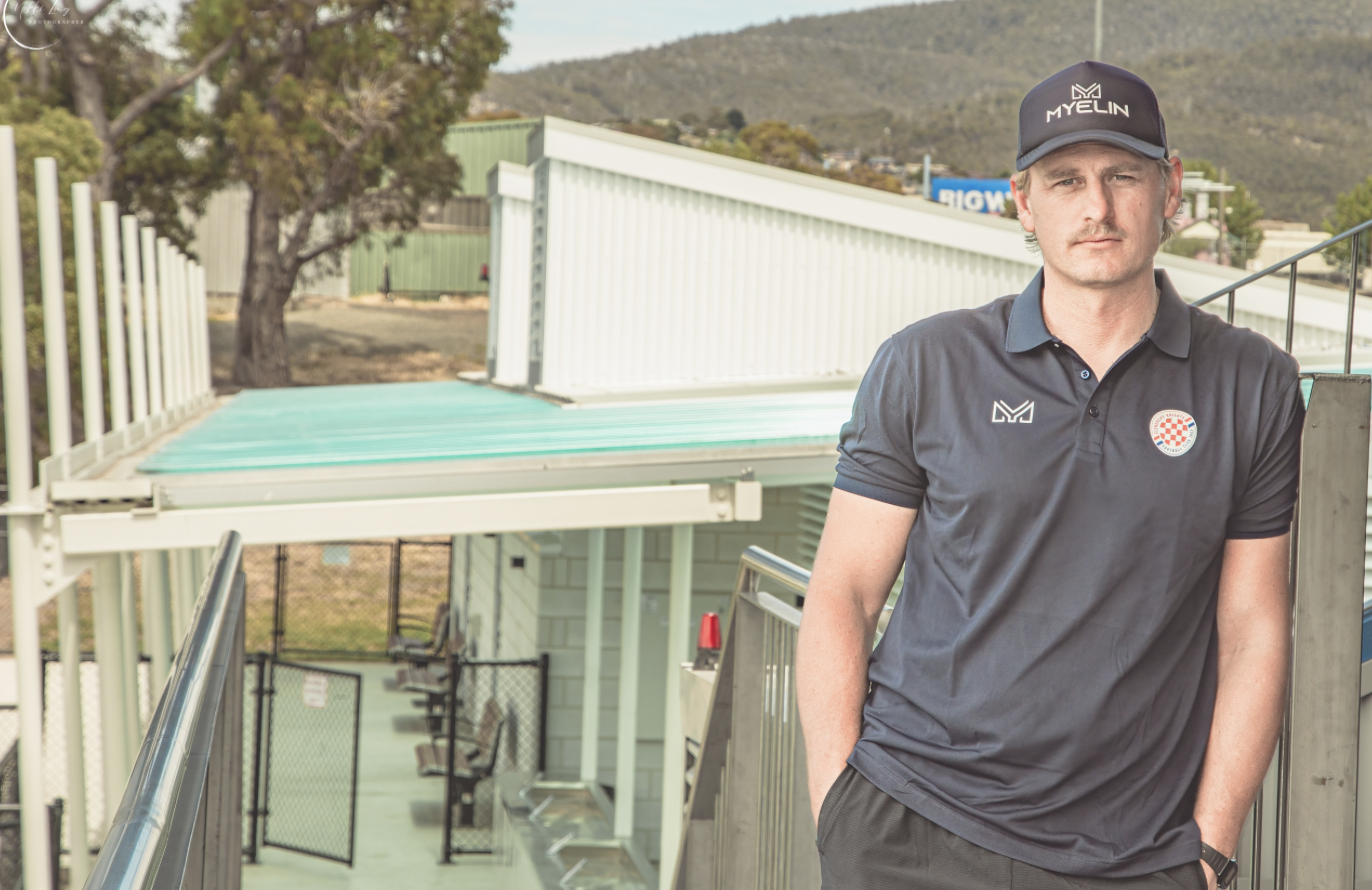
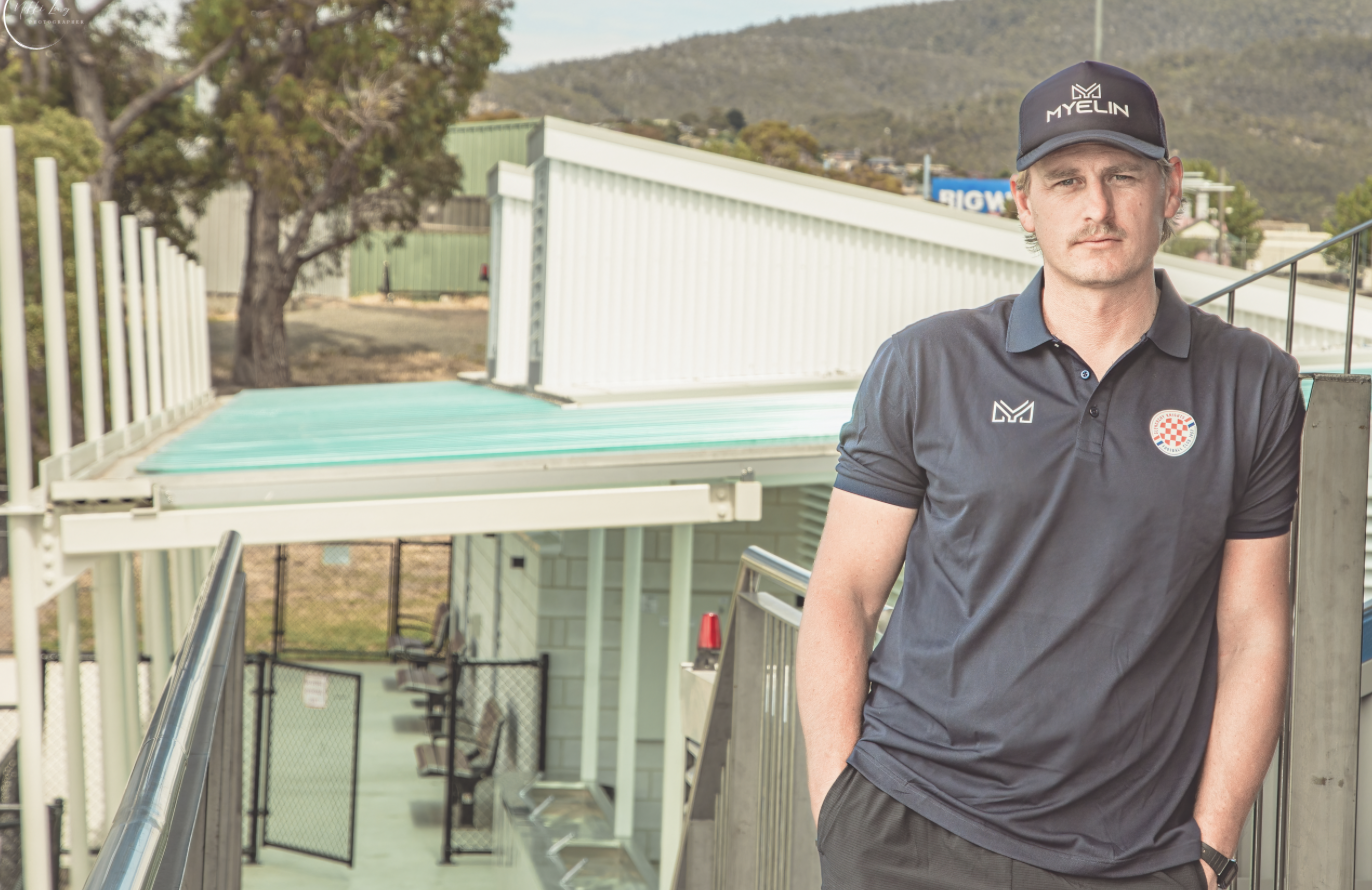
James Sherman - Another terrific photo by Nikki Long
Season 2026, Glenorchy Knights FC
James Sherman is one of those coaches who makes you feel optimistic about football.
Not because he talks loudly, or sells himself well, but because he is thoughtful, grounded, and serious about the work. James loves football, and you can tell quickly that the game still excites him, not just for what happens on a Saturday, but for what can be built over years.
James coached Glenorchy Knights from 2019 to 2024, then stepped away to work in Singapore in a player development role. Now he returns for the 2026 season as NPL Head Coach and in a broader technical leadership position across the club.
As part of my own written record of Tasmanian football, it felt important to capture James’s thinking in his own time, because coaches like this shape far more than just one team.
What follows is James Sherman’s reflection on football, coaching, Singapore, and what Tasmania needs to do if it wants to genuinely improve.
A football beginning
James’s earliest football memory is simple.
Kicking the ball with his mum in the backyard at home.
He says most sports were interesting as a child, but football just clicked, and it was easily accessible. There was always a ball nearby, always a game to be found. Once the love of it landed, it never really left.
When playing ends and coaching begins
Like many players, James expected to play for as long as he could.
But football has a way of forcing decisions on you. In pre-season 2016, he began having serious Achilles issues. It became apparent things weren’t going to improve much, and that got him thinking about what happens after playing.
That same year, he completed his C Licence.
Things progressed from there.
The people who shape you
When James talks about influence, he does not begin with elite programs or famous coaches.
He starts with family.
His mum and brother shaped him more than anyone. He also speaks with deep appreciation about the Armstrong family, who took him in as a sixteen-year-old straight out of Tasmania.
He was fortunate to have what he describes as stellar teammates, men who might be considered old school today, but who valued standards, care, and looking after each other.
That experience carries into the way he leads.
There are things that just matter, he says, and people caring about the small things makes a difference.
Small things add up.
Flexibility is not weakness
James is open about early coaching mistakes.
In 2019, Glenorchy Knights went through the middle of the season with six losses in a row. He reflects that they were trying too hard to match teams that were stronger.
In the final round of fixtures, they made a change.
They played deeper, stayed organised, and played on the counter.
They finished fifth.
The lesson stayed with him.
Flexibility isn’t weakness.
That is as much a leadership philosophy as a tactical one.
Building Glenorchy Knights beyond the first team
James’s years at Glenorchy were not only about the NPL side.
At the end of 2018, the club set up the Academy. He credits Dale Itchins with growing it strongly, and later James returned to the Academy Director role himself.
At the time he stepped in, the club had one state representative player across all youth teams.
Now, he says, that is drastically different. Glenorchy Knights consistently have female and male players in representative squads.
He highlights one example with pride.
Ebony Pitt, an Academy graduate and current WSL player, selected in a Junior Matildas training camp after a recent National ID tournament.
That is real development, not just talk.
Every year is a big year
James is clear that 2024 was a big year, but he also says every year is a big year, with or without silverware.
It is always demanding, and he says he would not change a thing.
The fun, for him, is in the small details. Keeping people engaged, fresh, always looking for a bit more.
How can we be better.
After six years as NPL coach and two years before that as an assistant, he needed a reset, not from football, but from the intensity of first team management.
Singapore and the value of procedure
James chose Singapore because he needed something new.
Staying in Tasmania would not have allowed him to do that. The chance to work abroad and experience new environments was refreshing, and working specifically in player development gave him time to improve his coaching.
He describes Singapore as an amazing country.
Education is paramount. Military service has a significant influence on society. Procedure is valued and prioritised, often.
He found the players and parents extremely open to development and supportive. He believes Singapore has real potential for rapid football improvement, given its geographical location, dense population, and strong resources.
We are guessing
In Singapore, James worked in a development environment and was struck by the importance of collaboration across all levels of football.
Discovering and monitoring players, communicating with clubs and coaches consistently, and using clear evaluation metrics, while also being willing to question those metrics.
He worked alongside talented colleagues and saw huge progress made in a short time with players aged between eight and eleven.
That reinforced something important.
We are guessing.
Every estimate or evaluation can never be claimed as a guarantee. That is simply the truth.
Success leaves clues
James does not say Singapore transformed him as a coach.
He says it reinforced what he already believed.
If things can be done simply, then that is good.
He enjoys being part of teams that are great on and off the pitch, and he enjoys creating challenging and dynamic environments that lead to good things.
Success leaves clues.
That phrase says a lot about his approach. Watch, learn, observe, build.
Returning to Glenorchy Knights in 2026
James does not describe this as a return.
He describes it as a new job.
That, he says, is good for him, good for the players, and good for the club.
He sees the challenge and believes the opportunity is there to improve quickly.
His role will support not only the NPL side, but also WSL, Under 21, Championship, and Under 18 coaches across men’s and women’s football.
For him, there is more to football than the outcome of a Saturday or Sunday afternoon.
How can staff challenge, stretch, and support players at every opportunity.
How can coaches deliver great sessions.
How do people learn best.
What do we need to do to deliver well across the board.
A playing model and coaching framework
The club’s aim is to create a clear playing model and coaching framework that everyone can see and work towards.
James’s role is to facilitate that, then work with senior staff to implement it.
A major focus is pedagogy.
Not just running sessions, but thinking critically about how sessions are designed, how players learn, and how coaches improve every year.
His day to day will involve team analysis, session review, and sharing content with coaches.
He also says the retention and recruitment of senior coaches this year is the best the club has had.
It is an exciting time.
Transparency, consistency, clarity
James’s non-negotiables as a coach are simple.
Transparency. Consistency. Clarity.
Stick at it, and good things will happen.
Guidelines, not rules
When asked about leadership, he says something that stands out.
Don’t make rules. Use guidelines instead.
Stick to process. Focus on what is within your control. Prioritise what is beneficial for the group.
Remain positive.
And play to win.
Coach education is the gap Tasmania cannot ignore
If Tasmania could change one thing to produce better players and coaches, James goes straight to coach education.
He means conferences and presentations, not just licence courses.
Bringing in presenters, and having local coaches share knowledge.
He believes Tasmania is miles off providing that for the people trusted with developing the game.
There are very good coaches locally, he says, and that knowledge should be tapped into for the benefit of all.
There is no excuse not to close the gap with other states. Tasmania should be able to box above its weight in professionalism and innovation in player development.
So why hasn’t it changed.
Because knowledge sharing hasn’t been consistent. It can’t be a token event to tick a box.
It needs to be purposeful and interesting.
Build it, and the progress will be obvious.
Final reflections
There is a freshness to James Sherman.
Not because he is new, but because he genuinely enjoys football, believes in learning, and cares about building environments that help players and coaches improve.
He talks about football as work worth doing.
In Tasmanian football, that matters.
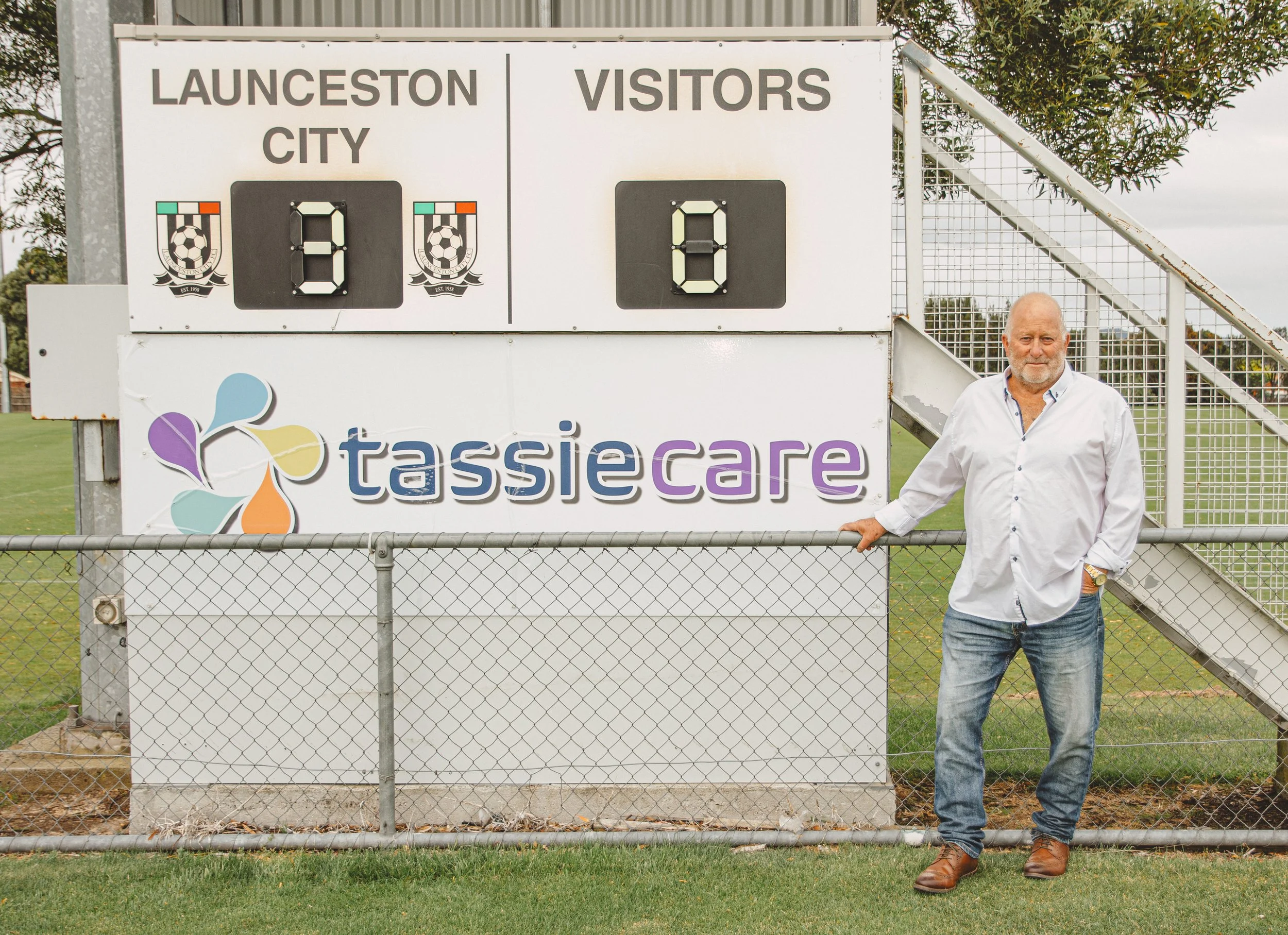
Danny Linger - The Accidental Football President
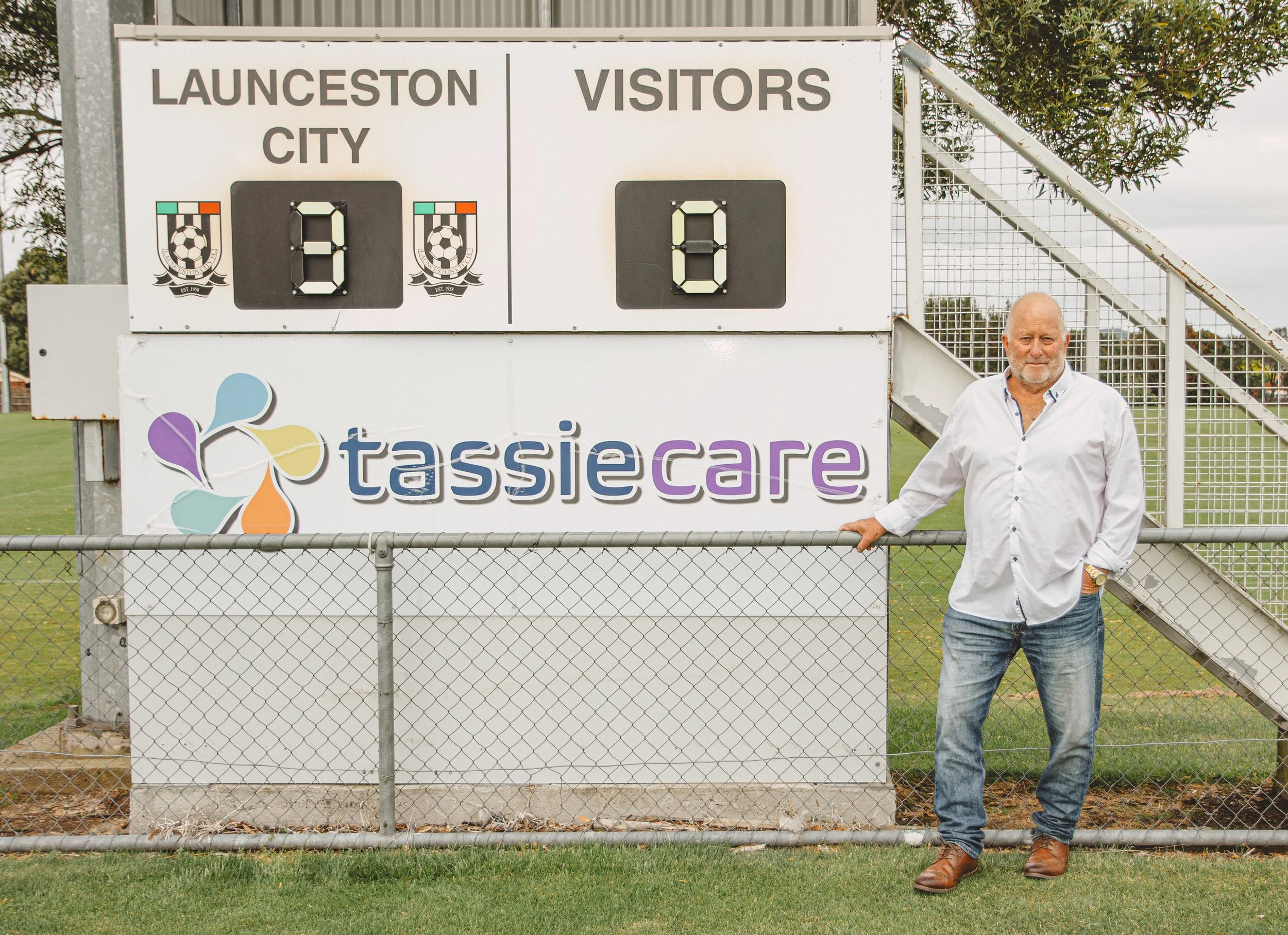
Danny Linger photographed by Nikki Long
Community football in Tasmania runs on volunteers who often arrive as parents, then slowly find themselves carrying whole clubs. Danny Linger, President of Launceston City FC, is one of those people. His story is practical, personal and at times blunt, especially when it comes to the demands placed on Tasmanian clubs and the gap between national expectations and local realities.
How Danny found football
Danny’s first involvement in football was not as a player or a coach.
It was as a parent.
When his son Jarrod started playing with his mates from school, Danny found himself at the sideline. He thinks it was around 2006, although he says he should check. Football, still referred to as soccer across most of the country, was not his first choice. He is more aligned to motorsport. But he could see the benefits of a “non-contact” sport and he jokes that it was probably more the mums who liked that part.
What struck him early was how enjoyable it was for all participants, even the parents. He remembers the smiles on those little faces and says that alone was reward enough.
In those early days he even thought it was great to get an early game on a Saturday at Churchill Park, because it left the rest of the weekend free to do all manner of other activities.
Little did he know that would soon change once they moved into senior football.
From there, joining Westside Devils felt natural. It was the power of numbers, all the boys from school joining the same club. For those not in the know, Westside Devils Junior Football Club was the junior feeder club to Launceston City FC, the senior counterpart based out of Prospect Vale Park.
Danny says he feels very fortunate and extremely proud that circumstances ensured he became part of such a fantastic club.
Why he still shows up
Jarrod has long since moved on with his life in Queensland but Danny is still deeply involved.
He says the question of why he keeps doing it could involve a very long winded and in-depth answer, but he tries to keep it as concise as he can. After working so many hours at all manner of tasks and club positions, he says the real answer is a sense of social responsibility to do as much as he can in this space.
Even now, he gets a huge amount of satisfaction seeing all the juniors running around in their treasured City tops each week. Whether that is normal team training or as part of the Juventus Academy, he says it really is a great sight.
He takes great pride in seeing junior and youth players develop into genuine respectful adults. Regardless of whether they continue in the sport or not, he says if that is all they achieve then they have succeeded.
The second part of the answer, he says, is a determination to continue developing the facilities.
He is careful here. He says his next comment is not intended to upset any other clubs because everyone has a passion for their own home base, but he firmly believes that, in general terms at least, Prospect Vale Park is right up there with any other football facility in the state, at least on field.
The pitches and the overall available space are right up there.
Off field, he says, they are lacking. Things are moving, but as everyone knows it is a slow burn and they need to keep pushing for what they deserve. With almost 900 members, he says four change rooms just do not cut it.
He says it has been a long road, but they are slowly making ground. They have also worked very hard to build relationships with major partners, mainly The Australian Italian Club and Meander Valley Council.
What a club President actually does
Danny says his day-to-day tasks have changed over time.
In the early days he was setting up on game day, acting as NPL team manager, something he says he really enjoyed, driving the bus and generally communicating with members, Football Tasmania and council.
During COVID, he describes it as a big year, with many early mornings trying to produce all manner of documents so everyone could get back on the park. He says he was exhausted after that.
In later years he says he has mainly dealt with infrastructure, senior committee matters and of course the various NPL regulatory requirements.
He does not think he would be too different from many other volunteers, but he believes most people outside club management would be shocked at how many hours volunteers dedicate to their club, to the point of it almost being a second job. He points to volunteers who are at the club multiple times per week to ensure everything is clean, tidy and runs smoothly on game day.
His message is straightforward.
Do not sit back and think it all just happens.
Roll up your sleeves and help, even if it is only for an hour.
You might actually enjoy it.
The hardest part nobody sees
Danny says straight up that volunteers do not do this for any accolades or thanks.
That is not it at all.
In saying that, he says it is nice to hear compliments instead of complaints, but at the end of the day they do the best they can with the time they have available, they really do try.
He often admits they do not always get it right, but he says the column with the ticks is much longer than the one with the crosses. They do make a difference.
He says the hardest part is not having enough time and energy to devote to getting things done. He always feels there is more to do and so little time to make it happen. He says it can be frustrating getting bogged down in official red tape.
Standards he will not compromise on
Danny says that in the last few years the club has really developed its management structure, especially since the amalgamation with the junior club back in 2019.
They are always aiming for best practice in all areas and he says they are proud of their work in achieving national Club Changer accreditation and all the work that went into it. He says the recognition from Football Australia reflects that work.
If he has to pick a standard that is non-negotiable, he says it is their child protection framework, ensuring they value and protect their junior members.
That is something, he says, they cannot and will not compromise.
How do you balance being welcoming and inclusive with lifting standards and performance?”
Danny says this is a very difficult question and he is not sure he can answer it without writing a novel.
He points to the scale. More than 70 teams, from U6 to WSL to NPL.
He says they have highly valued and smart professionals working at the club, much smarter than him, and each person makes a commitment to ensure the club aligns to its values without compromise.
What junior football should be about
Danny says his view is probably already evident.
He believes junior football should be about developing respectful well-balanced adults.
To some degree the rest is secondary.
By the time players get to senior football, he says winning becomes part of life and something they strive for each day.
The biggest structural weakness in Tasmanian development
Danny is blunt.
An 18-game senior NPL roster.
He says it is embarrassing.
He asks how this happened. He asks how Tasmania can possibly expect to develop and compete on the national stage when the competition is so short. He acknowledges finals exist, but he points out not all clubs will reap any benefit from those extra games.
He then compares it to other states. He says NPL Victoria plays a roster of 26 games while NPL New South Wales ends up with a 30-game roster, and he asks you to check that.
The true cost of facilities
Danny explains that Launceston City is in a unique position.
The club facilities are located on private land they lease, while the pitches are owned by Meander Valley Council. The location brings certain advantages, but it also carries a huge burden as they develop their infrastructure.
He says they are extremely grateful to council for the work they have done and continue to undertake to develop the on-field facilities, but as the club increases its investment off field it comes at a cost, and he suggests asking the finance department.
He says they are starting to see an increase in external entities wishing to utilise Prospect Vale Park, which is exciting, but to make the most of those opportunities they need to invest even more money.
His wish is to finish stage 2 of their development, but he fears that is a long way off and the cost is growing each year.
Where clubs are carrying too much
Danny laughs and says, oh boy, this is a good one.
He says the short answer is he finds it incredible that in a state of a little over 550,000 people, about the same as the population of the Gold Coast for instance, clubs are expected to meet the same criteria as every other NPL club in the country.
He says some of this has meant clubs have stepped up and improved, but when clubs are expected to meet the same infrastructure requirements as mainland NPL clubs, he feels it goes too far. There is just not the money available to invest.
He says certain entities forget they are all volunteers working their butts off just to put teams on the park. At the end of the day, he says it is the volunteer clubs that have the most to lose financially, and they are not given enough credit for all that hard work.
If Football Tasmania handed him the pen
Danny’s answer is short and sharp.
Listen and engage with your stakeholders.
Do not just nod and smile.
Actually act on the feedback provided by the major stakeholders, and he says he does not mean cherry pick what suits a pre-set agenda.
He says between the clubs across the state, the level of expertise available is immense, something any national organisation would cherish, yet he does not feel it is tapped into too wisely.
The best decision he made, and what he would do differently
Without doubt, Danny says the best decision would be pushing ahead with the junior and senior amalgamation in 2019.
He says it had been spoken about for some time, and the opportunity arose due to the senior club needing to update its 40-year-old constitution and the fact the junior club did not have one at all.
He says they discussed it with the junior committee, and then Alex Aylott, Junior President at the time, and Danny exchanged letters of intent. They worked at it during that year and took it to a Special General Meeting.
He says it was almost an anticlimax with a unanimous vote, but it was a great feeling to finally get it done.
Since then, he says, the club has gone from strength to strength. They have a board in place overseeing various committees and he says it seems to be working well.
He is careful to add they would not be where they are today without the commitment of previous committees. He does not want to take away from what people did over the years to establish the club in the first place.
On regret, he says he is not sure there is anything in particular. He says maybe over the years he could have spent less time on the day-to-day stuff and concentrated on moving the club forward, but it is not really a regret as such.
The brutally honest message to councils and government
Danny says football is here.
Football is growing.
And it is not about the shape of the ball.
He says football deserves better and government and councils should come along for the ride, not sit back and watch.
He adds, and remember, we vote too.
If he stepped away tomorrow
Danny says the club is currently undertaking refurbishment of nearly 50-year-old original change rooms thanks to a Federal Grant on the back of Play Our Way funding.
Construction is due for completion around April, but it still only gives them four individual change rooms. For a club of their size, with both male and female teams, he says they really need at least six, along with the additional storage that comes with that.
He says he is proud of the Peter Mies Pavilion, but they still need another $2 to $3 million to complete the development. He jokes that other than selling kidneys on the black market, he is not sure when or how they can gain that funding, and says they will just keep pushing.
He says council is working on an upgrade to their access off Westbury Road and they are collaborating on a lighting upgrade that is long overdue.
Watch this space, he says.
Finish this sentence honestly
Tasmanian football won’t truly improve until we actually come together as one.
Danny says that means grass roots, clubs and all participants have a voice that is heard, actually listened to and given a real chance to collaborate on the future of the sport. That voice needs to be clearly heard and understood from all key bodies.
Football Tasmania, Football Australia, and most of all politicians.
He says they should be seen all year round at games and events and collaborate to enrich the game, participation and the lives of young people. He says he does not mean show up when it is convenient, he means actually listen and act to make change.
He says they do not want to just see politicians at election time, although to be fair there are some that show up more than just every three years and that is appreciated. They know who they are.
He then returns to governing bodies. They say they are consulting and listening. He says he is yet to be convinced on that point and he will just leave that right there.
The final word
Danny adds something he wants included.
How much the club values volunteers and sponsors.
He says Launceston City and in fact all clubs, cannot function without them. Together they provide a community service that is quite often undervalued.
Launceston City really does have the best support, he says.
And he cannot thank them enough.
Max Clarke: Home, But Not Home
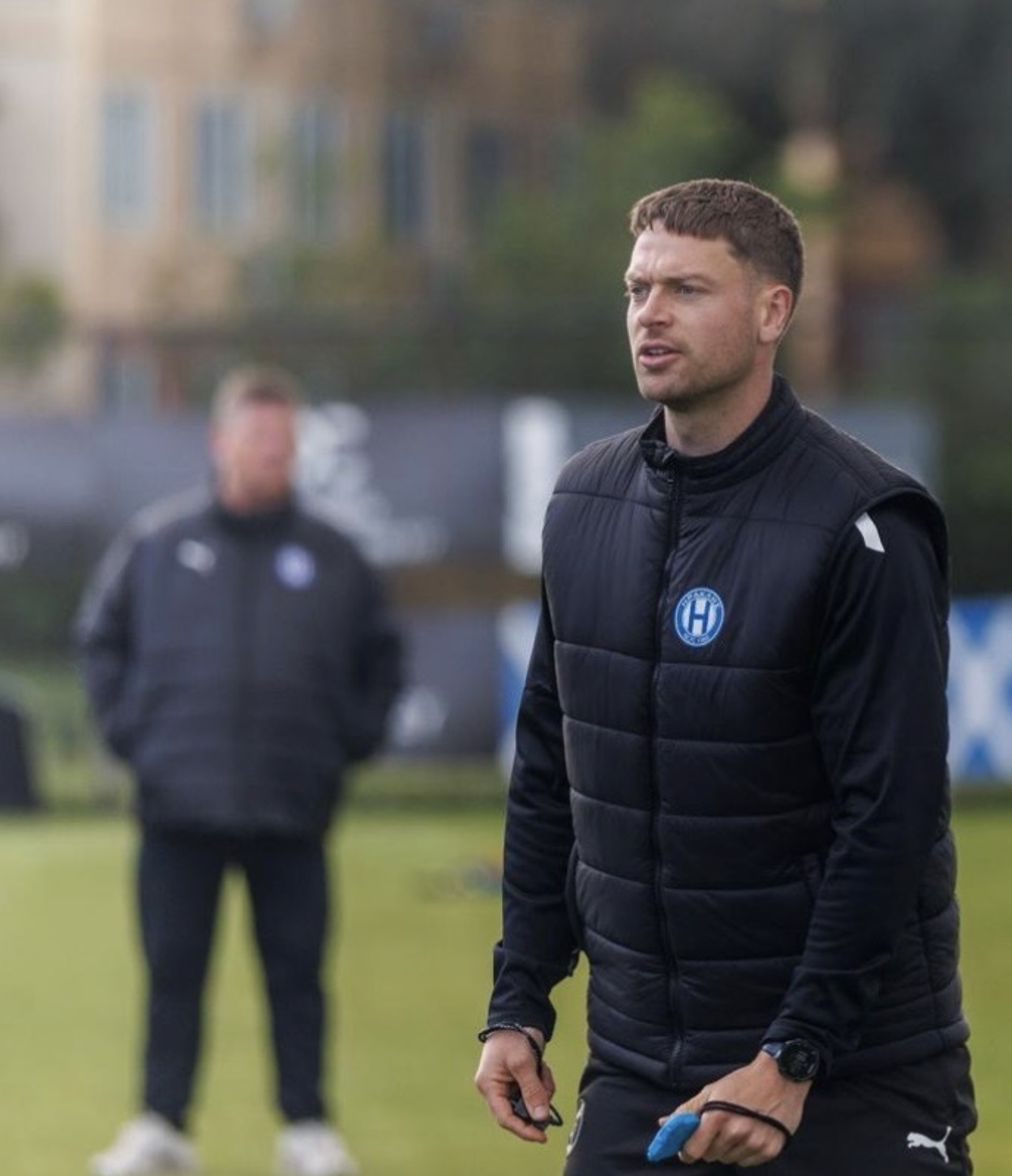
Max Clarke - Photo courtesy of Northcote City
Tomorrow my son Max will walk back into Darcy Street, not as South Hobart’s coach, but as the opposition.
That sentence still feels strange to write.
Last season, Max coached South Hobart. He didn’t just coach us, he led the club through one of those rare seasons that supporters remember for years, a League and Cup double and a team identity that people genuinely connected with.
Now he is returning with Northcote City.
Different badge.
Different changeroom.
Same ground.
Same faces.
And for me, as his mum, it’s an odd mix of emotions, pride, sadness and the quiet reality of what ambition looks like in football.
Tasmanian football is small enough that nothing is anonymous.
When someone leaves, everyone has an opinion.
When someone returns, everyone reads meaning into it.
But most of the time, the real story is not drama.
It is growth.
It is the emotional cost of choosing a pathway.
And it is the complexity of holding two things at once, love for your home club and the need to keep moving.
I wanted to capture this moment properly.
Not as a match preview.
Not as a headline.
But as part of the written record I am building about football in Tasmania, what it asks of people, and what it gives back.
So I asked Max to reflect honestly on returning home, and on leaving home.
Coming back with a piece of home intact
Max said the return feels exciting.
Not loaded.
Not bitter.
More like pride.
A chance to share his hometown and his home club with his new team, and to show how he has evolved as a coach.
“It doesn’t feel like a return with bad blood,” he told me.
“It feels like coming back with a piece of home still intact.”
That line stayed with me.
Because it is possible to leave without rejecting where you came from.
And that is not always how Tasmanian football reads it.
Home, but not home
Darcy Street will feel familiar.
But Max will not be walking into the home changeroom.
He will walk in, take in the place that still holds memories, and then step into the away changeroom and flick the switch.
He described the contrast perfectly.
Walking into Darcy Street will feel like home at first.
But the moment he steps into the away changeroom, it becomes business.
He has never experienced that contrast before.
And he is curious about how it will land in the moment.
That is the reality of football.
The same ground.
The same smell.
The same people.
But suddenly the emotional context is different.
The decision to leave
When a coach wins a double, people assume they will stay.
Comfort is seductive.
Success makes you want to settle.
Max didn’t.
He said leaving South Hobart was the hardest part.
Not because the club was failing.
The opposite.
It was because the club felt like family and was genuinely growing.
But ambition outweighed comfort.
He was careful about choosing his next environment.
He wanted the right next step, not just the next step.
And he is confident he got it right.
That matters to say.
Because too many people interpret leaving as an insult.
Sometimes it is simply a coach being honest with themselves about their pathway.
The emotional cost people don’t see
This is the part many football people pretend isn’t real.
They talk about “opportunities” like the human being is not attached.
Max described the emotional weight clearly.
He said people judge these decisions at surface level.
What they don’t see is the emotional cost, the sacrifice, the uncertainty, and the loneliness that can come with football.
That loneliness is real.
Leaving familiarity.
Leaving daily support systems.
Leaving identity.
Football is a career pathway, but it is also a constant dismantling and rebuilding of self-belief.
Especially for young coaches.
And especially when the football world is watching, even if it doesn’t understand what it is looking at.
Why he came back last year
There is another piece of the story that matters.
Max returned to Hobart last year after being in Melbourne.
He said he recognised football is built on connections as much as qualifications.
Coming home gave him stability, support, and familiarity.
It gave him the kind of environment where he could work clearly.
While there were other opportunities, he said Northcote felt right and allowed him to build with confidence rather than rush the next step.
That’s maturity.
Not taking the first offer.
Not chasing status.
Building carefully.
The double wasn’t the real prize
The trophies mattered.
They always do.
But Max said the bigger achievement was rediscovering his confidence and passion as a coach.
That is not a line you hear often, but it is the truth behind most successful seasons.
Coaching is exhausting.
It is exposure.
It is giving everything, and being judged anyway.
The double did more than fill a cabinet.
It solidified identity.
Max said South Hobart built an identity in how the team played and carried itself, and that clarity has shaped the way he coaches now.
When you watch coaches closely, that is what separates them.
It is not tactics alone.
It is identity.
What he is proud of, beyond trophies
When I asked Max what he was most proud of from his season at South Hobart that had nothing to do with trophies, he didn’t hesitate.
He said he was proud of the collective.
The identity the group built.
The behaviours they lived by.
The way players grew into new roles.
He said the togetherness of the group and the bond they shared across the season is something he will always value.
That is a coach speaking about leadership, not results.
The coaching evolution, what has actually changed
It is easy for coaches to say they have “evolved tactically”, but Max went a step further.
He said he is more adaptable now and manages games better.
He has clearer principles around his style of play, and a better understanding of when adjustments are needed to get results.
He is also more conscious of selecting players based on what a game requires, not just who looks best on paper.
Then he gave a specific example, and I appreciated the honesty.
Looking back at his last away game at Heidelberg with South Hobart, he felt he was probably too stubborn and didn’t respect how strong they were.
Now, he said he would approach that game with more balance and pragmatism.
That is real coaching growth.
Not the tactical diagram stuff.
The psychological stuff.
The humility to learn.
The Northcote project
He is excited about Northcote’s potential.
He described a club with strong history, ambition, and a willingness to do things properly.
He said the challenge has been quickly reacquainting himself with the league, and that has meant leaning on staff and players.
That line matters too.
Young coaches often think they have to prove themselves by doing everything alone.
Max is learning how to lead, and how to trust.
And that builds teams.
Family clubs and professional programs
Max’s perspective on environments was balanced.
Some clubs are exceptional at building a family culture, which matters deeply to him.
Other clubs have resources that allow for sustainable, professional programs.
He said he has learned from both.
That is football in Australia.
Especially in states like ours.
We do not all have the same foundations.
We do not all have the same money.
But the love of the game is not the only ingredient.
Structure matters too.
Tomorrow at Darcy Street
I asked Max what will be the hardest moment tomorrow.
His answer surprised me.
He said he doesn’t think there will be a hard moment.
He tries to enjoy games for what they are.
And tomorrow will be about appreciating a good contest with familiar faces and two teams trying to play the right way.
That is not a defensive answer.
It is a grounded one.
It shows how he’s processing this return, not as drama, but as football.
Although everyone else will probably still feel the emotion.
What he would tell his younger self
This was the line that wrapped the whole thing into one truth.
Max said he would tell his younger self to do it anyway.
Growth is uncomfortable, but necessary.
Leaving doesn’t mean disloyalty.
It means being honest about your potential.
And trusting that the relationships that matter will endure.
Final thoughts
Tomorrow’s match will have its own story.
But this post is not about the score.
It is about the complexity that sits underneath the surface of football in a small community.
Ambition has a cost.
And in Tasmania, where football is tight-knit and long-memoried, that cost is amplified.
But people don’t leave because they don’t care.
Often, they leave because they do.
Because they are trying to become something.
And because deep down, they trust that what mattered will still be there when they return.
Even if it is with a different badge.

It All Started at Meercroft Park

Danelle Last. It all started at Meercroft Park.
Danelle Last: Devonport Junior Soccer Association
I have known Danelle Last for many years, and I have lost count of the times I have called her for advice.
Usually it has been around the messy, high-pressure stuff, administering big junior events like the Hobart Cup, sorting systems, schedules and solving problems before anyone else even realises they exist.
Danelle is one of those people who makes junior football work.
Not with noise.
With competence.
With care.
And with a steady hand.
Football Faces Tasmania interview -
I love stories like Danelle Last’s because they are so recognisable.
Not the “born with a football at your feet” stories.
The real ones.
The ones where football comes barging into a family’s life, almost by accident, and then never really leaves.
Danelle didn’t grow up in football.
She grew up in an oval shaped football family, which is Tasmania in a nutshell.
But once her boys stepped onto the grass at Meercroft Park, it was over.
Saturday mornings became the rhythm of their family.
And eventually, so did committee meetings, team management, state team travel and all the invisible work that holds junior football together.
Since this interview was first done, Danelle has stepped away from her formal role at Devonport Junior Soccer Association, but in the way that so many good volunteers do, she hasn’t stepped away from the people.
She continues to mentor those who have taken on the roles behind her and she is still right there in the background, supporting her family as they chase their own sporting journeys.
That says as much about her as anything in this interview.
First football memories
My first football memories came from my boys.
Growing up we were an oval shaped football family. I knew absolutely nothing about the round football.
When our children got to an age where they could participate in a team sport, our first chose football.
In 2007 our Saturday mornings at Meercroft Park started with one playing and the other three following in the years to come.
My husband was always involved with coaching one of their teams.
Who instilled my love of football?
Most definitely watching my four boys play.
How long have you been involved and what roles have you played?
My personal involvement started in 2013.
It was the first year of the new Port Sorell Primary School and I was asked to coordinate the school teams. A joint role at the time with Ian Davies.
In 2014 I was asked to attend a Devonport Junior Soccer Committee meeting.
In 2017 I stepped into the role of Secretary, knowing I had big shoes to fill with the amazing job my predecessors, Marlene Crabtree and Bonnie Phillips, had done.
As my boys reached high school, I also filled roles as team manager for Youth Strikers teams.
What was football like in Tasmania when you started, and how has it changed?
I knew nothing about football when our boys started to play.
But in the time I have been involved, I have seen lots of good progressions and a few regressions.
The development and priority of women and girls has been encouraging.
There is now, for most people, a bigger emphasis on development.
How has football affected you and your family?
When football came along and became such a big part of my life it was quite a surprise.
The people who are now lifelong friends.
The DJSA committee (former and current) that are, in my biased opinion, the best committee in the state.
Friendships made at the Strikers, other associations, the boys state teams and through Football Tasmania.
Regardless that two of our boys have eventually chosen different sports, football has been a big part of all their lives.
Playing, reffing, coaching, state teams, the year of travelling to Hobart two to three times a week.
The friendships, the mentors, the coaches, the managers.
The people that have supported, encouraged, celebrated, and commiserated.
Which Tasmanians have affected your involvement in football, on and off the field?
When I saw this question, my thoughts went to the people that have made me want more for the game, more for Devonport, and made me want to be a part of the progression.
They have become my close friends, the people that have shared so much of this football journey with me.
Richard and Jayne Bidwell.
The other person is someone who has always been there for Justin and myself as a go-to person for advice, but more importantly as a mentor and role model for my boys.
Chris McKenna.
If you could change anything in Tasmanian football, what would you do?
Playing, training, coaching, refereeing would be accessible and welcoming to everyone.
Looking back, what do you think your legacy might be?
I hope it is a while before I leave a legacy as such!
I have been fortunate that football has enriched my life personally and as a Mum.
So many highlights, proud moments, and experiences.
Those first under six games to NPL and everything in between.
Standouts being, a manager for a team DJSA took to the Kanga Cup in Canberra, watching my eldest son coach my youngest and a special recent NPL game.
But it all started for us at Meercroft Park.
I would hope that I have helped make a difference in ensuring that each and every player, coach and referee attend on a Saturday morning and at the Devonport Cup, feeling safe, supported, included, and looking forward to the fun they will have.
I cannot take credit for the success of Devonport Junior Soccer Association, but I can be proud to be part of such a great team.

Marina Brkic, Glenorchy Knights FC: Mud, Bonfires and Making it Happen
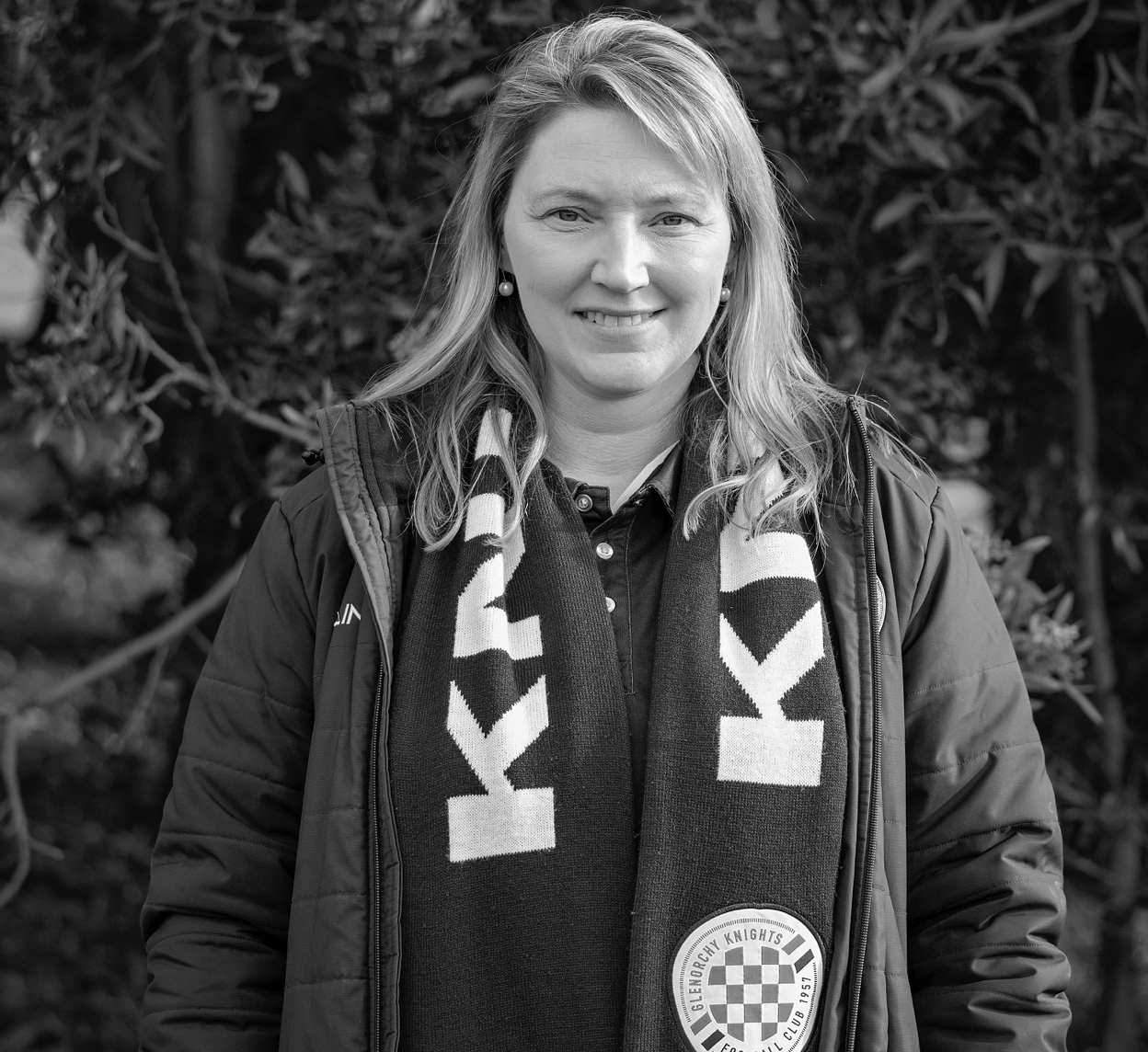
Photo credit: Lisa Creese
This Football Faces interview was originally done in 2022.
In football, two years can feel like ten. Coaches move on. Committees turn over. Programs change names. Roles evolve. People take a step back, or step up.
So yes, a few details in this interview may have shifted since it was first written. But the story underneath it hasn’t changed, a life spent in the game, a club carried by volunteers, and that familiar combination of mud, bonfires, chips, and doing whatever needs doing.
That’s why I’m republishing it now.
Marina Brkic, Glenorchy Knights FC: Mud, Bonfires, and Making It Happen
There are football people you notice because they are loud.
And there are football people you notice because they are everywhere, doing everything, holding everything together, usually without a fuss.
Marina Brkic is one of those people.
A Glenorchy Knights stalwart. A long-time player. A club official. A coach. A team manager. A social media machine. A youth team driver. A volunteer. A mother of three football boys.
Still playing herself, and loving it.
When I look back over the last couple of decades of Tasmanian football, faces like Marina’s are the ones that stand out. Not because they chase attention, but because they are always there, still doing the work.
This interview was done a couple of years ago, but it still rings true. It’s the kind of story that belongs on the record.
First football memories
Marina’s first football memories are not polished, glamorous, or Instagram-friendly.
They’re real Tasmanian football memories.
Doing the scoreboard at KGV with her sister, paid in the most authentic grassroots currency possible, a packet of chips and a drink.
Standing in the mud next to the bonfire while the games rolled on.
If you’ve been around long enough, you can smell that sentence.
That’s football.
Not elite. Not high performance. Not “pathways”.
Just people, cold hands, smoke in your hair and a community built around the game.
A life in football
Marina doesn’t just say she’s been around football forever.
She has.
Her dad took her to watch Croatia-Glenorchy from early on. The game was in her bones before she could properly name it.
She’s been involved for most of her life, playing for 30 years, starting with Raiders and DOSA, but with most of that time spent with Glenorchy Knights. That sort of loyalty is not as common as it once was and it matters.
Along the way she has also taken on the roles that clubs rely on:
Coach.
Team manager.
Committee member across various roles for 20+ years.
And now she’s club secretary, part of the executive, manages social media, manages a youth team, and “many other things” (which is volunteer code for too many things).
And as if that wasn’t enough, she has three boys who all play at the club, too.
This is what football looks like when you live it properly.
What Tasmania’s football used to feel like
One of the striking things Marina remembers is senior men’s football crowds.
Big crowds.
That atmosphere has faded in many places and I think most of us can admit it. We can debate why, we can blame a dozen things, but the shift is real.
Marina also points out something important about female football, girls her age simply were not encouraged to play. She was a late starter because of that cultural barrier.
And yet she’s spent years doing the opposite for the next generation.
She has pushed female football at her club and beyond it. She speaks with real pride about seeing lots of girls playing now in junior and youth teams and she notes that the quality and support for female football has improved.
That’s not an abstract achievement.
That’s a direct outcome of people like Marina doing hard work over a long time.
Heroes, anti-heroes, and what actually matters
Marina doesn’t go looking for celebrity football heroes.
She values something different, and it’s a quiet lesson in what club culture is built on.
Hard-working.
Reliable.
Club loyal.
Respectful.
She’s met plenty of those people along the way, and that’s what she appreciates.
No drama.
No ego.
No hype.
Just the people you can count on.
The ones who make football happen.
Football and family: the reality
People underestimate how much football takes from a family when someone becomes deeply involved in running a club.
Not playing.
Running it.
Marina is honest about that.
She talks about the impact on personal time. The work. The load. The constant demands. The unspoken expectation that you will simply keep doing it.
But she also says what makes it worth it.
Her whole family loves the game.
There are lows, but the highs are shared, and those shared highs are the reward that keeps you going.
I also loved her line about being supported to play herself. Especially when her children were young, it’s not easy. Someone has to hold the home, manage the logistics, make it possible.
Because women in football are often expected to sacrifice the playing part first.
Marina didn’t.
And that matters.
If she could change Tasmanian football
This answer should be printed and pinned to a wall in every governance meeting.
Marina’s view is shaped by time on the ground as a club official. She’s not theorising. She’s speaking from the trenches.
She says the demands on clubs have increased significantly and are about to increase further.
That’s the warning line.
And she makes it clear, any change that makes football easier for clubs, mostly run by volunteers with day jobs, would be welcomed.
Then she gets practical.
Not ideological. Not fluffy.
Rostering.
She points out that teams playing in different locations stretches club resources. It impacts the matchday experience. It chips away at club culture.
So she calls for something simple and sensible, consistent rostering of teams together.
It’s the kind of idea that doesn’t make for a glossy strategy document, but makes an immediate difference to actual volunteers.
That’s the kind of thinking Tasmanian football needs more of.
Her legacy
Marina doesn’t claim a grand legacy.
She says something much more accurate.
All clubs have committed and hard-working people that make it happen.
Her legacy is that she’s one of those people.
And then she finishes with humour, saying she would have liked to have scored more goals over the years, “no legacy there lol!”
That made me laugh because it’s exactly the kind of line football people write when they’ve been through enough seasons to know what really matters.
Legacy is not medals.
Legacy is being there, doing the work, shaping the culture, and helping the club survive and thrive across generations.
That is what Marina has done.
And she’s still doing it.

Nick Di Giovanni: A Life in Football

Nick Di Giovanni - photo Nikki Long
I have known Nick Di Giovanni for the entirety of my time as a club president.
Over many years, we have sat across tables from each other in meetings, shared rooms where difficult decisions were discussed, and navigated the realities of leading football clubs in a small state. We have not been close friends, but we have always been respectful, direct, and able to engage honestly, even when football politics made things uncomfortable.
Nick is one of the longest-serving presidents in Tasmanian football. Through Hobart Juventus, the evolution into Hobart Zebras and the merger that formed Clarence Zebras, he has been a constant presence during a period of significant change in the game. His experience spans grassroots football, club mergers, infrastructure challenges and the increasing demands placed on volunteer leaders.
As part of my own written record of the past twenty years in football, it felt important to include Nick’s story. Not as commentary and not as analysis, but in his own words.
What follows is Nick Di Giovanni’s reflection on football, leadership and what it takes to sustain a club over decades in Tasmania.
A football beginning
Nick’s football journey began with Juventus.
His first game was with the Under 13s, coached by Franco Cortese, who stayed with the group through to Under 17s. It was a successful team that won multiple titles and included players such as Luciano Fabrizio, Bruce Pears, Darren Bacon, Leon Darko, Frank Genovesi, Alistaire Cochrane and the late Darren Wells.
All of them went on to play senior football at Juventus under the guidance of Ken Morton.
Nick also represented Tasmania as a goalkeeper from Under 13s through to Under 18s and was coached by Steve Darby and Barry Shacklady, both of whom he remembers as influential figures.
In 1985, Nick moved to Queensland to open Jupiter’s Casino, now known as The Star. While there, he continued playing with Merrimac, another Italian-based club on the Gold Coast.
Four years later, he returned to Hobart. Work commitments at Wrest Point made it difficult to train at the level required for senior football but he stayed involved, playing socially and remaining connected to the game.
From member to President
Like many of that era, Nick’s deeper involvement came through volunteering.
Football clubs were busy, social places and one role often led to another. Over time, that hands-on involvement grew into responsibility, and eventually into leadership.
Nick believes he has now been President for close to eighteen years.
He stepped into the role when long-serving Juventus President Michael Pace retired and no one else put their hand up. There was no defining moment, no dramatic call to action. The club was in a good place and simply needed someone to take on the role.
So he did.
What the role really involves
Being club President, Nick says, is a year-round commitment.
Day to day, it involves constant communication with players, coaches, councils, Football Tasmania, committee members, sponsors and parents. It never really stops. There is always someone wanting a friendly chat, some information, or occasionally voicing frustration.
What people often don’t see is the work behind the scenes, or the fact that the role doesn’t end when the last match is played in September.
When Clarence Zebras formed through the merger of two clubs, Nick expected both the difficult and the positive moments that would come with it. The work was hard, but he believes it was necessary and hopes it proves beneficial for football on the Eastern Shore in the long term.
The Home of Football
The idea of a Home of Football has been discussed for many years, and Clarence Zebras has often been mentioned in that conversation.
From Nick’s perspective, sharing a facility with Football Tasmania would not be a problem in principle. The venue is large enough, similar to KGV but on a larger scale.
He sees clear opportunities if such a project were to eventuate, including year-round astro pitches, new club rooms, improved playing facilities and a covered grandstand. Much of this infrastructure is currently lacking and the venue itself is tired, having seen little upkeep compared to facilities for other sporting codes.
Nick is clear, however, that the club’s identity would remain, regardless of any shared arrangement.
He is also realistic. From what he understands, discussions so far have been limited, and when councils and government are involved, progress is slow. In his view, the project is a long way from happening.
Personally, Nick doubts it will occur at Wentworth Park. Even if the significant funding required were found, he believes the timeline would be five to ten years at best.
Access remains a major challenge. Limited seasonal availability, high costs, and shared use with touch football make the venue difficult to sustain without significant volunteer effort and sponsor support.
Longevity and stepping away
Rumours about Nick stepping away from the presidency have circulated for years, and he confirms there is truth in them.
He now has family on the Gold Coast and has purchased a place there. For now, he remains President, but like many long-serving volunteers, he believes the time is approaching for new, younger faces to step forward and shape the club’s future.
What has kept him in the role for so long is simple. He has loved being involved.
But the role is changing. Increasing expectations from Football Australia, combined with work commitments, have made the presidency feel more like a full-time position.
When the time comes to step away, Nick expects it will be difficult. The club has been part of his life across multiple identities. Still, he is certain he will remain involved in some capacity, regardless of where he is living.
Meetings, mergers, and reality
Reflecting on years spent in Presidents’ meetings, Nick doesn’t point to any single pivotal moment. There were many sighs, many disagreements, and frequent moments where clubs and Football Tasmania found themselves at odds.
In the end, decisions were accepted. There was often little choice.
On the subject of mergers, Nick believes they are likely to become more common in Tasmania. With too many clubs, increasing administrative demands and volunteer fatigue, mergers may be the only path to long-term survival for many.
He is clear that for a merger to work, both clubs must contribute meaningfully and be prepared for a difficult beginning. Success depends on ongoing committees and volunteers maintaining the commitment over time.
Without change, Nick fears more clubs will retreat into social football only, fielding a few teams without junior or youth pathways.
He is particularly critical of national expectations that do not account for Tasmania’s population and resources. What is required of a state of 500,000 people mirrors expectations placed on much larger states and he believes that imbalance is unsustainable.
Final reflections
Nick says his greatest pride has been growing the club and seeing so many juniors and youth now playing football on the Eastern Shore.
What he wishes people understood better is that club leadership is a volunteer role, requiring countless hours of work each week, often with little reward and significant stress.
Despite everything, football still gives him joy.
The excitement of match day remains. So does the camaraderie and the lifelong friendships built through the game.
For Nick, that remains the greatest reward of all.
About the author
I’m Victoria Morton. I’ve spent 20 years in Tasmanian football as a volunteer, club leader and advocate.
I’m writing a personal record of what I’ve seen, what I’ve learned and what Tasmania’s football community lives every week.
👉 Read more about me here: About Victoria

Matthew Rhodes - the person behind Tassie Football Central

Matthew Rhodes, Tassie Football Central - photograph taken by Nikki Long
Tassie Football Central has become a fixture of Tasmanian football life.
On weekends, thousands of people refresh the page for live scores, results, short reports and recognition. It is often the fastest, sometimes the only, place where matches across the state are acknowledged in real time.
But pages do not run themselves.
Behind Tassie Football Central is Matthew Rhodes. Consistent, present, largely unseen. I wanted to speak with Matthew not about reach or algorithms but about the person who shows up every week and why.
What follows is Matthew’s story, largely in his own words.
Football as constancy
“Football has pretty much been my life. Apart from my children and family, it’s one of the most important things in my life.”
For Matthew, football is not something that comes and goes.
“It gives me satisfaction seeing people get recognition in all the leagues around the state, which I believe TFC offers.”
Before Tassie Football Central existed, he saw a gap.
“We didn’t have an independent page on social media where we could discuss football issues.”
The page itself began simply.
“I just got an impulse one day to start the TFC Facebook page. To be honest, I never thought it would go past a couple of hundred members.”
It didn’t stop there.
When people start relying on you
“No, I never thought it would achieve anything like it has. It’s quite humbling.”
Last season alone, Tassie Football Central recorded more than five million views.
A typical matchday starts early.
“The day starts at around 6.30am when I post the statewide scorer board.”
It ends late.
“It probably doesn’t finish till about 10pm because there is always something going on after a day of football.”
Between those hours, Matthew moves between games, updates scores, approves posts, watches live feeds and writes reports.
“The site was created to give the most exposure to every club in Tasmania for free.”
“It’s humbling knowing so many players, families and clubs depend on what you post. I never take anything for granted. I try and improve the coverage every year so it feels new and different for all the members.”
Showing up, staying separate
Matthew’s voice online is direct and unfiltered.
“No, it’s just me. It’s just pure emotion I am feeling at the time.”
That honesty comes with distance.
“To give an honest opinion you have to stay separated and detached, if that makes sense.”
For Matthew, neutrality is not accidental. It is a principle.
The separation shows up in small moments.
“My youngest son asks me who you going for today and I say no one.”
While teams socialise after matches, Matthew goes home.
“I pretty much go to a game, come home, update the scoreboard and watch the live feed for my post-match reports.”
Criticism comes with the role.
“I’ve learned to accept criticism. If you have an opinion, I believe you should always hear someone else’s opinion. Like anything, sometimes it’s tough.”
It can also be lonely.
Recognition, quietly held
Matthew spends much of his time recognising others.
When asked whether anyone had recognised his work in a way that stayed with him, he paused.
“I spent a lot of time communicating with Peter Mies and he used to say ‘keep them honest’. That saying stayed with me.”
There were others.
“Cathy Hancock supporting me in the early days was tremendous. And Vicki yourself has always been a great support.”
He also speaks about the community itself.
“The 8.5 thousand followers is something that I treasure as well.”
And then, the work itself.
“Football Tasmania starting the Hall of Fame was ten years’ work for me. I wrote over a hundred emails and stories. That is something I am very proud of.”
Day to day
In the last two years, Matthew’s life changed suddenly.
“Two heart attacks. The last one involved a six-hour operation and a huge recovery.”
He was forced to retire from work.
“I’ve gone from earning about seventy thousand a year to around thirty thousand.”
Tassie Football Central did not stop.
“Huge role in my rehab. It took a lot out of me, so TFC was huge in my healing.”
Matthew now lives day to day.
“A good day is I wake up. For me that’s a gift. I suppose I’m one of those people that have died and come back, so every day is a bonus.”
That reality has sharpened how he experiences football.
“I get excited every time game just in case it maybe my last. I don’t take anything for granted.”
Asking for help
After ten years of running Tassie Football Central for free, Matthew recently asked for voluntary support.
“To be honest, I hated doing it.”
The site has given away more than five thousand dollars in prize money over the years, funded by Matthew and sponsors.
“I like to provide the best coverage possible. I started doing live video match reports. People asked for better lighting and sound, so I spent seven hundred and fifty dollars to make it happen.”
The subscription remains voluntary.
“If I receive nothing, that’s fine. But twenty-seven people have taken it up so far, and it all helps.”
“I am also very grateful to the sponsors who support the site. Without them, a lot of the coverage and awards simply wouldn’t be possible.”
Loneliness and identity
When football is quiet, Matthew’s world narrows.
“I live alone so sometimes it would be great to have a partner to bounce off when it’s been a hard day.”
He is honest about how he sees himself.
“I suppose I am just a guy. Nothing exciting about me.”
What grounds him is simple.
“I do love my sport and spending time with my kids.”
Football helps him on the hardest days.
“A reason to leave home and get out amongst people.”
Mental health and cost
Matthew has been open about mental health challenges.
“It’s no secret I have mental health issues. Football plays a huge role in keeping me mentally well.”
His advice to others is practical.
“When it’s dark, reach out for help. That can be tough with the stigma, but it’s important. Talk to a friend or support services, but either way seek help.”
There has also been a cost.
“For a long time I was never invited to season launches, end of year dinners or included on the media list.”
“That was why I started my own awards,” he says. “Most people would have walked away after that.”
That exclusion mattered.
“As a person I am human.”
He kept going anyway.
“I paid for awards, paid for people to do blogs, covered everything myself. There’s a lot people don’t know.”
At times, it took everything he had.
“I’ll be honest, sometimes I just broke down in tears. But I was always there to fight the next battle for the clubs.”
Things have changed in recent years.
“The last two years the relationship with Football Tasmania has turned around. We don’t agree on everything, but I am included now and treated with respect. That has meant a lot.”
Why he keeps turning up
Matthew is clear about motivation.
“Anyone who does anything for legacy or recognition is doing it for the wrong reason.”
What drives him is simple.
“The people in the game. Supporters, players. It’s important to me to keep them in the loop.”
When asked what he would miss most if Tassie Football Central stopped tomorrow, his answer isn’t about reach or influence.
“I’d miss the people. Going to football and listening to football people is fantastic.”
And when asked about stories that matter most, he doesn’t hesitate.
“Somerset in the Northern Women’s Championship. I had covered them for five years and they never won a game. This season they won their first game. That was my favourite story of 2025.”
Matthew does not seek recognition, nor does he expect to be remembered. That may be true in the formal sense. But every weekend, across grounds and touchlines and group chats around Tasmania, his presence is already felt. Not loudly. Not perfectly. Simply, consistently. And sometimes that is enough.
Matthew reviewed this piece prior to publication and approved it as written.
About the author
I’m Victoria Morton. I’ve spent 20 years in Tasmanian football as a volunteer, club leader and advocate.
I’m writing a personal record of what I’ve seen, what I’ve learned and what Tasmania’s football community lives every week.
👉 Read more about me here: About Victoria
Alex MacDonald - A Football Life
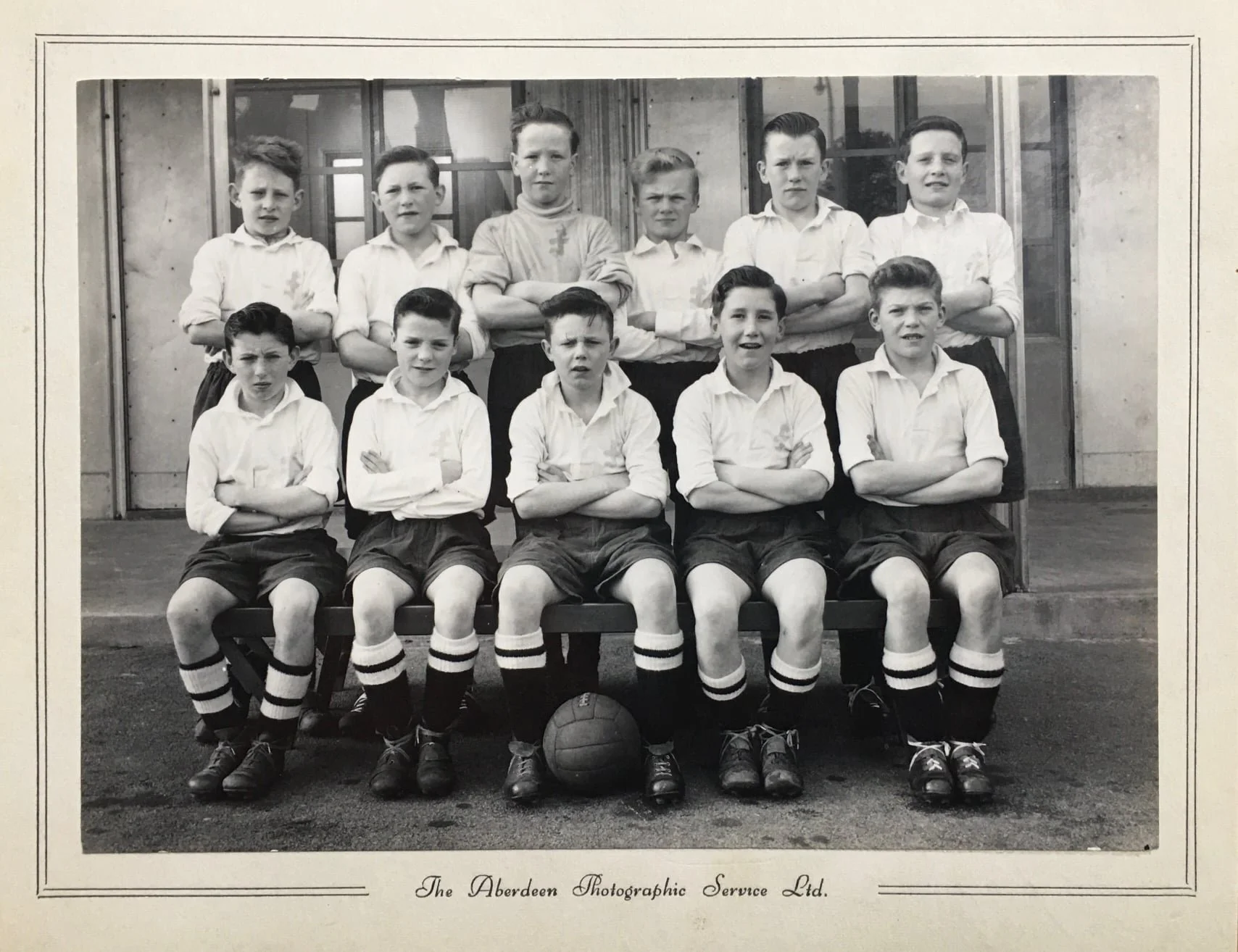
Alex, back row, 2nd from left - 1957 Edinburgh Primary School League Champions, School Board Cup Champions, Inspectors Cup Champions
Some football stories are about trophies, titles, and moments.
Others are about belonging.
Alex MacDonald’s story is the latter.
From a childhood shaped by displacement, to football as refuge and identity, to a life rebuilt through the game in Tasmania, Alex’s journey reminds us that football does not just develop players, it shapes lives.
This is his story, told in his own words.
Early Years: Football as Belonging
Football has shaped my life in ways I could never have imagined.
My earliest memories go back to 1951, as a six-year-old chasing a ball through the streets of Craigmillar in Edinburgh. Like every kid, I dreamed I was playing for Scotland. Life was cramped, three families living in a three-bedroom tenement, but to me it was full and alive. We slept four to a bed under army greatcoats and I thought nothing of it. Life felt good.
At seven, everything changed. My parents sent me to live with relatives in England while they waited to be allocated a new house. I felt abandoned, though I could not name it then. I still remember being put on a train at Waverley Station with a note pinned to my coat and a box of food.
I ended up in Anlaby, Yorkshire. Quiet, unfamiliar, and strange. School was hard. I sounded different. I was teased. Football became my way in.
When I scored a hat trick for the school team, everything shifted. Suddenly I belonged. That was the first time I understood what football could do.
Bill Sinclair and the Power of Coaching
When I returned to Scotland, I faced the same ridicule, my accent had changed again. Once more, football rescued me.
My teacher at Fernieside Primary, Bill Sinclair, changed my life. He ran football the right way, skills first, repetition, discipline, patience. We trained relentlessly, often without playing games. We learned to use both feet. He soaked leather balls overnight so we learned control under difficulty.
Over time, his methods worked. Our under-nine team became the “big team”. At twelve, I was named captain, the last name read out at assembly.
That season we went undefeated. Even the newspapers noticed. Scotland captain John Greig and Rangers player Ralph Brand presented our medals.
Looking back now, Bill Sinclair did far more than teach football. He gave a struggling child resilience, confidence, and belonging. I owe him more than I can ever say.
The Lost Years and a Chance Conversation
From fifteen to twenty-one, I think of my football as my lost years.
I was apprenticed in insulation and sheet metal, travelling constantly between power stations across Scotland and England. Football became fragmented. I trained wherever I landed, carrying a letter from my club asking permission to join sessions. Games were rare, but I trained with good players and coaches, and I enjoyed it more than I realised at the time.
As my apprenticeship ended, I played a friendly match back home. Afterwards, a man in the bar said a few young players were heading to Australia under the ten-pound immigration scheme.
“You’re good enough,” he said.
“Think of it as a two-year football holiday.”
Six weeks later, I was on a plane.
Australia, Tasmania, and Finding Home
I landed in Melbourne in 1967 and hated it. Football wasn’t even a thought. I just wanted to work, save, and go home.
Three months later, work took me to Hobart, and everything changed.
Hobart felt like home almost immediately. Football found me again through a chance pub conversation. One training session with Hobart Caledonian was all it took. I signed, and my Tasmanian football life began.
The Callies were a wonderful club, serious about football, strong socially, and welcoming. The standard surprised me. Hobart football was technically strong, driven by immigrant communities who valued skill and craft.
After two seasons, a representative match up north introduced me to Glenda, the love of my life.
Devonport City and Reinvention
Work took me to Devonport, where I trained with Devonport City during the week and travelled south on weekends. The club felt ambitious, energetic, and alive. Eventually, President Gordon Rimmer squared things off with Callies, and I signed.
That decision led to fifteen years with Devonport City.
The club had vision. Bingo funded facilities. Officials worked tirelessly. Trainers and physios were as good as any in the state. On the field, we were initially mid-table, but off it the club surged forward.
Personally, I found success, best and fairest awards, Sports Writers’ Awards, and rediscovered skills Bill Sinclair had instilled years earlier.
The turning point came with the arrival of Bob Oates, a professional from England. Hierarchies disappeared. I was moved from attack into central defence.
At first, I thought it was a demotion.
It wasn’t.
I thrived. I could read the game, organise, and lead. Devonport City arrived as a force, and I found my place.
The Final Years and What Football Gave Me
In the 1980s, statewide competition arrived. Devonport embraced it again, signing Steve Darby from Liverpool. His standards were high. We didn’t always have the quality to meet them, but I loved working under him and won another best and fairest.
By then, life was changing. We had a young family, land, and a house to build.
One day, walking off the pitch at Valley Road, I knew.
That was it.
I was 36.
Looking Back
I didn’t do too badly. Two state league best and fairests. Two Sports Writers’ Awards. Over thirty medals, including the very first ones I received at twelve years old.
But the greatest prize football gave me was Glenda.
Fifty years on, she’s still beside me.
Football shaped my life, in every sense.
— Interview edited and presented by Victoria Morton
He was our Kenneth
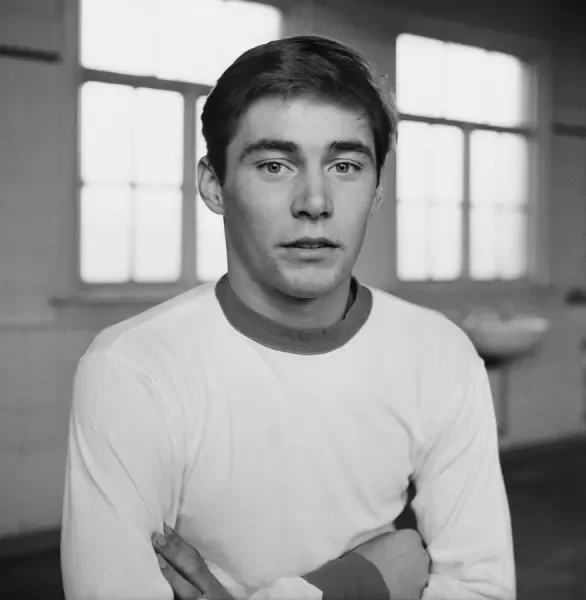
Ken at Aston Villa
Part One: Copley
Copley, 1947
He was born Kenneth Morton on 19 May 1947.
No middle name.
At home, Eddie and Edna called him Kenneth. Outside the house, particularly in the North East of England, he was Kenny.
He was our Kenneth.
Copley was small. One road through the village. Farmhouses set back off the lane. From the very top to the very bottom, barely a kilometre. Quiet enough that you noticed sound when it arrived.
When Ken talks about it now, he says it reminds him of All Creatures Great and Small. That same sense of countryside calm, of people knowing one another, of space to roam.
Sundays were special. Copley Sunday meant picnics, family together and football on any bit of grass that would allow it. Cousins were there. Neville and John Chapman. Neville would later play for Middlesbrough, but back then he was just older, fitter, someone to chase in the summer holidays.
Copley felt safe. Friendly. A farming community where people said hello, where they noticed if you didn’t have your ball with you. There were only one or two shops at first, a Co-op later. A handful of council houses. Not many children. Five-a-side or six-a-side at most. If the ball went over a wall, nobody complained.
Ken was an only child. Well looked after. Well cared for.
He was born in a terraced house, two or three in a row of five. There was a yard and across the driveway a patch of grass. Enough space to juggle, to practise, to wear the ground down. To have a kick without troubling anyone.
Eddie was a busy man. He ran a garage and helped the local farmers. Edna was kind and loving. Like most households of the time, it was disciplined and structured, but Ken never got into trouble. He was always playing football.
Their first house had a backyard. Over the lane was an allotment. That became another place to play. When they later moved to Copley Lane, there was a hot bath ready when he came home muddy and tired. Boots left at the back door. Football was never discouraged. It was simply part of life.
Ken remembers Auntie Effie and Auntie Gwenie, his aunties by marriage. Gwenie was a Sunderland supporter, so football talk and football history were always around. His dad was friendly with Gordon Coe, president of Evenwood Town Football Club. At the time, the club was bringing players in from the army barracks and Eddie spent a lot of time driving and picking them up. Football, again, was just there. Woven in.
One of Ken’s earliest football memories has never left him.
He would have been eight or younger, at a match between Evenwood and Bishop Auckland. The legendary Bob Hardisty was carrying the ball out of defence when Ken ran under the wooden barrier and took it cleanly off him.
He didn’t get into trouble. The Evenwood crowd applauded. Bishop Auckland supporters were less impressed, the tackle stopping the start of an attack. Hardisty looked shocked, then smiled. Ken remembers him coming over afterwards and shaking his hand.
He doesn’t think his dad was with him that day. He thinks he was on his own.
Football never arrived in Ken’s life. It was always there.
Other boys went to the beck, the stream that ran nearby, or into the woods. Ken went with the ball. Always with the ball. He can’t remember getting his first one, only that he always had one.
After school was his favourite time of day. Three o’clock. Dribbling in and out of the white lines painted on the road home, then straight up to the recreation ground. He walked to school every day, ball under his arm, even though there was a bus.
Breakfast was simple. Cornflakes. His favourite meal was beans on toast. Still is.
Winters could be harsh. Snow covered the roads. His dad would clear them with the plough, and Ken would jog behind it on the way to school. If the driveway was blocked, it was cleared so he could have a kick. Weather rarely stopped him.
He wore sandshoes most days, boots for football. They weren’t brilliant. Wet Saturdays were just Saturdays in the North of England. The sound of the ball on stone walls was a dull thud. His mother always knew where he was.
If he couldn’t get out, he read. Football annuals. Football cards. Licking his fingers to turn the pages while waiting for the chance to play again.
Television was black and white. Match of the Day on Saturday nights showed him new things. Different goals. Players running with the ball. Diving headers. The next day he would be out practising what he’d seen, alone if necessary, becoming Tom Finney or Stanley Matthews in his own mind.
He was good at other sports. Decent at cricket. A strong tennis player. A very good athlete. He won the 100, 200 and 400 yards at school. But none of it competed with football.
While other boys his age played in the woods, Ken, six or seven years old, played football with older boys at the rec. He was always challenged. Losing taught him resilience. When something went wrong, he worked harder. Got the ball out and battered it against the wall until it felt right again.
He didn’t talk much on the pitch. He let his football do the talking. He wasn’t a bragger. He was loved in the village. People noticed him without making a fuss.
He was never lonely. There was always a ball.
Looking back now, he says football was everything to him.
“If I look at it now,” he says, “it was like a marriage.”
When asked where home feels like now, he says it’s where we live today. But when we watch English television and he sees a village, a lane, a patch of countryside, he still says, smiling, just like Copley.
Copley gave him space.
Family gave him security.
Football gave him direction.
This is where the story begins.
Football Faces Tasmania Peter Mies
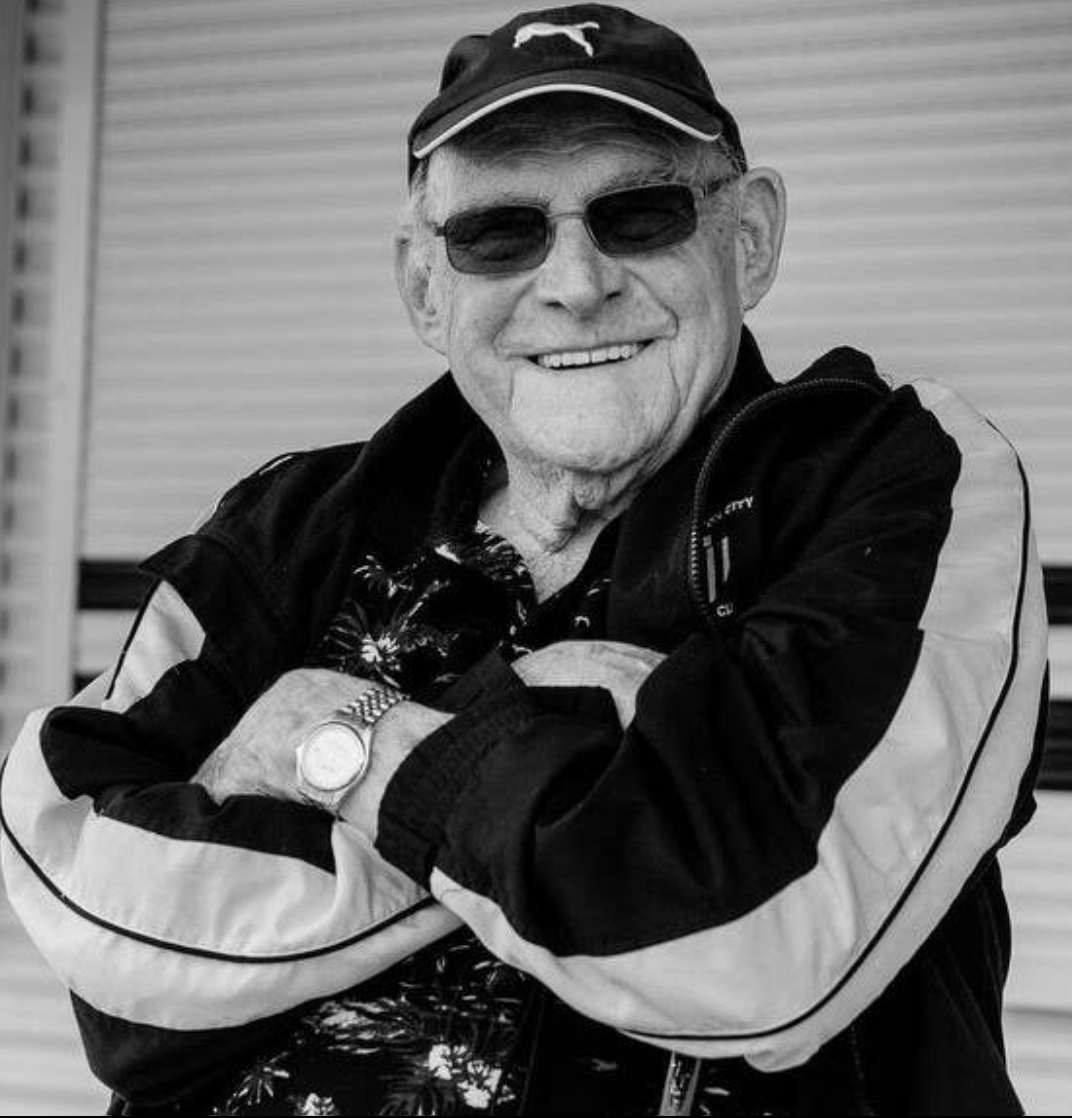
Peter Mies at Launceston Juventus.
Photo: The Examiner.
I interviewed Peter Mies some time ago, never imagining I would one day be sharing his words after his passing.
Peter’s life in football spanned decades, continents, clubs, and generations. He played, coached, captained, administered, volunteered and supported the game in Tasmania for over sixty years. More than that, football was how he found belonging as a migrant, how he built lifelong friendships and how his family remained connected across three generations.
This interview is shared largely in Peter’s own words. I have resisted the urge to polish or rewrite them. What follows is not a tribute written about him but a record of how he spoke about the game he loved, the people who mattered most to him and the life football gave him.
What are your first football memories and did any particular person instil a love of football into you?
On the push bike early Saturday mornings in Holland, aged seven. Playing football in the snow. It did not matter what the weather, I just loved to play.
How long have you been involved in football and what roles have you played?
I have been involved for seventy-five years. I have been coach, captain, Tasmanian representative, president, life member. I am still Club Patron of Launceston Juventus, LCFC.
You name it. I have done it.
Tell us what football was like in Tasmania when you first got involved. Was it better, worse, different? How has it changed?
Many players were migrants that came from Europe. The standard was generally better, some teams were better for sure. The players are generally fitter now though.
Did you have role models or football heroes, or anti-heroes for that matter?
Didi, Garrincha, Pelé, Cruyff, Maradona, Messi.
How has football affected you and your family?
When I arrived in Tasmania as a migrant, it was great to have football here so that I could continue playing and continue my love of the game. It was a great way to meet new people and make new friends that also loved the beautiful game.
I have continued this love of the game in Tasmania for over sixty years in all capacities. I have been fortunate to be involved as a player and coach and to win every major trophy on offer in Tasmania.
Football has been a massive part of my family, going across three generations, starting with me and still going strong. I have been fortunate that my son Roger had a great career and I followed him very closely. I also have five grandchildren that have all played football and I have followed them all through their childhood.
Roger’s children, Noah and Ryan Mies, in Launceston, and my daughter Olga’s children, Sam, Zac and Olivia Leon, in Hobart.
I always went with Roger everywhere, including interstate to watch him play as a junior, and then through his senior career. I never missed a game.
I also went interstate to watch my grandsons Noah and Ryan play. I would be watching Noah and Ryan play every weekend in Launceston, and if I was not watching them, I would be in Hobart watching Sam, Zac and Olivia.
Noah, Newcastle Olympic, and Olivia, Clarence Zebras, are still playing. I watch Noah every week on TV on YouTube. I am still very black and white when I watch Launceston City play every week.
Football has given a lot back to me.
Which Tasmanians have affected your involvement in football, both on and off the field, and why?
The biggest influence on my football career has been my beautiful late wife, Christina. She stood by me in everything in life and supported me in every role I had in football.
Christina also became a very well-deserved life member of Launceston Juventus, LCFC, for the many years she ran the club canteen. I lost count.
She always made the hamburgers fresh by hand the night before, as well as organising everything for game day. She helped with any club activities and loved watching me, her son, and her grandchildren play.
She was a great supporter of Launceston Juventus, LCFC, and football in general. A true lady.
If you could make any changes to Tasmanian football, what would you do?
Some aspects of the administration of the game. With all the computers and the like these days, something that should be relatively simple, such as rostering, seems to throw up outcomes that do not make much sense.
The rostering seemed more straightforward when it was run by volunteers with a pen and paper.
Looking back on your football life, what do you think your legacy to the game in Tasmania might be?
I began an amazing family dynasty, where myself, my son Roger, and my grandson Noah are the only family in Tasmanian football history to have three consecutive generations play for Tasmania.
I have overseen the rise of Launceston Juventus as a football powerhouse in Tasmania and have been involved in winning every major trophy available in the state. We are the only club in the north of the state that have played in every year of the State League or NPL since the 1960s.
I have always been an advocate for improving the standard of football in Tasmania and was instrumental in bringing key import players to Tasmania, for example Peter Savill, Peter Sawdon and the Guest brothers. These players helped raise the standard of the game through their own playing quality, but also gave back to Tasmanian football and worked with local players and juniors so they could improve for the betterment of the game.
I am very proud to be the Club Patron at LCFC.
I always played the beautiful game with total passion and commitment, hard but fair. I have kept that philosophy in the way that I have lived my life.
Football Faces Tasmania - Cathy James
Cathy James
Cathy James has moved on from Kingborough Lions now, but she remains one of the truly inspirational volunteers we interviewed.
Hard-working, dedicated, and quietly effective, Cathy is the kind of person every club relies on and rarely celebrates. She did not see her contribution as anything special. She simply showed up, again and again, and did what needed to be done.
This interview captures Cathy’s story in her own words, and reflects the care, commitment, and generosity that underpin community football in Tasmania.
Tell us YOUR story about how you became involved in football and what you love about the game and the community:
My “Football Story” is not one of wanting to be a Matilda – there were no Matildas in the 1970s. It is not one of having a “football hero” and following their career. My involvement in Football is an accident.
Growing up in Oakville, a tiny town (it had a school and a fire station) on the outskirts of Sydney. The readily available team sport option for girls was Netball. And yet, funnily enough, Matilda, Courtney Nevin, went to the same Primary School and played for the Oakville Ravens – which just shows how rapidly things can change in the world of Football.
My first Football memory is: “thank goodness, a sport other than netball”. Arriving at High School I discovered there were other amazing sports – hockey, cricket, volleyball and soccer. Soccer as it was still know then, didn’t rate highly against the other football codes, Rugby Union and Rugby League, and it was only played by English and European immigrants. However, soccer could be played by girls. There was one InterSchool Tournament per year and while I wasn’t a shining star, I was committed.
My real involvement in football began when I wanted my kids to play team sport – I chose Football. It was a sport I had enjoyed and it is also a sport that anyone at any age can play – it’s running; there is limited throwing or catching. With 3 kids playing for Kenthurst Soccer Club I put the boots back on and that was 20 years ago. And, in the meantime, 2006 FIFA World Cup and all of Australia fell in love with Football and the Socceroos.
The thing about sport is it’s a bridge-builder. When you relocate, whether it’s across town or to a new state, you can join a sporting club and you’ve got something in common with people in the community. 15 years ago, the family moved to Tasmania, into the Kingborough region, joined Kingborough Lions United FC and never left – well that’s 4 of us. Even after all these years, I cannot convince my husband of the merits of the round ball game.
While the game of Football has many highs and lows being involved in a Club can support people through their highs and lows. While in my playing days, I have often been described as “uncoachable”, I have always given 100% effort, pretty much like now as a volunteer. And, dare I say it, my best game of Football was played a few days after my Dad died fully supported by my Football family.
Another thing about being involved in a Not-For-Profit Community Sporting Club is, that without volunteers and money they don’t thrive. I have a lot of a “can do” attitude and my daily mantra is “how can I make a difference today”. I have been a player, a team manager, the Club Secretary/Adminstrator/Registrar, Kiosk Manager. I have enjoyed all the benefits of being a player – coaching, equipment, playing strip, facilities, so for me it’s a natural progression to “give back”. Registration fees do not cover all the costs required if Clubs were to pay people to do all the activities it takes to get teams on the park and down here in Clubland there are plenty of inspirational people to keep you going.
At Kingborough I’ve been lucky to play with and work with some incredible people. There are families here that have had multiple generations come through and I’m sure there are other Clubs that have benefitted from the same thing. The list of people in Tasmanian Football that inspire me is endless. Bernie Siggins was an amazing “can do and will do” man and was a true inspiration to all players and volunteers at Kingborough Lions United FC. Brian & Jill Dale truly love and care for their Club and have put years of time and energy into it. I know each Club has role models like these and they don’t do it for the acknowledgement they “just do it”.
Football in Tasmania is rapidly changing. Community Clubs are having to comply with regulations – food business, RSA, workplace health & safety, and recently COVID-19.
Clubs are small businesses with massive interests in their communities. We currently have 2 Clubs vying for selection to be WWC 2023 Base Camps; we’re building towards having A-League and W-League teams. Football has massive participation across males & females. It is a great time to be involved in Football in Tasmania. And, it is a great time to be a Volunteer in Football in Tasmania.
Football Faces Tasmania
Brian Roberts - much missed by myself and those in football.
Sitting around my kitchen table with my friend, photographer Nikki Long, we talked about something that has bothered me for a long time.
So many people who are deeply loved, deeply committed, and deeply embedded in football in Tasmania are largely invisible. They are known within their clubs and communities but rarely beyond them. Their work is constant, often exhausting and almost always unpaid. And yet their stories are seldom told.
We wondered what might happen if we simply made them visible.
That conversation became a Facebook page called Football Faces Tasmania.
We started interviewing people from across the game. Coaches, volunteers, administrators, parents, quiet achievers. People who have given years, sometimes decades, to football here.
What struck me immediately was this: almost without exception, every person we interviewed said some version of the same thing.
“I’m not really worthy.”
“My story isn’t anything special.”
“There are plenty of others more important than me.”
That reflexive modesty is telling. It says a lot about the culture of football in Tasmania and about who feels seen and who does not.
I disagree with every one of those assessments.
These stories are special. They are worthy. They are the story of the game.
I conducted the interviews and transcribed them. Nikki took the photographs. Together, the words and images capture people as they actually are, thoughtful, generous, worn, proud, funny, uncertain, committed.
I will be publishing these interviews here, with their photographs, as a record and a recognition.
Not to elevate anyone above others.
Not to create heroes.
But to say, clearly and publicly: you matter, your contribution matters and this game does not exist without you.
This is Football Faces Tasmania.
BRIAN ROBERTS
What are your first football memories and did any person instill a love of football into you?
My first memories are during my childhood being taken to watch Wrexham F C and Rhyl Athletic play on Saturday afternoons. I also played for my preparatory school Oriel House where I obtained my colours. I subsequently attended Repton Public School where I played for my house The Mitre.
I do not think anyone instilled a love of the game it was a way of life. My father played for the family firm.
How long have you been involved in football and what roles have you played?
In 1951 we came to Tasmania settling at 7-mile beach where we ran the shop. I tried out with Caledonians but did not make it, to unfit and slow.
Football when we came to Tasmania was going through a transition. the influence of the migrant was being felt accordingly the style of the game was changing from that akin to Australian Football to that which we see today.
You held some influential roles in Tasmanian Football how has it changed from when you were in charge? Tell us what football was like in Tasmania when you first got involved, was it better, worse, different? How has it changed?
After moving to town, I was with the Southern Tasmanian Soccer Federation as their new club’s officer. I had to contact migrant groups to see if they could start a soccer team. I arranged a match between Italian and Greek migrants but their clubs didn’t come to life until later. I only succeeded once assisting in the foundation of Hollandia a Dutch team. I subsequently joined them and played in their reserve side most of the time after a while I moved to Hydro a team based in their drawing office. I played in their 1st team. We were not very successful. Hydro them changed their name to Rangers and started importing players from Scotland. I continued to play for them in the reserves.
I then took a break I cannot remember why. Later a typewriter mechanic Tom McLoughlin who had played with Rangers and used to service our office equipment persuaded me to join him as assistant Coach at Rapid. This was step up as they were one of the better teams. I also used to play in the reserve team.
One of my workmates Jurgen Webb was with South Hobart and he pestered me constantly to join him at South. I eventually did so as all my English-speaking friends had left Rapid, so I moved clubs. Rapid were not very happy.
On joining South, I was immediately recruited on to the committee where I served as Treasurer for 13 or 14 years. At the same time, I coached the underage sides the first and reserve sides and played in the reserves (we were a pretty awful side full of old men). I get tired thinking about those years. I was probably about 55 when I played my last game in Alps a side that had been absorbed into the South machine. One of my happiest recollections is when we won the league under Tony Skaro. It was a very good team. We went to the Cascade where all these old players or supporters kept putting money on the bar. More of that later.
During my time with South, I took a spell of leave and was elected as a director of Soccer Tas. I served for about 6 years rising to Chairman. Due to a difference of opinion, I resigned and returned to South in an advisory role.
Which Tasmanians have affected your involvement in football both on and off the field and why?
One of our chairmen who had a major impact on our club was Les Richardson. Through his influence we acquired the Clubrooms at Wellesley Park. They had originally been built by the South Hobart Cricket Club. They moved to Queenborough, so the rooms were not occupied full time. We purchased the key to the door for $10000 payable in 5 instalments. Through economy and struggle we met the payments though the last year we were late so had to pay an additional penalty. At the time we were the only football club to have permanent office and headquarters. The licensed bar that came with the purchase materially helped our financial management. I do not know how many hours I spent swinging a mattock digging the trenches for the floodlighting of Wellesley Park.
Soccer then went through what I would call the lunatic stage. The first state league was formed. South did not make it. However, that was just as well as professional football hit the state. Money flowed like water. This did work to our benefit as those senior players who were displaced by imports came to South, so we had a very good Div. 1 side. Then the bubble burst the league collapsed and we were all back to square one. Things were pretty tough as all the players we had signed left so the ranks were pretty thin. Nevertheless, we struggled through and survived.
Did you have a role model or football heroes or anti-heroes for that matter?
I do not have any heroes or otherwise however three persons who have had the most impact on South are Brett Anderton, Victoria and Ken Morton. When Brett arrived, we were just a club. He changed our routines and introduced a professional aspect to us on our on and off field standards. Ken took over a few years after Brett departed. He lifted our standards and expectations to a higher standard which continue to this day. Victoria Morton has also made a major contribution to our clubs standing in the football community. I cannot let this pass without mentioning Pam Clarke, her son played for South, so she graduated to the committee then chairperson. She was at the helm during some of our most trying times and worked extremely hard for the club. Another stalwart that comes to mind is Paul Roberts, no relation. How he came to join us I cannot recall probably through junior ranks. Paul was a tower of strength, he maintained the clubrooms, set up the field when we had home games at Wellesley. He used to set up for our home games as dawn broke. Eventually we persuaded him that such early starts were unnecessary. His constant topic of conversation was the drums. We eventually found out that he had a store full of 44 gallon drums in which he stored his collection of cans, cordial, and milk bottles.
Which recalls one of our fundraisers. One Sunday when we were not playing the committee, players and supporters canvased the South Hobart area for milk, cordial bottles, and cans. We would then deliver to the Cascade bottle department for money.
Hilarious happenings, in 1977 we won the Div. 1 league under our new coach Tony Skaro. It was the event of the decade as we had little success for a long time. We obtained a supply of port from an individual whose name is etched in my memory. “You will be OK as long as you only sell it to club members”. It was stored under my house. Well, it took off like a house on fire, perhaps it was the novelty but there was a stream of “supporters” calling for a bottle or two. We presented the licensee of the Cascade hotel with a bottle as sign of our appreciation of his support. His wife was delighted, he not so much. What we did not realize that there was a representative of the licensing board at the bar. Next thing there was a knock on the door and a port collector asked if he could buy a bottle for his collection. OK I said. Next thing cars appeared, and all these detectives spilled out and I was arrested for running a “sly” grog shop.
A friend of mine who was a solicitor in town heard of my situation and decided he would defend the case as a bit of a lark. We spent close to a day in court to the surprise of the prosecuting counsel. The guy who sold us the port gave evidence with an angelic expression on his face. I could have!!!!!!!!! him. The case was adjourned as the magistrate could not give decision. Eventually I had to return, and a conviction was recorded under the probationary offender’s act. The port which had been seized was returned on condition it was stored and consumed in the club house. I still have a bottle.
How has football affected you and your family?
Football must have affected my family though with the passage of time it has faded away. I must say that when things were thin on the ground for the club, I probably spent 4 or 5 nights working for the club. How I kept my domestic life up to scratch I do not know
If you could make any changes to Tasmanian football, what would you do?
Now what changes would I make? Well promotion and relegation for a start. I would examine the cost structures and try to make the game as inexpensive as possible. I would review the FFT staffing structure. Tasmania is too small for us to ape mainland structures. I would try to expand our game by encouraging the formation of Div. 5 or 6 clubs. Large oaks from small acorns grow.
Looking back on your football life what do you think your legacy to the game in Tasmania might be?
How will I be remembered, well for about a fortnight or so then perhaps at the occasional football reunion?