
Bringing the Game into Disrepute

I’ve just read a post on Tassie Football Central.
It’s anonymous.
Written under the name “George Best”.
It raises concerns that people within Tasmanian football feel unable to speak openly. That when issues are raised, they are often met with silence, or at least the perception that nothing changes. It points to real pressures in the game, referees, clubs, competition demands.
But its strongest message is not the problems themselves.
It’s the feeling that people cannot safely talk about them.
And that’s the part that matters.
When people stop putting their name to things
Football people are not shy.
They stand on sidelines in the cold.
They volunteer.
They argue, they care, they show up week after week.
So when those same people feel the need to go anonymous, something has shifted.
If people feel unheard, they don’t stop speaking.
They just stop putting their name to it.
There is a system. So why aren’t people using it?
On paper, there is a pathway.
Clubs can contact Football Tasmania, usually through staff and the CEO.
There is an AGM.
There is a Board.
But there is no clear, regular forum for open discussion.
And the Board does not engage directly with the community it governs.
Everything is filtered.
And when communication through that filter is unclear or inconsistent, people don’t feel heard.
They feel managed.
And over time, they stop engaging.
The silence before the silence
This is how frustration builds.
Not through confrontation.
Through absence.
Emails that go unanswered.
Questions acknowledged but not addressed.
Decisions made without explanation.
Information shared late, or not at all.
That is how people learn.
Not that they can’t speak.
But that speaking doesn’t lead anywhere.
The phrase we all know
“Bringing the game into disrepute.”
It exists for a reason. To protect the game from genuine harm.
But in an environment where communication is unclear, it can start to feel like something else.
A line people hear in their head before they speak.
Be careful.
Don’t push too hard.
Whether that is intended or not doesn’t really matter.
If people feel it, it shapes behaviour.
This is where it turns
Because there must be a clear difference between:
Damaging the game
and
questioning how the game is run
If that line is not visible, people will always choose the safer option.
They won’t stop speaking.
They’ll just speak differently.
Privately.
Quietly.
Or anonymously.
This isn’t just frustration
It would be easy to dismiss the anonymous post.
But anonymous voices don’t appear out of nowhere.
They are a signal.
That people don’t feel heard through the existing system.
And that is not a social media issue.
It is a governance issue.
The real risk
The risk is not criticism.
The risk is disengagement.
When clubs stop asking questions.
When referees feel unsupported.
When volunteers step back.
That is how the game weakens.
Not loudly.
Quietly.
So how did we get here?
Not through one decision.
But through a pattern.
A gradual erosion of communication.
A lack of visible transparency.
A growing gap between those making decisions and those living with them.
And eventually, a point where someone feels safer being anonymous than being themselves.
What happens next
This is the moment that matters.
Not to defend.
Not to dismiss.
But to listen.
Because if people feel unheard, they will find other ways to be heard.
The question is whether the system listens before anonymity becomes the norm.
Final thought
“Bringing the game into disrepute” should protect football.
It shouldn’t be the phrase people hear when they are deciding whether to speak up.
Because if that’s where we are, then the issue isn’t the anonymous voice.
It’s the environment that created it.

Membership 101: Who Actually Gets a Vote?

AGM season always brings questions.
Watching Spurs struggle to stay up, and with United about to play Chelsea, there was a quiet moment to think between games.
This year, one of those thoughts came from Evelyn.
On Tassie Football Central, responding to my recent blog, Evelyn described years of trying to engage with Football Tasmania. Asking about the AGM. Wanting to be involved.
Then, after seconding a board nomination, something changed.
An invoice arrived.
A membership fee.
For many clubs, that is the first real indication that membership exists. Not an explanation. An invoice.
This is not about any new constitution that may be introduced. It is about how the system operates now, under the current constitution.
It is a simple story, but it opens up a bigger question.
What actually is “membership” in football governance?
Start here: membership is not automatic
This is the part most people do not realise.
Running a club does not automatically make you a member of Football Tasmania.
Registering players does not make you a member.
Competing every weekend does not make you a member.
Under the current constitution, membership is a separate, formal status.
You have to be admitted.
So how do you become a member?
This is where things become less clear.
The constitution says that an organisation can apply for membership, and that the Board determines whether to admit that application.
Admission is not automatic. It sits with the Board.
That is the rule.
But it does not explain, in practical terms:
who you contact
what you submit
how long it takes
or what the exact criteria are
So the process exists.
But it is not visible.
Why membership matters
Membership is not symbolic.
It is the gateway to governance.
Only members:
attend General Meetings
vote at AGMs
elect the Board
If you are not a member, you are outside that system.
Even if you are deeply involved in football every week.
Clubs, associations, and where your voice sits
There is another layer that makes this more complex.
Not every team, club, or school program sits as a direct member of Football Tasmania.
In many cases, regional bodies, like junior associations, are the recognised members.
That means thousands of players, across multiple clubs and schools, may sit behind a single vote.
At the same time, some clubs may hold direct membership and vote in their own right.
So the question is not just whether you are a member.
It is also where you sit in the structure, and how your voice is represented.
Not all votes represent the same base
Membership is not just about being in the room.
It is also about how representation works.
A regional body with thousands of participants may hold one vote.
A single club may also hold one vote.
That is how many governance systems operate.
But for most people in the game, it is not visible, and not well understood.
The role of fees
Evelyn’s experience, and others, point to another layer.
There can be a membership fee.
I found an invoice issued to South Hobart Football Club in 2024, $110, referencing a by-law.
So yes, there is a cost attached.
But the important question is not the fee itself.
It is understanding what that fee gives you.
Does it confirm membership?
Is it required to maintain it?
Unless that is clearly explained, clubs are left to interpret it themselves.
Timing matters too
Another question that is not clearly answered.
When do you need to be a member to vote at an AGM?
Is there a cutoff date?
Can a club become a member just before a meeting?
The constitution does not set this out in a way most people would find or understand.
So how would you know?
This is the heart of Evelyn’s comment.
Unless:
someone tells you
you go looking
or you read the constitution closely
You probably would not know how membership works.
And most volunteers running clubs are not reading constitutions.
They are organising teams, managing parents, lining fields and doing all the hundreds of other jobs required.
What this means in practice
It creates a quiet gap.
Clubs assume they are part of the system.
But the formal pathway into governance sits somewhere else.
Defined.
But not clearly explained.
What is missing
This is not just about a fee.
It is about clarity.
If membership is the gateway to governance, then every club should know:
how to become a member
whether they already are one
what qualifies them
what it costs
what rights it gives them
and when they need to act before an AGM
These are not hypothetical questions, or questions about a future model. They sit within the current structure.
And when AGM notices are sent, that information should be front and centre.
Not assumed.
Not buried.
Not left to interpretation.
Because this is about voice
Football in Tasmania runs on volunteers.
People who give their time every week to keep clubs going.
Those people should not have to decode governance structures to understand how to participate.
They should be able to see the pathway.
A simple question this AGM season
Evelyn’s experience leaves us with a simple question.
Are we actually members?
And if we are not, how would we know?
In football, we talk constantly about player pathways.
It might be time we created one for clubs.
Before we forget what a football club feels like
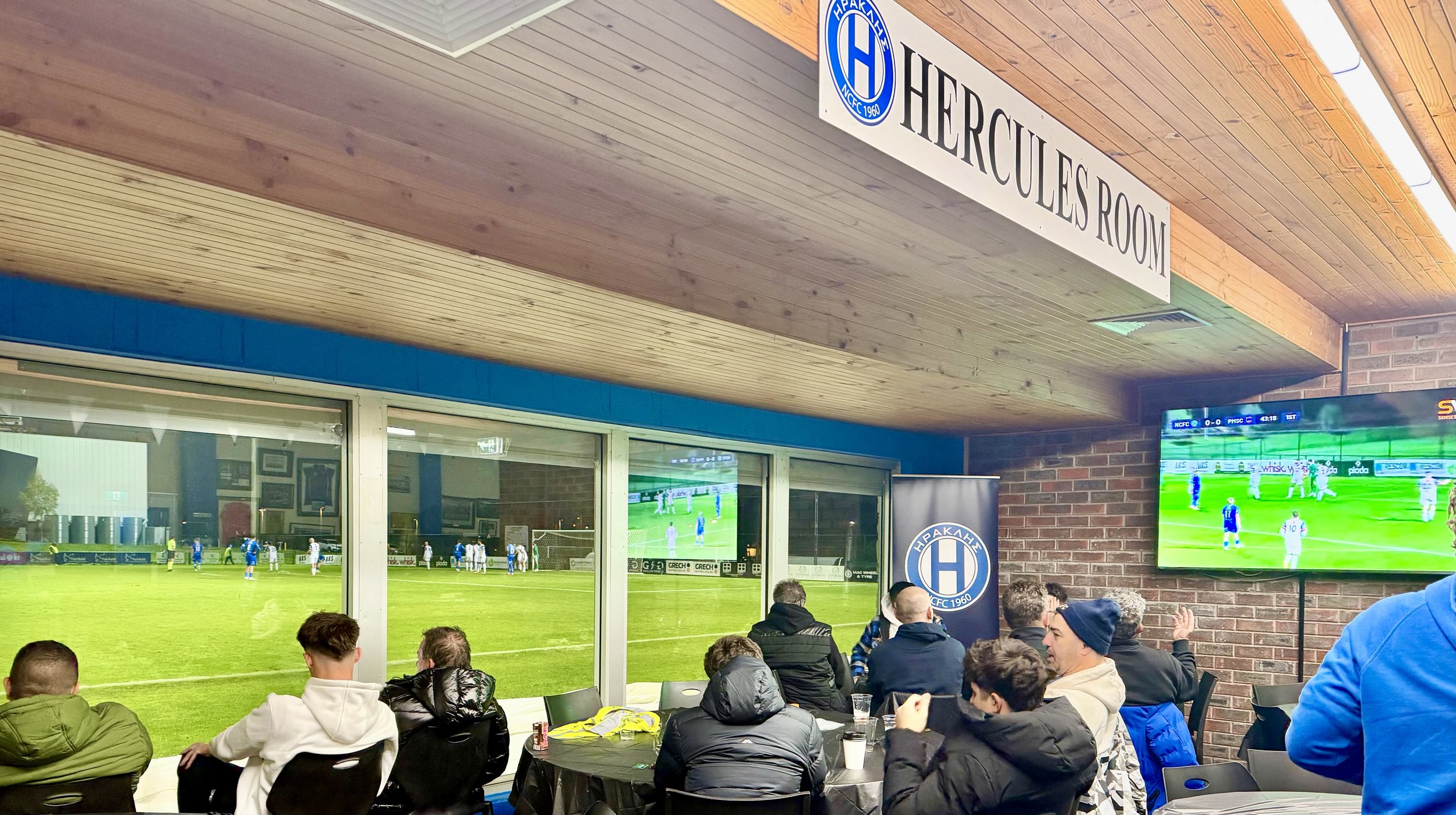
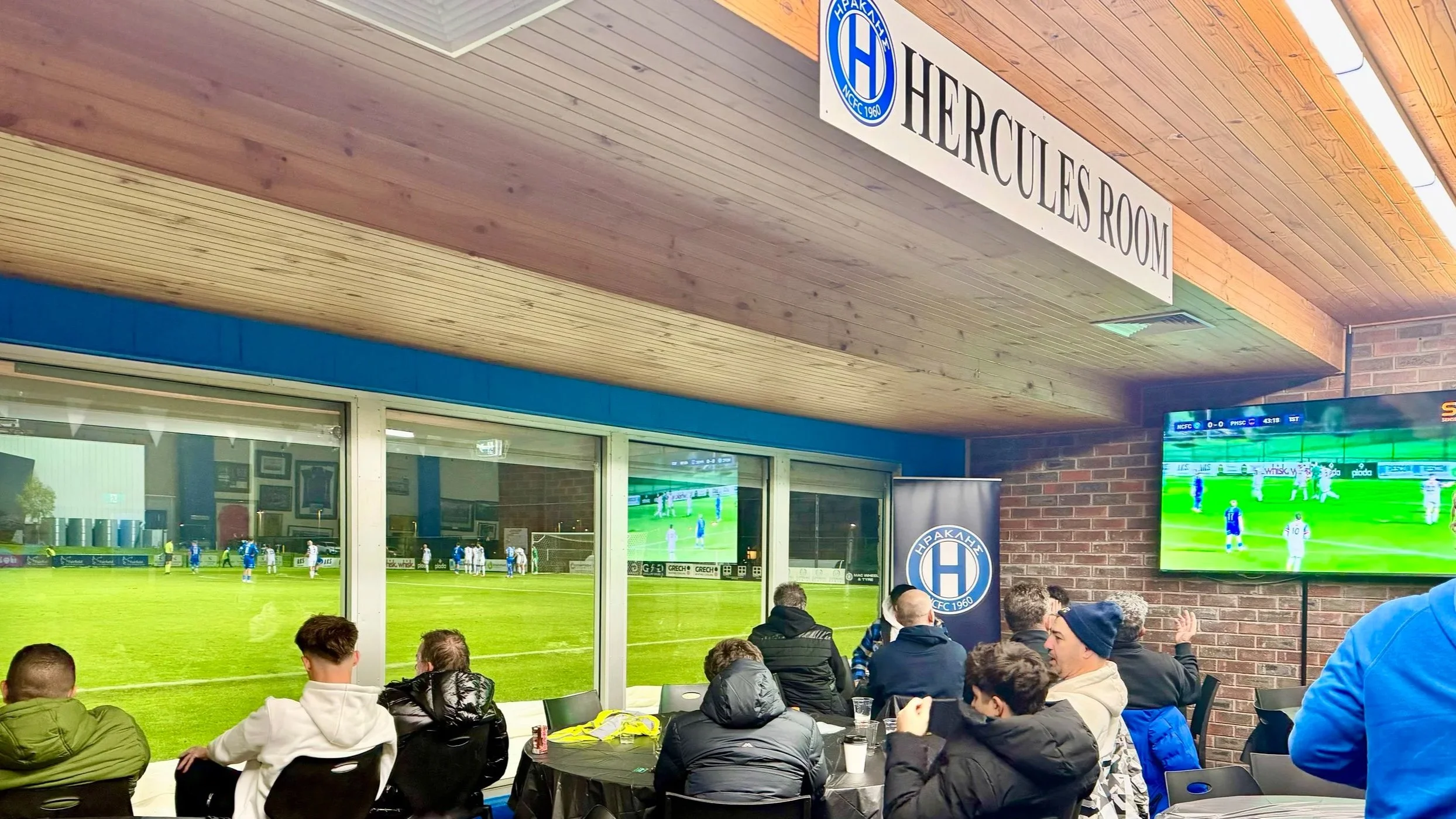
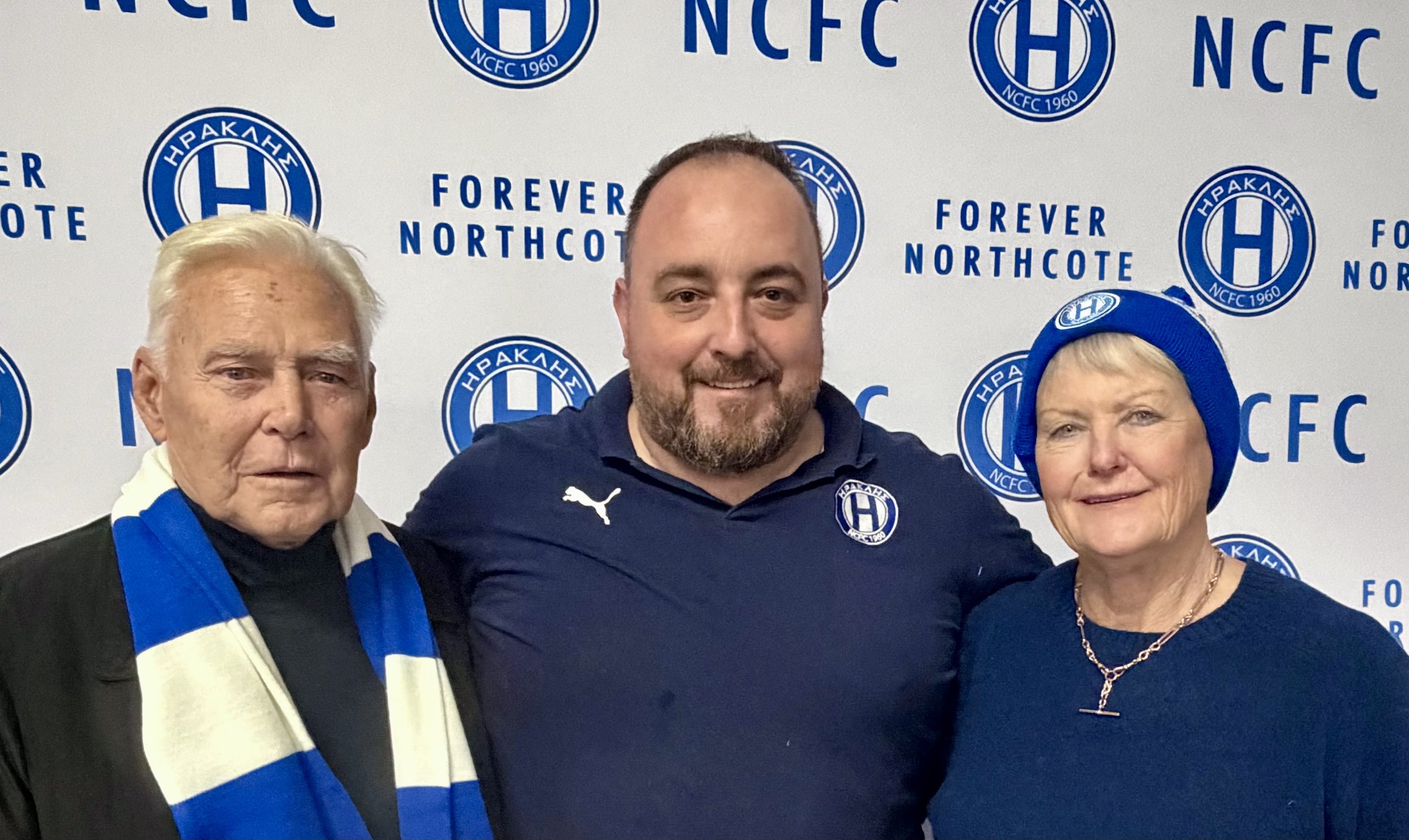
It is a cold Friday night in Melbourne, at Northcote City FC where my son Max is coaching.
Tonight I am a mother. A guest. Watching.
I have felt versions of this at grounds all over the country.
This is not unique.
But on this night, it is here.
The lights are on.
The pitch is perfect.
And there is football being played.
But that is not what stays with you.
You smell it before you see it
Before you even get inside, you know.
The smoke hits you first.
Souvlaki on the grill.
That unmistakable smell drifting across the ground.
It pulls people in.
Not just for food.
For connection.
Then the welcome
You are not just allowed in.
You are welcomed.
Handshakes.
Smiles.
People stopping to talk.
And then:
“Oh, you’re Max’s mum.”
Just like that.
You are known.
I felt comfortable.
I felt welcome.
I felt proud.
And then the generosity
It doesn’t stop.
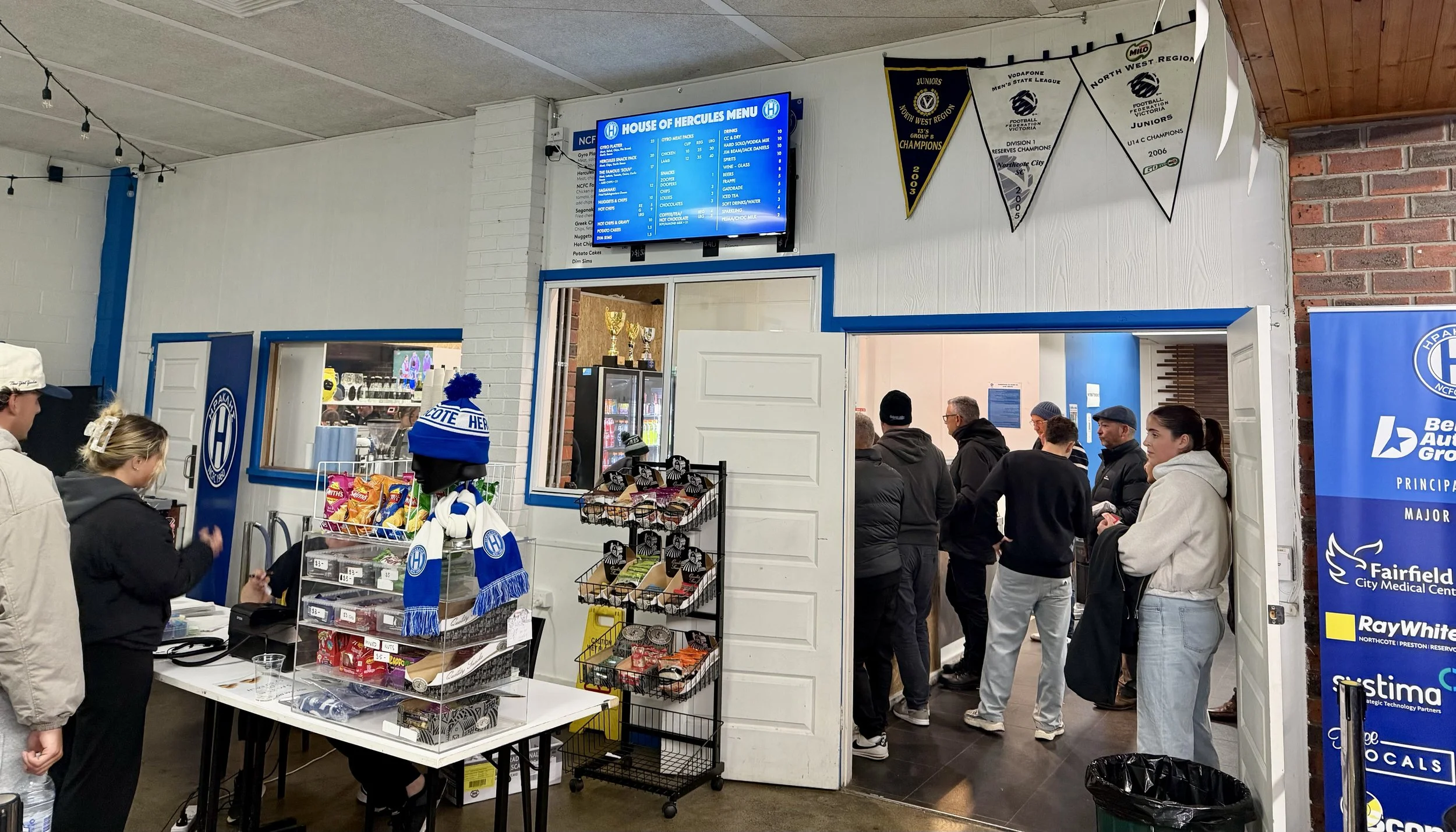
Greek salad.
Saganaki.
And of course the melt-in-the-mouth lamb and chicken souvlaki.
Hot jam donuts.
Steaming hot tea pressed into your hands.
“Are you sure you don’t want more?”
You haven’t even finished what you have.
And still it comes.
You go to pay.
And they won’t let you.
Not for anything.
You try.
But they insist.
Endless generosity.
Blue and white, and everything that comes with it
Then you start to notice the rest.
Blue and white everywhere.
Scarves. Walls. Shirts.
Trophies lining the room.
Not for show. For memory.
This is not just a club.
This is heritage.
Greek language in the air.
Conversations that have been happening for decades.
Old friends meeting again.
Friday night.
Home game.
Same place.
Week after week.
Year after year.
This is not an event.
This is tradition.
This doesn’t happen by accident
It would be easy to call it hospitality.
But it is more than that.
This is culture.
Built.
Protected.
Passed on.
And fragile.
Inside, the same feeling
Inside the clubrooms it continues.
People everywhere.
Talking.
Laughing.
Watching through the windows.
No one rushing off.
No one disengaged.
The football is outside.
But the club is happening inside.
A whole-of-club identity
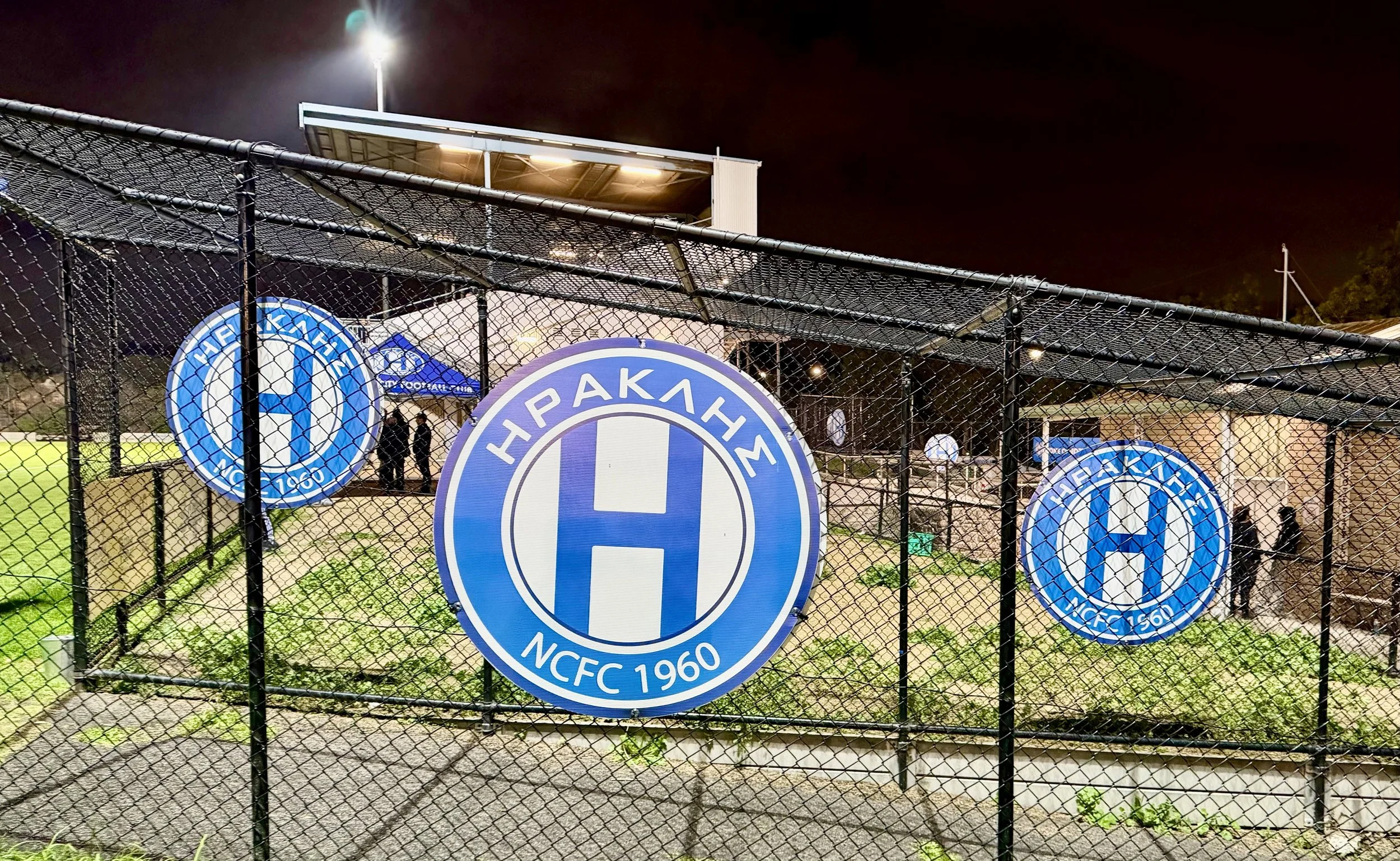
Talking to Michael, their president of nearly eight years, it becomes clear this is deliberate.
Juniors.
Women and girls.
Seniors.
Everyone matters.
Everyone belongs.
And that shows.
And it takes work
A lot of work.
If you are a club person, you know this.
It doesn’t just happen because people care.
It happens because people give their time.
Their energy.
Their weekends.
Their lives, in some ways.
Michael has three kids at the club.
That is why he is there.
Just like me with South Hobart.
We joked that with the youngest playing U14s, he has a few years to go before he can step down.
But the truth is, people like that don’t really step away.
Once you are in it, you stay.
Maybe not in the same role.
But you keep helping.
You keep turning up.
You keep stepping in when needed.
Because that is what clubs are built on.
Because this can be lost
Clubs like this don’t survive because of strategy.
They survive because of people.
And if we stop valuing this, if we overlook it or take it for granted, it disappears quietly.
Not with a headline.
Just with a slow drift away from what made clubs special in the first place.
Because this is what football is supposed to be
In a time where football feels increasingly structured, managed and measured, nights like this matter more than ever.
It is not transactional.
It is not polished.
It is human.
It smells like smoke.
It tastes like shared food.
It sounds like familiar voices.
It feels like belonging.
And maybe the question isn’t how we build better systems.
Maybe it’s whether we still remember how to build clubs like this.
Because if we don’t, they don’t last.

Why Football Clubs Should Never Ignore AGM Season

Every year Football Tasmania makes decisions that shape the game across this state, and every year many of the clubs most affected by those decisions leave their seats empty when it matters most.
Competitions change.
Boards are elected.
Voting rules can shift.
Constitutions can be amended in ways that shape football for years.
Yet when the moment comes to influence those decisions, too many clubs are absent from the room.
That moment is AGM season.
And in Tasmanian football, it matters more than many realise.
The meeting most clubs underestimate
Every year, Football Tasmania holds its Annual General Meeting.
For many clubs, the AGM is treated as procedural:
reports are tabled, elections are held, paperwork is approved.
But an AGM is not just administrative ritual.
It is one of the few formal moments when the members of Football Tasmania exercise their real democratic power.
This is where:
directors are elected,
constitutional changes are voted on,
leadership is questioned,
governance direction is shaped.
A change in voting rules, a board election, or a constitutional amendment can alter who holds influence in Tasmanian football for years.
If clubs are absent from that process, they are absent from the room where decisions are made.
Football Tasmania belongs to its members
This is worth repeating because many people misunderstand it.
Football Tasmania is not a distant authority floating above clubs.
It is a member-based organisation.
Its authority comes from its affiliated clubs and associations.
That means:
the clubs are not outside the governance structure.
They are the governance structure.
And every member club matters.
A small rural club.
A junior-only club.
A volunteer-run regional association.
Each has a place in the democratic framework.
That is one of the fairest features of football governance.
But fairness only works if members participate.
The constitution is the most important football document most clubs never read
A constitution sounds dry.
But in governance terms, it is everything.
It determines:
who gets to vote,
who can nominate candidates,
how board elections work,
how meetings are run,
how power is distributed.
Most clubs never read it.
Yet when disputes arise, or major decisions are made, the constitution is the rulebook everyone suddenly wishes they understood.
AGM season is often when constitutions are amended, governance rules are tested, and clubs discover too late how much those documents matter.
That is why this season deserves attention.
Timing matters too
Under Football Tasmania’s constitution, the AGM must be held within five months of the end of the financial year.
That creates a strict governance clock.
There is only a limited window each year in which:
elections can occur,
constitutional amendments can be adopted,
members can formally exercise voting rights.
As that deadline approaches, the governance calendar tightens.
Important governance decisions rarely happen by accident.
They happen because the calendar requires them to happen.
Silence creates concentration
Many clubs say they feel unheard.
Yet many of those same clubs:
do not attend AGMs,
do not nominate candidates,
do not submit motions,
do not ask questions.
That creates a quiet paradox.
Clubs often feel powerless while leaving their power unused.
When fewer members participate, fewer voices shape outcomes.
That is not conspiracy.
That is arithmetic.
Silence creates vacuum.
Vacuum creates concentration.
And then decisions begin to feel distant.
The danger of sideline governance
Tasmanian football has developed a familiar habit.
People react loudly after decisions are made.
But reaction after the event is not governance.
It is commentary.
Governance happens before decisions are final:
when agendas are circulated,
when constitutions are reviewed,
when nominations open,
when votes are cast.
If your club has strong opinions about Football Tasmania but no one attends the AGM on its behalf, that silence is not neutrality.
It is surrender.
The empty chairs matter
At every AGM there are empty chairs.
Those empty chairs represent:
absent voices,
unused votes,
surrendered influence.
They matter.
Because every empty chair makes it easier for a smaller number of people to shape the future of the game.
Healthy governance is not quiet.
Healthy governance includes:
questions,
debate,
contested ideas,
active participation.
Noise is not disorder.
Noise is democracy working.
A question for every club this year
As AGM season approaches, every club should ask:
Who is representing us?
Have we read the agenda?
Do we understand the constitutional rules?
Are there questions we should be asking?
Are we using the vote we already have?
Because if clubs want stronger governance in Tasmanian football, the answer is not silence followed by frustration.
The answer begins by entering the room.
When the decisions are made, will your chair be empty?
In six weeks’ time, Football Tasmania’s AGM will arrive whether clubs are ready or not.
The decisions taken there will shape leadership, rules and influence across the game.
When that moment comes, every club has a choice:
Leave the chair empty and accept whatever follows.
Or turn up, take your place, and make some noise.
Customers complain upward.
Owners show up.

Nothing Was Wrong With the Appointment, Except One Thing

A Routine Football Decision
Union Berlin needed a new head coach.
Results had stalled, pressure had mounted, and Steffen Baumgart was dismissed. In football, this is not unusual. Clubs make these decisions every season. Managers come and go. Interim appointments are made. The cycle moves on.
So when Union Berlin announced they would promote from within, there was nothing remarkable in that decision.
In fact, it looked like the sort of calm, rational football choice clubs make all the time.
The replacement was already inside the system.
This was someone who knew the squad, understood the club environment, and had already been trusted within Union Berlin’s senior football structure. Continuity matters in moments like these, and internal appointments are often the least disruptive option.
A Résumé Built for the Role
And the qualifications behind this appointment are hard to dismiss.
The football credentials are formidable.
A UEFA Champions League winner with Turbine Potsdam in 2010, followed by multiple domestic league titles during one of Germany’s strongest football eras.
There is international pedigree too.
Germany’s Under-20 World Cup-winning national team setup also forms part of the résumé, meaning elite tournament football has shaped this career from the beginning.
When injury ended the playing career early, the move into coaching followed a serious pathway rather than a ceremonial one.
There was work in Germany’s youth national team development system.
Then came progression into Union Berlin’s football structure.
In 2023, Union Berlin promoted this coach into its senior men’s first-team environment, working directly alongside Bundesliga coaching staff.
Since then, the experience has only deepened:
involvement with Union Berlin’s senior men’s squad
leadership of Union Berlin’s Under-19 men’s team
prior touchline responsibility in Bundesliga match conditions
In football terms, this is a résumé clubs trust every week.
Elite honours.
International pedigree.
National development coaching.
Bundesliga staff experience.
Direct involvement in men’s senior football.
On paper, it looked like exactly the kind of interim appointment football makes every week.
A logical internal promotion.
A club choosing stability over panic.
The Reaction That Made No Football Sense
And yet the online reaction was immediate and ugly.
Union Berlin publicly denounced the attacks directed at the appointment, making clear the club stood fully behind its new coach.
Not tactical criticism.
Not serious debate about whether another candidate was better qualified.
Not concern over lack of experience.
The hostility was clearly not about football alone.
Which is what makes this story revealing.
Handed only the football résumé, most supporters would likely shrug and say:
fair enough.
A sound appointment.
A reasonable choice.
The outrage only becomes understandable when you discover what some people could not accept.
The résumé had not changed.
The experience had not changed.
Only the lens through which some people viewed it.
The One Detail That Changed Everything
Union Berlin’s new interim head coach is Marie-Louise Eta.
Marie-Louise Eta is a woman.
That is what triggered the backlash.
Not lack of qualifications.
Not lack of experience.
Not lack of merit.
Football’s Real Barrier
Football likes to call itself meritocratic.
But moments like this expose the fault line beneath that claim.
And that should trouble football everywhere, because Berlin is not an exception. It is simply the example we can see most clearly.
The barrier was never a shortage of qualified women.
The barrier was football’s refusal to see them.

Annus Horribilis: South East United and the Hardest Decision a Club Can Make

There are seasons when football reminds us that behind every ladder, every fixture and every regulation is something far more fragile than points tables.
People.
South East United have announced that they have made the difficult decision to withdraw from the Southern Championship and Championship 1 competitions for the remainder of the 2026 season.
Football Tasmania has since issued the formal procedural notice confirming what follows: fixtures involving South East United will be removed from the records, played results voided, and goal-scoring statistics erased.
That is how football administration works.
But nothing about this story feels administrative.
Because this is not simply about a club withdrawing from competition.
This is about a club enduring what can only be described as an annus horribilis.
In recent months South East United have suffered the death of their president, Glen Roland, a loss that struck at the heart of the club. Glen was not simply a name on paperwork or a committee office bearer. He was one of those people community football depends on, the kind who build clubs through belief, persistence and countless unseen hours of volunteer labour. South East United’s growth carried his imprint. He represented the optimism behind the club’s ambitions and the quiet work that keeps regional football alive.
And now this.
The fact that this decision has come from the club itself makes it no less painful. If anything, it speaks to the burden carried by those still trying to hold things together, making hard choices not because they want to, but because sometimes protecting the future of a club means stepping back in the present.
Ambition in football is not a dirty word.
Regional clubs should dream.
They should try to rise.
They should test themselves against stronger opposition and imagine bigger futures for their players and communities.
South East United did exactly that.
Sometimes in Tasmanian football we are too quick to treat struggle as failure, when often it is simply the cost of trying to build something ambitious in an environment where margins are thin, volunteers are stretched, and one or two devastating blows can shake the foundations of an entire organisation.
What has happened at South East United could happen to any club.
That is the part worth remembering.
Today is not a day for ridicule or whispered judgment.
It is a day for compassion.
For recognising that football clubs are living community institutions, vulnerable to grief, burnout and circumstance.
The hope now is not for quick fixes or harsh assessments, but for the time and space every grieving club needs to regain its footing.
Because clubs like South East United matter.
Not only when they are climbing.
Especially when they are hurting.

Governance Is Not Sexy

Governance is often invisible until people begin to feel its absence
I’ve been thinking a lot about governance recently.
Not in an abstract sense, but in what it actually feels like for members.
Because there’s a difference between having rights, and feeling like those rights matter.
Governance rarely excites people in football. It does not come with the colour and emotion of match day. It does not fill grandstands or create highlight reels. But in football, especially in Tasmania, it shapes competitions, pathways, clubs, and the decisions that affect how the game is experienced at every level.
At its simplest, governance is how decisions are made, who makes them, and how those people are held to account.
And that matters more than many realise.
What works on paper
On paper, Football Tasmania has the foundations you would expect of a modern sporting body.
Its constitution sits comfortably within the framework of contemporary corporate governance. Members can vote. Directors are elected. Meetings can be called. The structures exist.
And on paper, that sounds reasonable.
But governance is rarely tested on paper.
It is tested in moments.
When decisions are contested.
When clubs disagree.
When members simply want to understand what is happening and why.
That is where governance becomes real.
Because having rights is one thing.
Feeling like those rights matter is something else entirely.
The gap between rights and reality
What I keep coming back to is this: much of football governance still operates as a compliance model.
The rules are there.
The processes exist.
The requirements have been technically met.
But modern expectations in sport have moved beyond that.
Across Australia, good governance is no longer measured only by whether rights exist. It is measured by whether those rights are visible, accessible, and meaningful to the people they affect.
It is not enough to say members have a vote.
People need to understand how decisions are made before they ever get to that point.
Because if you have to go searching for answers, something is already out of balance.
A vote every few years is not the same as feeling heard.
When information sits at the top
When information stays at the top and only moves when it has to, a gap forms.
And people fill that gap themselves.
Not always because decisions are wrong, but because they are not clearly understood.
Over time, that creates distance.
You hear it in clubrooms, on sidelines, and around grounds.
What happened there?
Who made that call?
Why?
Those questions do not come from nowhere.
They come from people trying to make sense of processes they cannot see.
A clear example is the recent decision to expand the NPL competition and move to an 18-round season, communicated to clubs after many had already begun preparations for the 2026 season.
The merits of that decision are open to debate.
The governance issue lies in how it was experienced by clubs, as something significant, affecting planning, budgets, staffing and player preparation, delivered after many had already begun shaping their season around different expectations.
That is where governance is felt most sharply.
Not simply in the decision itself, but in how and when people are brought into it.
And once that distance forms, it is hard to pull back.
When silence fills the gap
If we are honest about our game, and honest with its stakeholders, and by stakeholders I mean the people who live and breathe football every week, the volunteers, clubs, coaches, parents, players, and the readers of this article, then decisions should not feel mysterious.
Yet this season there have been decisions that have raised questions, and in some cases there has been little clear communication about why they were made.
That absence matters.
Because when decisions are not explained, silence fills the gap.
And silence is not neutrality in governance. It is a choice.
It creates uncertainty, frustration, and speculation where clarity could have built understanding.
If there were a stronger sense of connection between the board and the wider football community, if decisions were accompanied by clearer reasoning, even unpopular outcomes would be easier to accept.
People can live with decisions they disagree with.
What is harder to live with is not understanding them at all.
What happens when governance doesn’t feel real
When people cannot understand the process, they do not simply ask questions.
They begin to step back.
Volunteers disengage.
Clubs stop expecting answers.
Frustration replaces trust.
And over time governance stops feeling distant and starts feeling irrelevant to the very people it is meant to serve.
That is dangerous in community sport, where the whole system depends on participation and goodwill.
You can sometimes see that disengagement in the quietest moments.
At last year’s AGM, there were moments where the silence in the room felt heavier than any spoken disagreement.
Not because silence always means consent, but because it can also reflect uncertainty about whether speaking up will make any practical difference.
That kind of silence is worth noticing.
It suggests a disconnect between the formal right to participate and the lived confidence that participation matters.
Governance fails long before constitutions do.
Consultation only works if it matters
Consultation is often presented as evidence of engagement.
But consultation only works if people believe it matters.
Otherwise it becomes a process people go through, not one they believe in.
And once consultation feels performative rather than meaningful, trust erodes quickly.
It is much harder to rebuild than it is to preserve.
This is cultural before it is structural
What is interesting is that the changes needed are not structural in the first instance.
They are cultural.
This is not primarily about rewriting constitutions.
It is about changing the mindset from:
What do we have to share?
to:
What would actually help our members understand this better?
That is a very different question.
One is about compliance.
The other is about connection.
Because governance in sport is not simply a system of control.
It is a relationship.
Leadership sets the tone
This kind of governance does not happen by accident.
It requires leadership that is comfortable being visible, open to feedback, and willing to explain decisions, not simply make them.
Transparency explains decisions.
Accountability stands behind them.
I was reminded of this recently when a question put to the CEO was answered with the view that members should take their concerns to the Board they elected.
In one sense, that answer is constitutionally correct. Boards are elected by members, and boards appoint and oversee chief executives.
But it also reveals something deeper about governance culture.
If accountability is experienced only as deflection upwards through the structure, rather than as shared responsibility across leadership, members are left feeling further removed from the decisions that affect them.
Formal governance may still be intact.
But lived accountability begins to feel distant.
Trust is the whole game
Like any relationship, governance depends on trust.
If members can see how decisions are made, if they understand how outcomes are reached, then even difficult decisions can hold.
If they cannot, everything becomes harder than it needs to be.
Disagreement is not the problem.
Opacity is.
A strong game deserves strong governance
Tasmanian football has strong foundations.
Clubs are sustained by people who care deeply.
Volunteers give up countless hours.
Parents drive children across the state.
Coaches, referees and administrators carry enormous unseen loads because they believe in the game.
Governance should reflect that same strength.
Not simply by meeting requirements, but by building confidence.
The question that matters
I do not think the real question is whether members have rights.
The question is whether those rights feel real.
Because in the end, governance is not about clauses and constitutions alone.
It is about whether people feel connected to how their game is run.
Because governance only works when the people beneath it still believe it belongs to them.
Seatgate: We Now Know How Clubs Applied. We Still Don’t Know How They Knew
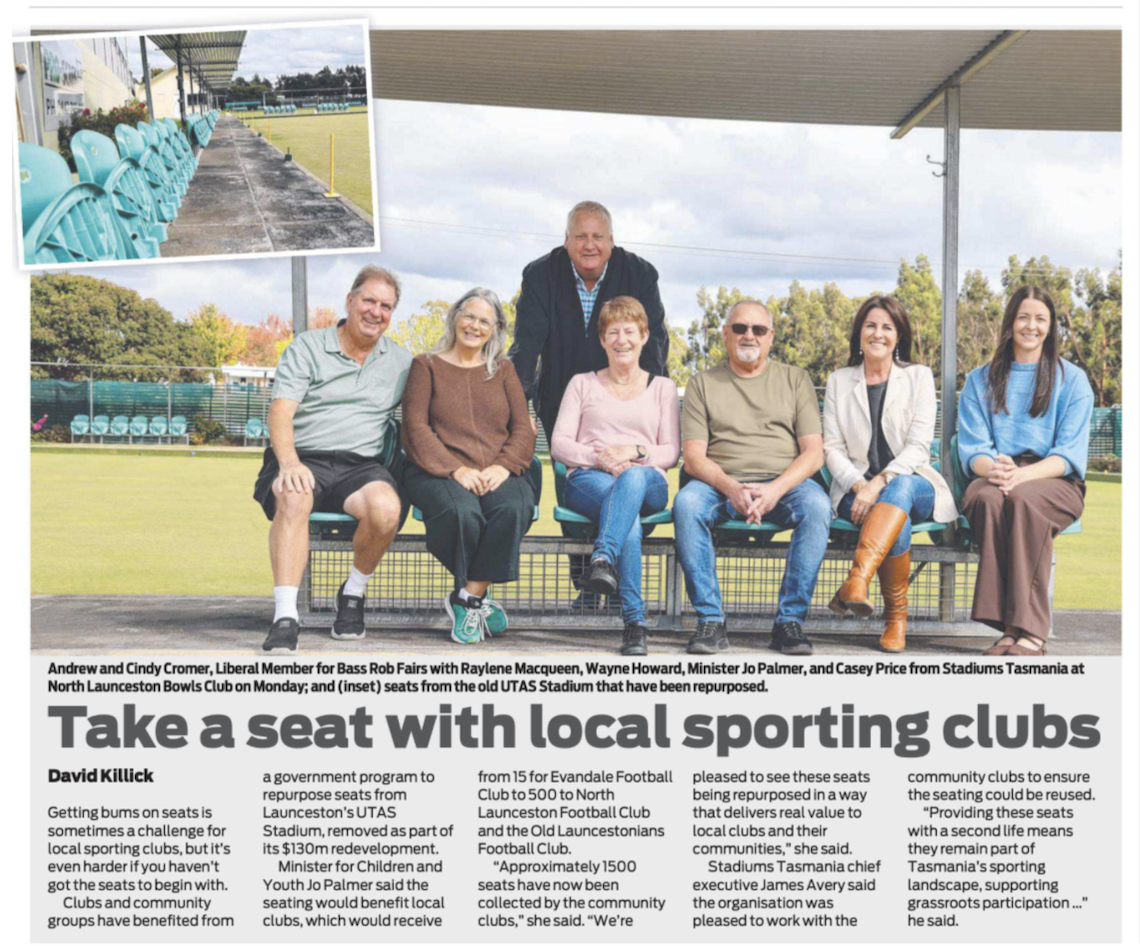
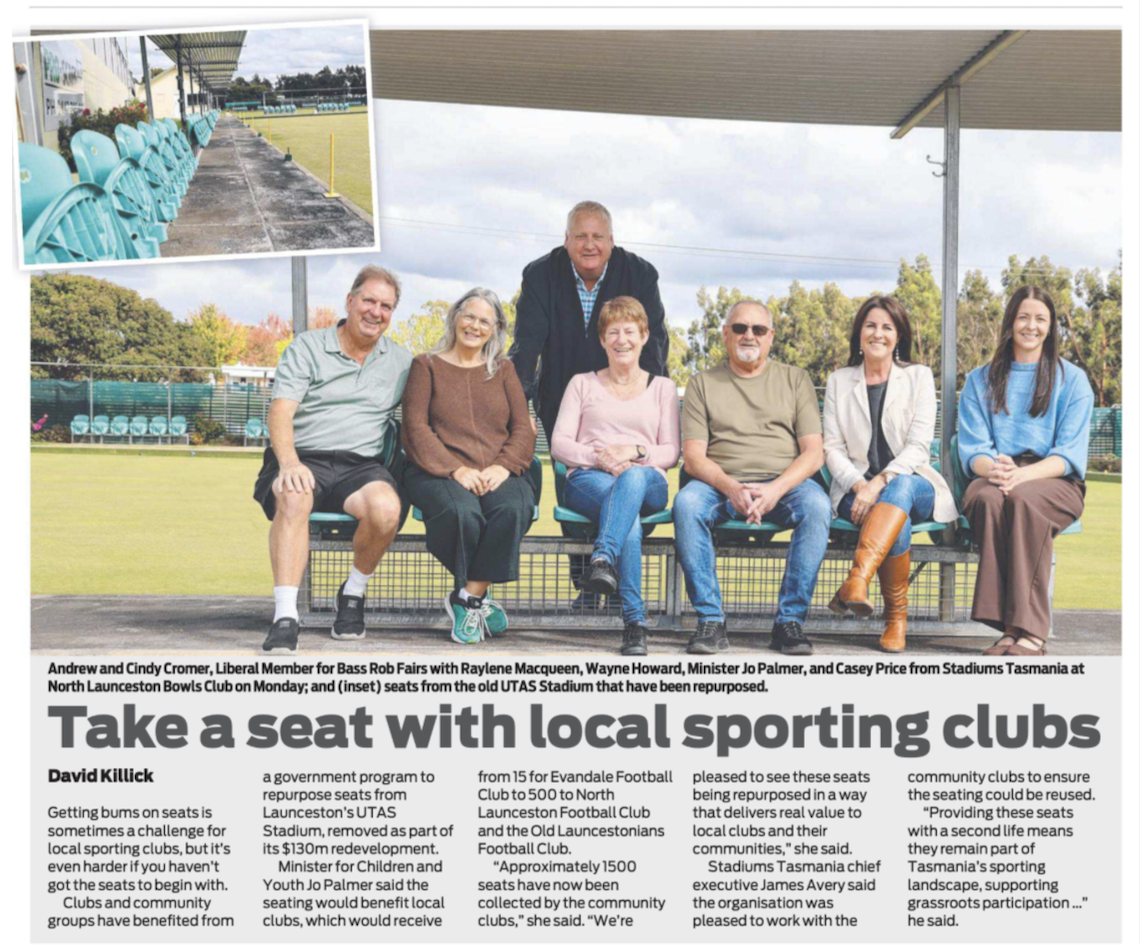
After I wrote recently about the redistribution of 1,500 seats from UTAS Stadium to 15 northern Tasmanian sporting clubs, a football volunteer from the north, Josh Perry of Rosevears, sent me something useful.
He had written directly to Jo Palmer’s office asking about the process.
The response from Jo Palmer’s electorate office was polite, prompt and helpful.
And it clarified one important point.
The clubs applied through Stadiums Tasmania.
That answers one part of the question.
But not the most important part.
What Has Been Confirmed
Jo Palmer’s office has now made clear that this was not a selective allocation process.
Clubs were not hand-picked.
They applied.
That matters, because it confirms the distribution itself appears to have been fair.
The government’s original statement, that every club that applied received what they asked for, now makes practical sense.
So let us be clear.
This is not a story about favouritism.
It is not a story about AFL clubs doing anything wrong.
And it is not criticism of Jo Palmer’s office, which responded transparently.
What Still Has Not Been Answered
The central question remains untouched:
How were clubs told the seats were available?
That is the missing link.
Because unless we understand how the opportunity was communicated, we still cannot answer why no northern football clubs appear on the list.
Not:
Launceston City FC
Not:
Launceston United FC
Not:
Riverside Olympic FC
Nor the many Championship, community and social football clubs across the north that would also have benefited.
Clubs where spectators still stand on sidelines.
Clubs where parents bring folding chairs from home.
Clubs where even a small bank of seating would make a real difference.
The Missing Link
The application pathway is now clear.
The communication pathway is not.
Was there:
a public expression of interest?
direct email contact to clubs?
notice through governing bodies?
circulation through AFL Tasmania?
circulation through Football Tasmania?
Those details matter.
Because if the opportunity was widely circulated and football clubs simply did not act, that tells us one story.
If it was circulated unevenly, that tells us another.
At the moment, we do not know which is true.
This Is About More Than Allocation
The seats themselves are not the controversy.
Reusing them is a good idea.
Giving them to community sport is a good idea.
The issue is not where they ended up.
The issue is whether all sports had equal opportunity to know they were available.
That is a very different question.
And a very important one.
An Uncomfortable Possibility
There is another possibility too.
Football clubs may well have known.
And simply not acted.
If that is the case, then this is not a government problem.
That is a football problem.
And perhaps that is the harder conversation.
Because missing out through exclusion is frustrating.
Missing out through inaction is something else entirely.
So Where Does This Leave Us?
We now know:
clubs applied through Stadiums Tasmania
the allocation process itself appears fair
Jo Palmer’s office has clarified that much
What we still do not know:
who was told
how they were told
whether all sports received equal notice
Until that piece is answered, the story is incomplete.
Because in this case, the real issue is not the seats.
It is the silence around how clubs were invited to claim them.
The Question Still Stands
So the question remains simple.
Who was told, and how?
Because until that is answered, football still cannot know whether it missed out because it was absent from the room, or because it never knew the door was open.
Continue Reading
Sometimes the most revealing part of a process is not the allocation itself.
It is how quietly the opportunity was announced.

When Shame is the Weapon: A Warning From One Of Our Own

There is a cruel kind of crime that depends on silence.
It begins with trust.
A message online.
A conversation that feels genuine.
A connection that seems to fill a lonely space.
Then, suddenly, the threat arrives.
This week Matthew Rhodes, known to so many in Tasmanian football through Tassie Football Central, shared publicly that he had been the victim of sextortion and blackmail.
When he rang me to tell me what had happened, I tried to lighten the moment with humour. I laughed and said that if they wanted to put the body of a young person on my old face, well, that was hardly the worst thing in the world.
Humour can sometimes be how we hold difficult things at bay.
But beneath that moment was something deeply unsettling.
Because this is not funny at all.
This is not really a football story, and yet it is.
Because football communities are made of people, and Matthew is one of ours.
Over the years, through Tassie Football Central, we have come to know him in that familiar modern way that communities know the people who show up every day. We know his passion for Tasmanian football. We know his enthusiasm. We know the way he writes, his jumbled spelling and tangled words, imperfect and unpolished, but unmistakably his. They are our jumbled spelling and words now, part of the voice many in this community recognise instantly.
And we also know something else about Matthew.
He has spoken openly on his page about his mental health struggles. He has written honestly about loneliness, about difficult days, about the parts of life many people hide. That openness is brave, but in the wrong hands it can also make someone visible to predators.
Scammers look for vulnerability.
They scan profiles, posts and public comments for clues about who may be lonely, isolated, grieving or emotionally exposed. What many of us read as honesty and courage, they read as opportunity.
That is part of what makes this so cruel.
What is sextortion?
Sextortion is a form of online blackmail.
Typically it begins when someone creates a fake identity online and forms a connection with a victim. That connection may be flirtatious, emotional or simply friendly. Over time, trust is built. The scammer then persuades the victim to share private images, or creates fake manipulated images, and uses them as leverage.
The demand is simple and brutal: pay money, or the images will be sent to family, friends, employers or published publicly.
Sometimes there are no real images at all. Increasingly scammers use edited or AI-generated material simply to create fear.
The threat is the weapon.
The shame is the currency.
Why these scams work
These crimes are not successful because victims are foolish.
They work because they are carefully designed to exploit human vulnerability.
Loneliness.
Isolation.
Grief.
A desire for companionship.
These are not weaknesses. They are ordinary parts of being human.
Matthew himself wrote movingly about believing he had found someone who cared. That is painful to read because it is so recognisable. Many people know what it is to long for connection.
That longing is what predators exploit.
What to look out for
There are warning signs people should know:
Someone online becomes emotionally intense very quickly
They push conversations onto private messaging apps
They ask for intimate photos or videos early
They create urgency, secrecy or emotional pressure
They threaten immediate exposure unless money is paid
If threats begin, experts are clear: do not pay.
Paying rarely ends the blackmail. It often encourages more demands.
If this happens to you
If you are targeted:
Stop responding immediately
Keep screenshots and evidence
Do not send money
Report it to police and the eSafety Commissioner
Tell someone you trust
Seek emotional support
The scam thrives in silence.
Speaking breaks its power.
Matthew’s courage in going public
What Matthew has done by speaking publicly is brave.
Scammers rely on embarrassment to keep victims quiet. Public honesty removes that leverage. It says clearly: I will not carry your shame for you.
And that is the truth at the centre of this.
The shame belongs entirely to the criminals.
Not to the people they deceive.
Not to the people they manipulate.
Not to the people who trusted.
Matthew is not defined by what happened to him.
He is a victim of a calculated crime, and by sharing his experience he may help protect others from the same trap.
That matters.
Because if there is one lesson here, it is this:
This can happen to anyone.

What Parents Carry in Tasmania’s State Team Journey

It was hard not to notice the latest Emerging Matildas results.
My first reaction, if I am honest, was anger.
Who do we blame?
What is going wrong?
Why does Tasmania keep finding itself here?
Perhaps that anger came from recognition, because after decades in Tasmanian football, these scorelines still sting precisely because they are so familiar.
But that reaction did not sit well with me for long.
Every goal conceded is carried by a child, a young player who loves this game and has dared to aspire higher.
Every scoreline reflects not just a result, but the effort, hope and vulnerability of young footballers representing their state as bravely as they can.
So I found myself asking a different question:
What does this actually feel like for the families and players inside the experience?
I spoke with the parent of one Tasmanian player, anonymously, to allow honest reflection without placing a family or child under public scrutiny. What follows is one family’s lived experience of a system many of us see only through results.
The scoreboard never tells the whole story
What emerged was not bitterness or blame.
It was pride in the journey, belief in the value of the experience, and realism about the hard truths of elite youth football from a small state.
“It’s the journey, not just the game,” she told me.
She spoke not only of her daughter, but of the wider group of girls, watching them grow through pressure, disappointment and shared ambition.
“These girls share the joy and the heartbreak,” she said. “That matters.”
What struck me most was how often she spoke about the whole squad rather than just her own child, proud not only of one daughter’s effort but of a collective group of girls carrying Tasmania together.
And despite the defeats, she would do it again.
“To watch her giving the best in Australia a crack is worth every cent.”
What families really invest
The financial cost is substantial.
Around $3,200 is the direct cost of sending her daughter to the tournament itself.
Then come the additional costs: months of statewide travel for training, petrol, accommodation, flights, car hire, family travel to attend the championships, kit and all the incidental expenses that gather around representative sport.
For this family, the true cost will exceed $6,000.
But money is only part of it.
There are months of planning, hours on the road and family schedules constantly rearranged around training camps and football commitments.
This is not simply paying for football.
It is committing a family to a dream.
Dreams need realism too
“Don’t crush their dreams,” she said. “But keep it realistic.”
Tasmania is a small football state competing against jurisdictions with vastly larger player pools. New South Wales and Victoria can field multiple teams in each age group. Tasmania cannot.
That tyranny of numbers is real.
Many Tasmanian families, she said, came into this tournament buoyed by last year’s Origins success, believing Tasmania might arrive as one of the stronger sides.
But national championships are another level entirely.
“Origins compared to Nationals is like comparing the Hobart Cup to the NPL,” she said.
It is a sharp comparison, but an accurate one.
For her, realistic success is not national titles.
“Top eight would be massive for our kids.”
That feels like a benchmark worth hearing.
Not every loss tells the same story
One of the most revealing parts of her account was Tasmania’s match against Queensland.
Tasmania did not win.
But in her view, it was the side’s best performance of the tournament.
The girls pushed Queensland hard enough that their opponents kept their first goalkeeper on the field throughout.
That detail stayed with her.
It meant Tasmania had made one of the strongest states take them seriously.
“They didn’t get the win,” she said, “but we were proud of their play.”
Heavy defeats can flatten public perception into a single narrative of failure, when tournaments are really made up of smaller stories: moments of courage, competitiveness and progress that do not always show on ladders.
The emotional cost of heavy defeats
But heavy defeats leave their mark.
Some losses, she admitted, are emotionally brutal.
A scoreline like 13–1 is not forgotten when the whistle blows.
Young players carry those moments back into dressing rooms, hotel rooms and long nights away from home.
At national tournaments, defeat happens in full public view, which makes resilience even harder won.
And it raises a difficult question:
At what point does exposure to elite competition remain constructive learning, and at what point does repeated heavy defeat begin to erode confidence rather than build it?
That is not a criticism of players.
It is a question every development pathway must ask itself.
The questions families still ask
Her strongest concern is preparation time.
She believes selections should happen much earlier, as soon as current programs finish, giving squads longer to train together before facing the strongest teams in Australia.
More time together would mean:
better cohesion,
better tactical understanding,
less rushed preparation,
and more time for families to financially plan.
She also raised something I have heard before in Tasmanian football circles: some parents are unclear how selections are ultimately made.
Whether that perception is accurate or not, it matters that it exists.
If engaged families inside the system do not fully understand selection logic, Football Tasmania has a communication challenge.
And beyond selection lies the bigger unanswered question:
What exactly is the pathway trying to achieve?
Is it:
identifying one or two elite players for national pathways?
exposing Tasmanian players to higher-level football?
building competitive state teams?
Without clear public benchmarks, families are left to interpret the system through results alone.
And results rarely tell the whole truth.
Losing, resilience and the small-state dilemma
I have lived this pathway too.
I went through it with two of my own sons years ago, watching Tasmanian teams walk into national tournaments knowing the odds were often against them.
Ken has always said that in football, losing can become a habit, not because players stop trying, but because repeated defeat shapes expectation.
The harder question for Tasmania is how to break that cycle when the tyranny of numbers is real.
How does a small state build belief when larger states arrive with deeper squads and stronger depth?
There is no easy answer.
But children are often more resilient than adults imagine.
That was true in our family, and it is true in this parent’s story too.
Young players recover faster than we think.
They absorb setbacks differently.
They turn disappointment into determination in ways adults often underestimate.
More than football
Perhaps her most important line was also her simplest.
“This game is more than football. It is life skills and character building.”
That feels true.
These tournaments are not only about ladders and placings.
They are about young people learning:
how to compete,
how to lose,
how to recover,
how to persist.
That is not nothing.
But if Tasmanian families are investing this much money, time, emotion and faith into the pathway, then they deserve clarity in return.
Clearer benchmarks.
Clearer purpose.
Clearer communication about what success is meant to look like.
Because what parents carry in Tasmania’s state team journey is far heavier than a result sheet can ever show.
A Licence Is Not a Strategy
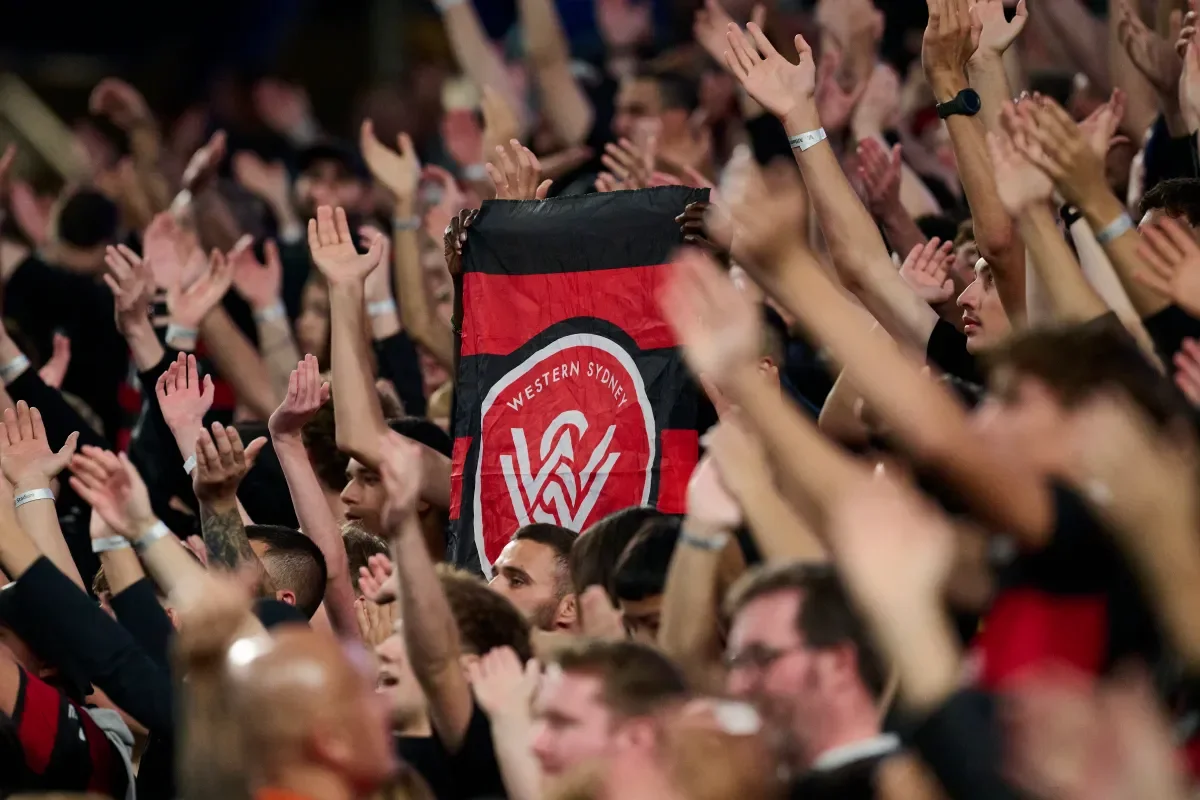
Getty images
Over the weekend I read several comments about how far Western Sydney Wanderers FC have fallen.
That struck me.
Because when the Wanderers began, they were everything football people dream about.
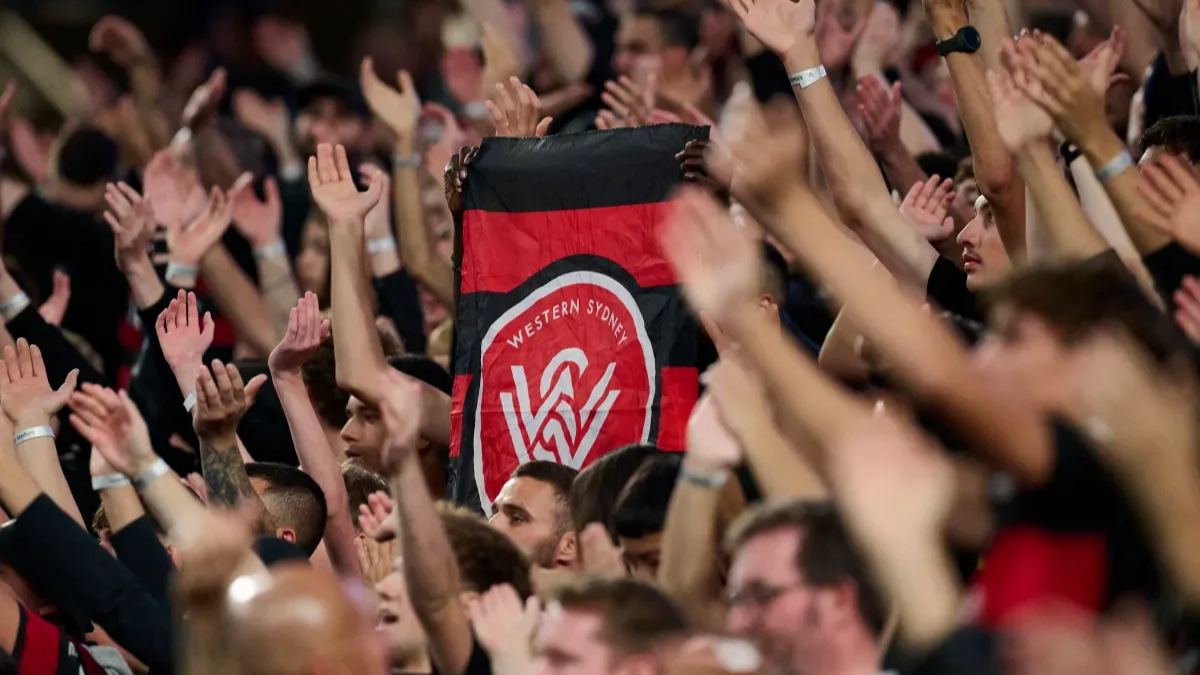
Those early images are still vivid: thousands of supporters walking together to the stadium, red and black everywhere, drums beating, chants rolling through the streets. It felt tribal, alive, authentic, the kind of football atmosphere Australia rarely creates but desperately wants.
This was western Sydney, one of the great football heartlands in the country, and the Wanderers looked unstoppable.
Now the crowds are smaller.
The atmosphere has thinned.
The Sydney Derby no longer feels like the electric event it once was.
So what happened?
And what does that have to do with Tasmania?
Quite a lot, actually.
Because the Wanderers are a reminder of something Tasmanian football urgently needs to understand:
An A-League licence is not success.
It is simply permission to begin.
The contradiction at the heart of Tasmanian football
At the same time Football Tasmania continues to include a Tasmanian A-League club in its strategic ambitions, many of the people actually carrying football in this state are exhausted.
Clubs are stretched.
Junior associations are overloaded.
Volunteers are burning out.
Parents, delegates, registrars, referees and committee members are doing enormous amounts of unpaid labour simply to keep football functioning every weekend.
That is where this debate begins for me.
Not in boardrooms.
Not in strategic vision statements.
But on grounds, in clubrooms, and inside associations where the real work of football happens.
What is an A-League licence, actually?
For readers unfamiliar with how the system works, an A-League licence is simply the right to operate a club in Australia’s national professional competition.
It is granted by the Australian Professional Leagues.
That licence gives you:
entry into the competition,
national exposure,
access to broadcast structures,
commercial opportunities.
What it does not give you:
supporters,
financial stability,
club culture,
long-term sustainability.
That is where public discussion often goes wrong.
People speak as though getting a licence is the achievement.
It is not.
A licence is merely the front door key.
What matters is what kind of house you are opening it to.
I supported Tasmania’s earlier bid, and why that matters
I was a signatory to Tasmania’s serious A-League push during the 2018 expansion process, and I do not regret that.
Because that bid was fundamentally different.
At that time:
there was genuine private capital involved,
wealthy backers supported it,
infrastructure assistance had been offered,
the league was actively expanding.
That was a credible commercial bid.
It was not reliant on asking a financially fragile Tasmanian Government to underwrite a football dream.
That distinction matters.
Supporting that bid made sense then.
What concerns me now is not the idea of ambition itself, but the change in context.
Why the current strategy feels disconnected
Football Tasmania’s strategic plan still includes ambitions such as:
delivering a Tasmanian A-League club,
delivering a Home of Football in Tasmania.
These may sound visionary.
But many of us embedded deeply in clubs and associations do not recall broad meaningful consultation about whether these are truly the game’s highest priorities.
And that matters.
Because Football Tasmania is supposed to represent:
clubs,
associations,
players,
volunteers,
coaches,
referees.
If the grassroots game does not feel ownership over these ambitions, they risk becoming top-down aspirations rather than community-driven priorities.
The proposed Home of Football may well have merit, but it raises the same question: who decided this is the game’s most urgent priority?
What Football Tasmania would say, and why that argument has logic
To be fair, Football Tasmania would likely argue:
elite pathways matter,
an A-League team raises football’s visibility,
flagship projects inspire participation,
major ambitions attract investment.
None of that is irrational.
In fact, all of it has merit.
A successful elite club can inspire young players.
A visible flagship team can energise a sporting landscape.
But those arguments only hold if the base of the game feels healthy and heard.
Without trust from grassroots football, ambition begins to look detached from reality.
The Wanderers warning
That is why the Wanderers matter here.
They had everything:
a major market,
huge supporter energy,
identity,
scale,
momentum.
And still, they are now struggling to hold the intensity that once defined them.
Their decline is proof that launching a club is the easy part.
Sustaining it is the hard part.
If a club in Sydney can lose its atmosphere despite all those advantages, Tasmania should be extremely cautious about assuming a licence alone solves anything.
The deeper structural question: is this even the right model?
The deeper question may not be whether Tasmania should have an A-League club at all.
The deeper question is whether chasing entry into a closed, licence-controlled competition is the right ambition for Tasmanian football.
Unlike most football systems in the world, the A-League remains a closed-shop model.
Clubs cannot earn their place through promotion.
They must be admitted.
That is very different from the emerging National Second Division model, which offers a pathway built far more closely around football merit, club readiness and earned progression.
Tasmania should absolutely be part of national football ambition.
But there is an important difference between:
strengthening clubs so they can rise through open football pathways, and
investing scarce energy into seeking invitation into a closed franchise system.
One approach builds the game from its foundations.
The other depends on being let in.
The grassroots contradiction no one should ignore
Every registration sends money upwards.
Families pay fees.
Clubs collect them.
Associations administer competitions.
Then significant portions flow to:
Football Tasmania,
Football Australia.
That system is accepted because governing bodies are meant to strengthen the game.
They are meant to regulate it, support it and help it grow.
Yet at grassroots level, many clubs and associations experience something very different:
increasing compliance burdens,
rising administrative expectations,
volunteer fatigue,
limited operational support.
Those of us living inside clubs and associations know this reality intimately.
We know how much unpaid labour holds football together.
We know referees are harder and harder to recruit and retain.
And we know how often that work feels unseen.
That is where frustration grows.
Because when grassroots football feels ignored, ambitious elite projects begin to feel less like inspiration and more like displacement.
This is not anti-ambition. It is about sequence.
Tasmania should absolutely have football ambition.
But ambition must be built in the right order.
Before elite expansion comes:
stronger clubs,
stronger associations,
better facilities,
better referee support,
reduced volunteer strain,
better coach education
sustainable pathways.
That is where Tasmanian football’s future is built.
Not by chasing the most prestigious badge first, but by strengthening the structures already carrying the game.
The real question Tasmania should ask
The wrong question is:
How do we get an A-League team?
The better question is:
What must Tasmanian football become before an A-League team would even make sense?
Until the people carrying football in this state feel genuinely supported, chasing admission to a closed national competition is not strategic vision.
It is a prestige project built on foundations that are already under strain.
Paul Asked Why Football Wasn’t on the News
Why Isn’t Football on the News?
Paul messaged me last night with a simple question.
“Why was there no football on the news tonight?”
It came at the end of a day when football had been everywhere.
Junior football had just kicked off for the season. Youth matches were continuing across Tasmania. Fields were full from morning until late afternoon. Children pulled on boots for their first games of the year. Parents stood on sidelines in coats and scarves. Coaches encouraged. Referees officiated. Volunteers set up grounds, packed away goals, lined fields and opened canteens.
Across the state, football was alive in every direction.
And yet, if you switched on the nightly news, you would have little sense that thousands of Tasmanians had just spent their day inside the game.
I had to make a small confession in reply.
In our house, we barely watch free-to-air television anymore.
Like many people now, we get our news elsewhere, through digital platforms, social media, independent outlets, ABC radio and the networks built around our own interests.
And that may be the irony: football may have outgrown television long before television noticed.
Because while football no longer depends on television to survive, television still helps decide which sports are treated as culturally important.
Football has already solved the visibility problem for itself
The first truth is this: football is no longer waiting for mainstream media to validate it.
The game has built its own media ecosystem.
NPL clubs now run increasingly sophisticated communications operations. Many have photographers, videographers, livestream crews, social media managers and match-day commentators. They produce player announcements, interviews, highlights packages, match reports and behind-the-scenes stories.
That did not happen by accident.
It happened because football learned that if it wanted its stories told consistently, it would have to tell them itself.
In many ways, mainstream television is no longer where football’s real audience lives.
For younger audiences especially, legitimacy is no longer granted by appearing on the six o’clock news. It is granted by digital visibility in the spaces where they already consume sport.
The storytellers who matter most are often outside mainstream media
Football’s media world is bigger than clubs alone.
Matthew Rhodes saw the gap in Tasmanian football reporting and created Tassie Football Central, which has become indispensable to the weekly life of the game.
Week after week it records the rhythms of Tasmanian football:
previews, results, ladders, transfers, youth competitions, grassroots developments.
And we must not forget Walter Pless.
Walter’s match reports, interviews and chronicling of Tasmanian football over many years are of enormous historical importance.
If television captures moments, Walter Pless preserves football’s collective memory.
Long after a nightly bulletin has disappeared into the ether, Walter’s written record remains.
That is not simply reporting.
That is preservation.
People care about stories close to home
One thing football understands better than mainstream media is this:
People like to read about people they know.
That is why local football storytelling resonates so strongly.
When I write interviews, they are often among the most widely read pieces I publish, not because they feature famous people, but because they tell stories about familiar lives:
the coach everyone recognises,
the volunteer who has quietly served for decades,
the young player emerging through the ranks.
These are stories rooted in community.
And they matter because they reflect us back to ourselves.
Mainstream television, by its nature, rarely captures that intimacy well.
The issue is not hostility. It is outdated media assumptions
This is important to say clearly.
Tasmanian editors are not anti-football.
Most are working within shrinking newsroom budgets, shorter bulletins, fewer camera crews and inherited assumptions about what audiences expect sport to look like.
And those assumptions are old.
Commercial television still defaults heavily toward legacy hierarchies, where AFL remains familiar, easy and institutionally embedded.
Football loses in that system not because it lacks relevance, but because legacy media structures are slow to recognise change.
The same pattern runs across the wider media landscape
This is not just a television issue.
Tasmania’s newspapers and radio outlets follow similar patterns.
Football appears episodically, cup finals, controversy, national team moments, major announcements, but rarely with the consistency given to sports long embedded in mainstream editorial culture.
That is the real problem.
The absence of football from the news is not a reflection of football’s place in Tasmanian life.
It is a reflection of how slowly traditional media adapts to cultural reality.
Should we still care?
This is where the contradiction becomes interesting.
Football may no longer need television.
But television still influences how institutions perceive importance.
Visibility affects:
sponsorship recognition,
political attention,
infrastructure debates,
funding decisions,
public legitimacy.
If a sport is rarely visible in mainstream media, it becomes easier to overlook when resources are allocated.
Media invisibility can still become structural invisibility.
That part has not changed.
Perhaps the real story is not football’s absence
Paul’s question began as a simple observation.
But perhaps the real story is not that football is missing from the nightly news.
Perhaps the real story is that Tasmania’s media institutions still underestimate where football now lives.
Because football has not been waiting.
It has built its own parallel world of storytelling, livestreaming, reporting and community memory.
And in doing so, it has quietly created something remarkable:
A sport that no longer needs permission to matter.
The question now is whether mainstream media is willing to catch up.
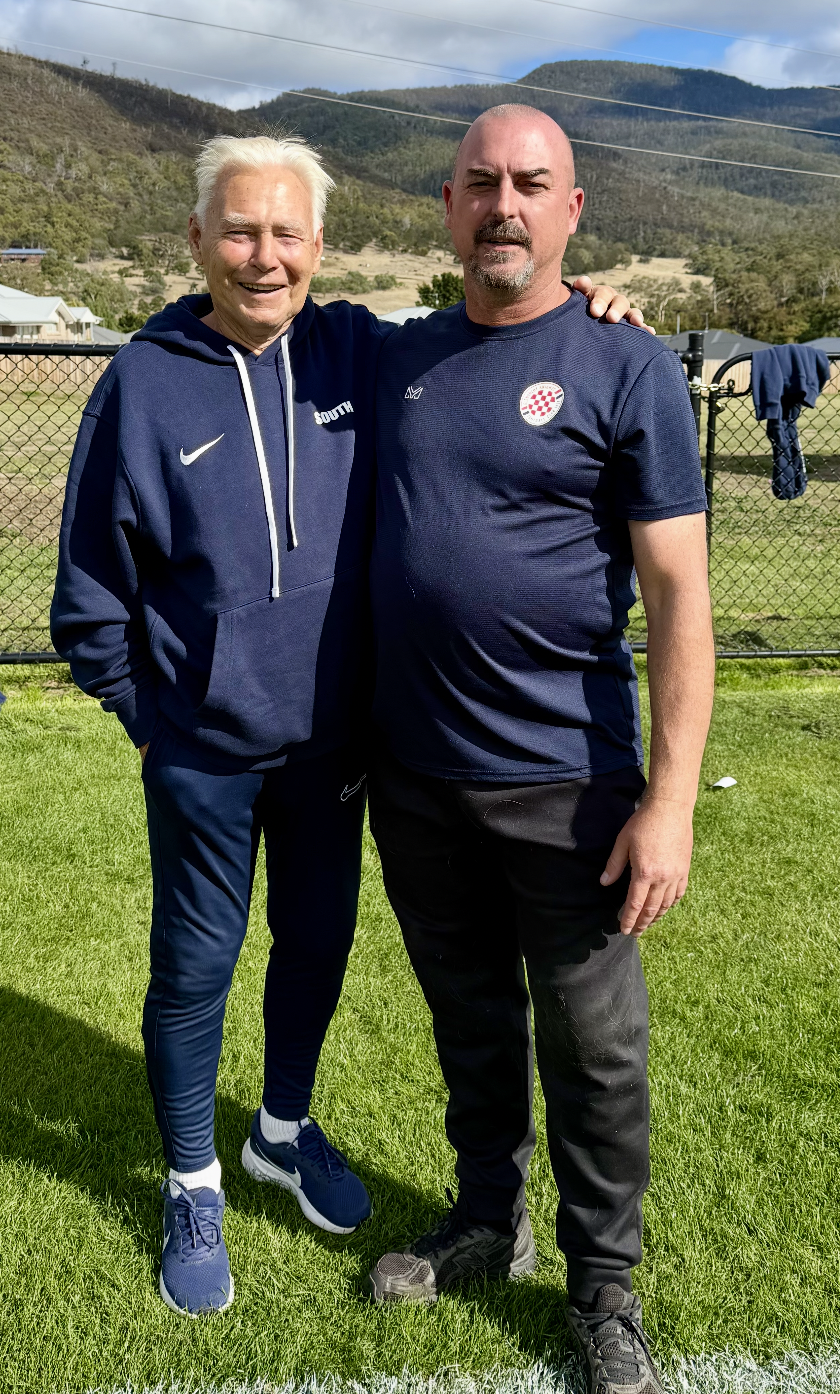
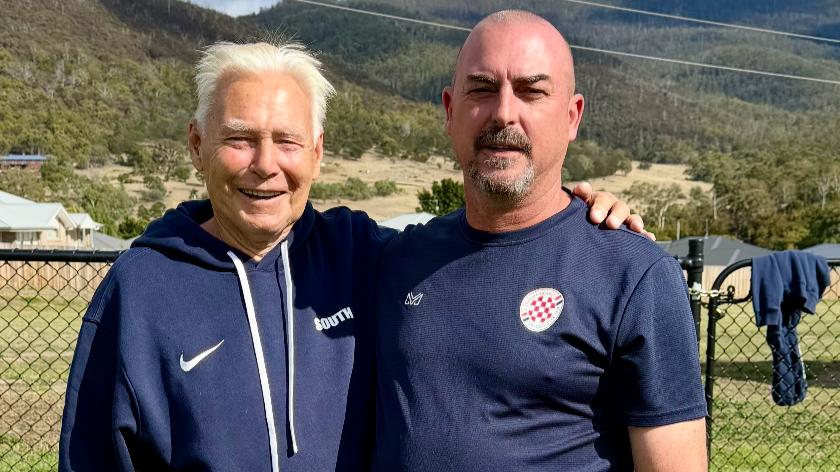
Recently I posted a photograph of Ken Morton and Brett Pullen together, and it drew a remarkable amount of attention.
That response was not accidental.
These are two recognisable Tasmanian football figures, from different clubs, different pathways, different football histories, yet both deeply familiar to the wider football community.
People stopped because they knew who they were.
That is the point.
Local football is built on relationships, memory and recognition.
The stories that resonate most are often not about elite stars or national headlines, but about the people whose names and faces are woven into the everyday life of the game.
That is something mainstream television rarely understands well, but football people understand instinctively.
Stop Telling Football to be Grateful, Part 4: When the Number Hit $3 Billion
If you haven’t read Part 3, where I break down the funding gap in detail, you can read Stop Telling Football to be Grateful, Part 3: OMG the Money!
This one is different.
This one is about a moment.
The moment the number changed
I listened to a chilling interview on SEN this week.
It was chilling because of one word.
Three.
Three what, you might ask.
Three billion.
And in that moment, the scale of this stopped being abstract.
What was actually said (a quick 101)
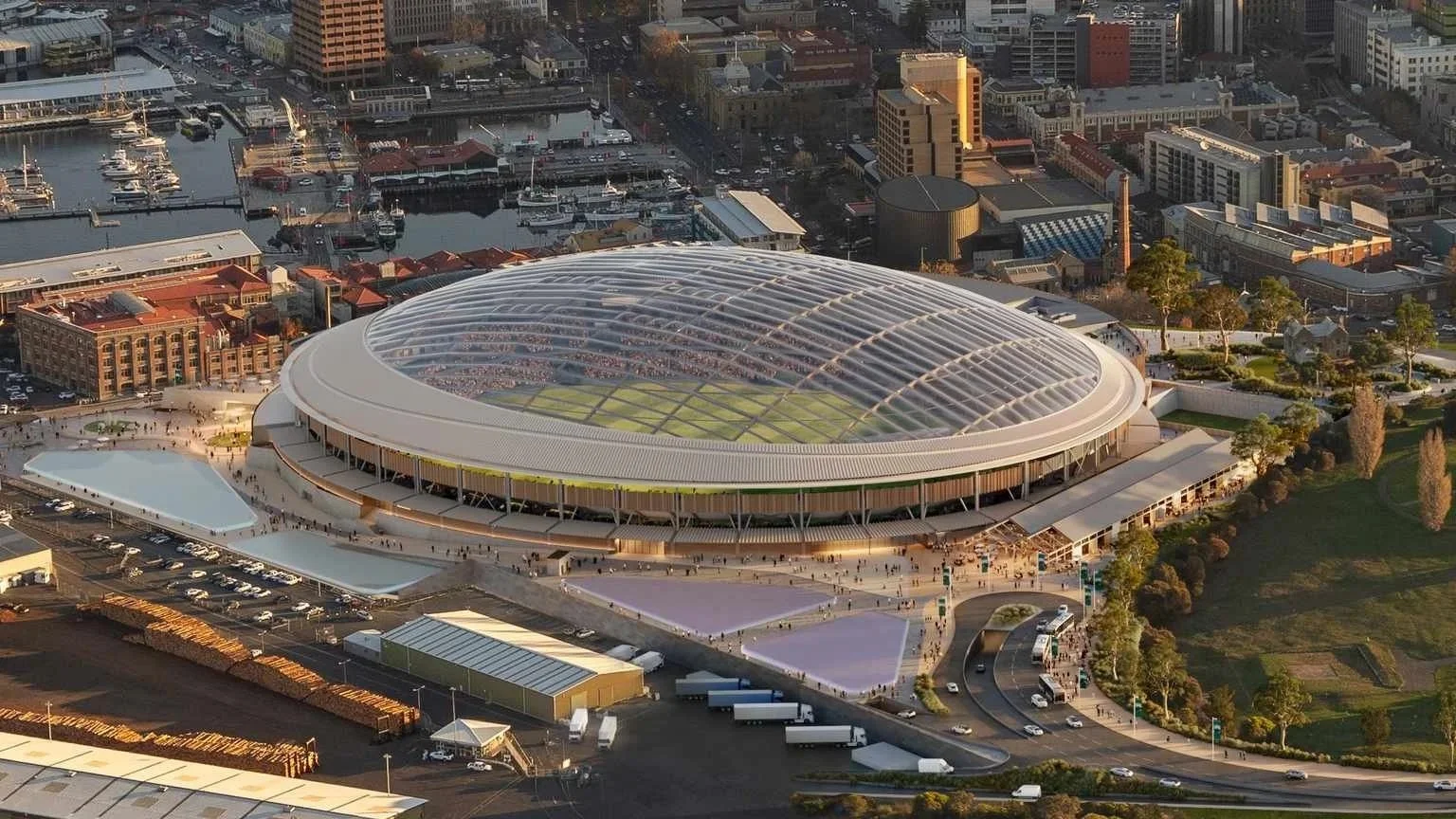
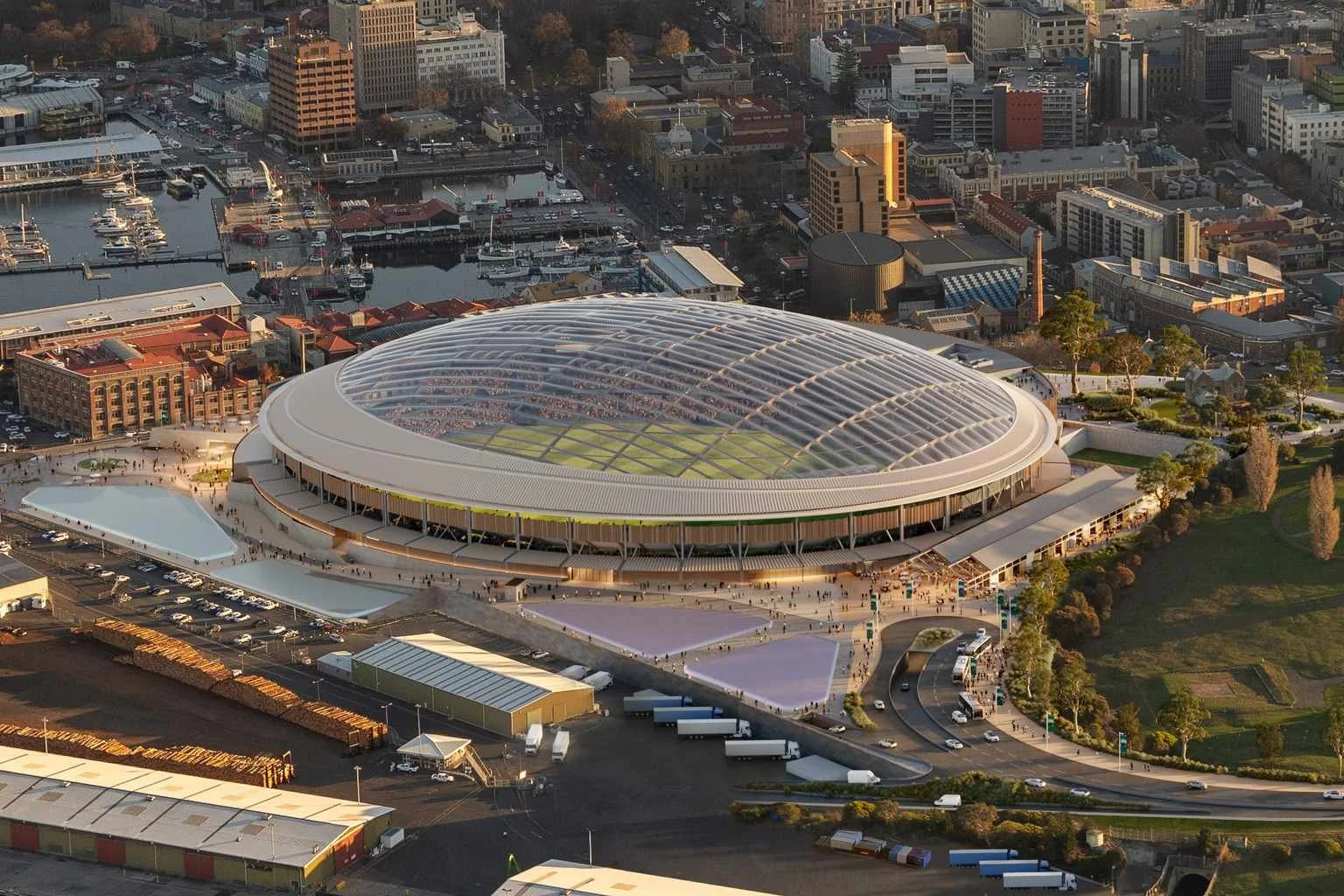
For those who didn’t hear it, Sydney Swans chairman Andrew Pridham was speaking about the proposed Hobart stadium in this SEN interview.
His position was clear.
Tasmania needs a stadium.
A proper one.
Not a compromise.
If the state wants an AFL team and the long-term future that comes with it.
And I understand that argument.
I actually agree with part of it.
Tasmania should have a team.
Why the number is moving
There is another reason that number matters.
It’s not just a throwaway line.
Construction costs are rising globally, and major projects are exposed to forces well beyond Tasmania.
Even this week, ABC radio was discussing how tensions around the Strait of Hormuz are pushing up fuel and shipping costs.
At the same time, Australia’s Prime Minister is in Singapore talking about securing fuel supply.
That’s the scale we are dealing with.
These are not distant issues.
They flow directly into construction.
Fuel drives transport.
Shipping affects materials.
Energy prices impact manufacturing.
And many building materials themselves are tied to global supply chains.
Steel.
Concrete.
Plastics and PVC products used across modern construction.
When those costs rise, projects don’t stay where they start.
They move.
And they almost always move upwards.
So when someone inside the industry says “three billion”, it’s not just a dramatic number.
It reflects the reality that these projects are vulnerable to global shocks.
War.
Supply chain disruption.
Energy price spikes.
And that makes the question even more important.
Not just what it costs today…
But what it ends up costing tomorrow.
This isn’t theoretical
And this isn’t theoretical.
It’s already happening.
This week, ABC reporting showed construction projects in Australia increasing by more than $100,000 in a matter of weeks as fuel and material costs surged.
PVC products, pipelines and essential infrastructure materials are up 30 to 40 per cent.
Asphalt has jumped by around 50 per cent.
Fuel costs have effectively doubled in their impact across construction.
These are not small movements.
These are structural shifts.
And they are happening before a project like this has even begun.
Projects don’t stay where they start.
And right now, they are moving fast.
This isn’t just Tasmania
This isn’t unique to Tasmania.
Around the world, major infrastructure projects are blowing out.
Costs don’t stay where they start.
They rise with energy prices, supply chain pressure, labour shortages and global instability.
That is the environment this stadium would be built in.
And Australia is not immune to it.
Major projects across the country have faced delays, cost increases and budget revisions.
That is now the norm, not the exception.
Which makes early estimates just that, estimates.
And in Tasmania, the margin for error is smaller.
We don’t have the scale of larger states to absorb major cost overruns.
Which means when projects grow, the consequences are felt more sharply.
And more widely.
But then came the question
Because once you hear “three billion”, the conversation shifts.
It’s no longer just:
Should we build a stadium?
It becomes:
At what cost?
Because if that level of investment is required to secure a team, what does it mean for everything else?
Are we building something for Tasmania…
Or are we trampling on the rest of us to get there?
What does that mean for the rest of us?
Governments do not operate in infinite budgets.
Every major commitment shapes what comes next.
If Tasmania commits to a multi-billion dollar stadium, with ongoing operating and lifecycle costs, that doesn’t sit in isolation.
It sits alongside every other demand.
Health.
Education.
Infrastructure.
And sport.
All sport.
Whose money is this?
And it’s worth saying this again, because it gets lost in the language of “government funding”.
This is not some separate pool of money.
It is not mysterious money that belongs to someone else.
It is our money.
Taxpayer money.
The money of the parents driving kids to training.
The volunteers running canteens.
The workers, the small businesses, the communities that keep sport alive.
So when we talk about billions being committed to one project, we are not talking about “government spending” in the abstract.
We are talking about a choice.
A choice about where our money goes.
And who it serves.
And right now, that choice is telling a very clear story.
This isn’t just about football
This is not just a football issue.
This is about every participation sport in Tasmania.
Football.
Netball.
Basketball.
Athletics.
School sport.
Community recreation.
So the question becomes unavoidable:
Will there be anything left for the rest of us?
Or will grassroots sport be asked, once again, to wait… apply… fundraise… and be grateful?
The “multi-purpose” argument
We are already hearing it.
That this will be a multi-purpose stadium.
That cricket will use it.
That it will host events.
And maybe it will.
But even if cricket goes in there, even if concerts fill the calendar, it doesn’t change the fundamental issue.
Participation sport does not happen in stadiums.
It happens on local grounds.
On school ovals.
On shared community spaces with lights that barely work and changerooms that still don’t meet the needs of women and girls.
A multi-purpose stadium is still a centralised, elite piece of infrastructure.
It does not solve the everyday reality of community sport.
It doesn’t give a junior team somewhere to train.
It doesn’t ease ground shortages.
It doesn’t reduce waiting lists.
It doesn’t change the lived experience of the thousands of Tasmanians who play sport every week.
While we debate what fits inside the stadium…
the rest of sport is still outside, waiting.
The part I can’t ignore
I fear for my code of sport.
And I fear for every other community sport in Tasmania.
Because if $3 billion is poured into a stadium that most people will never set foot in, we are making a very clear decision about what matters, and what doesn’t.
This is no longer just about what we build.
It’s about what we risk.
Tasmania should have an AFL team.
But building a cathedral to one sport risks leaving the rest of us outside.
Stop telling football to be grateful.
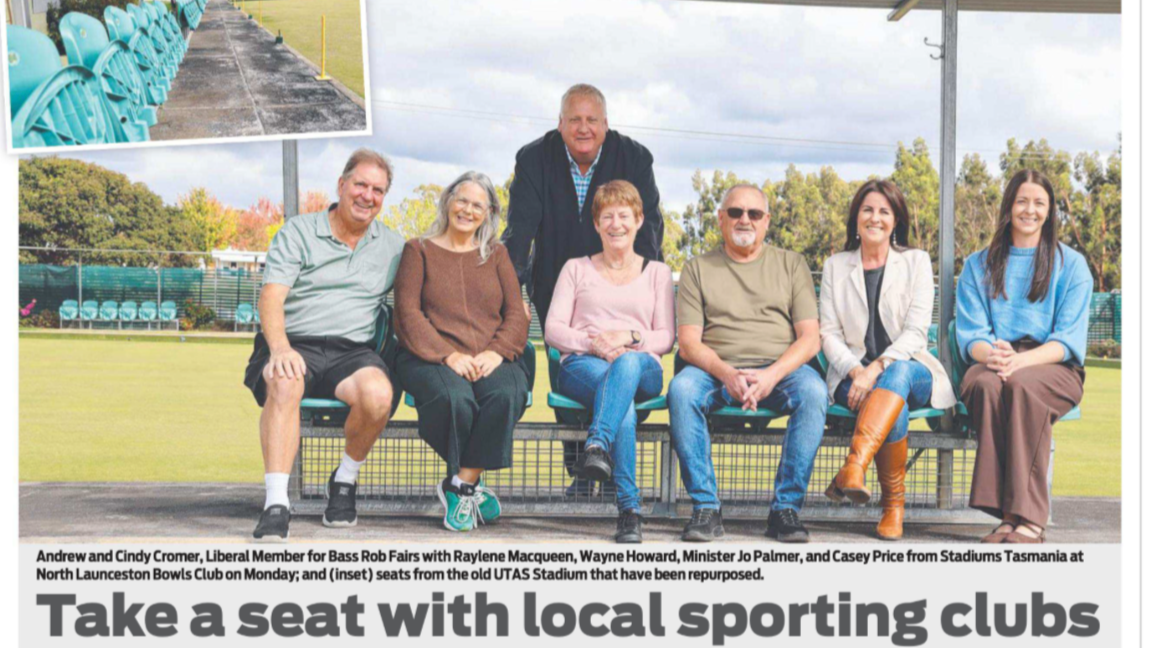
Who Knew About the Seats?
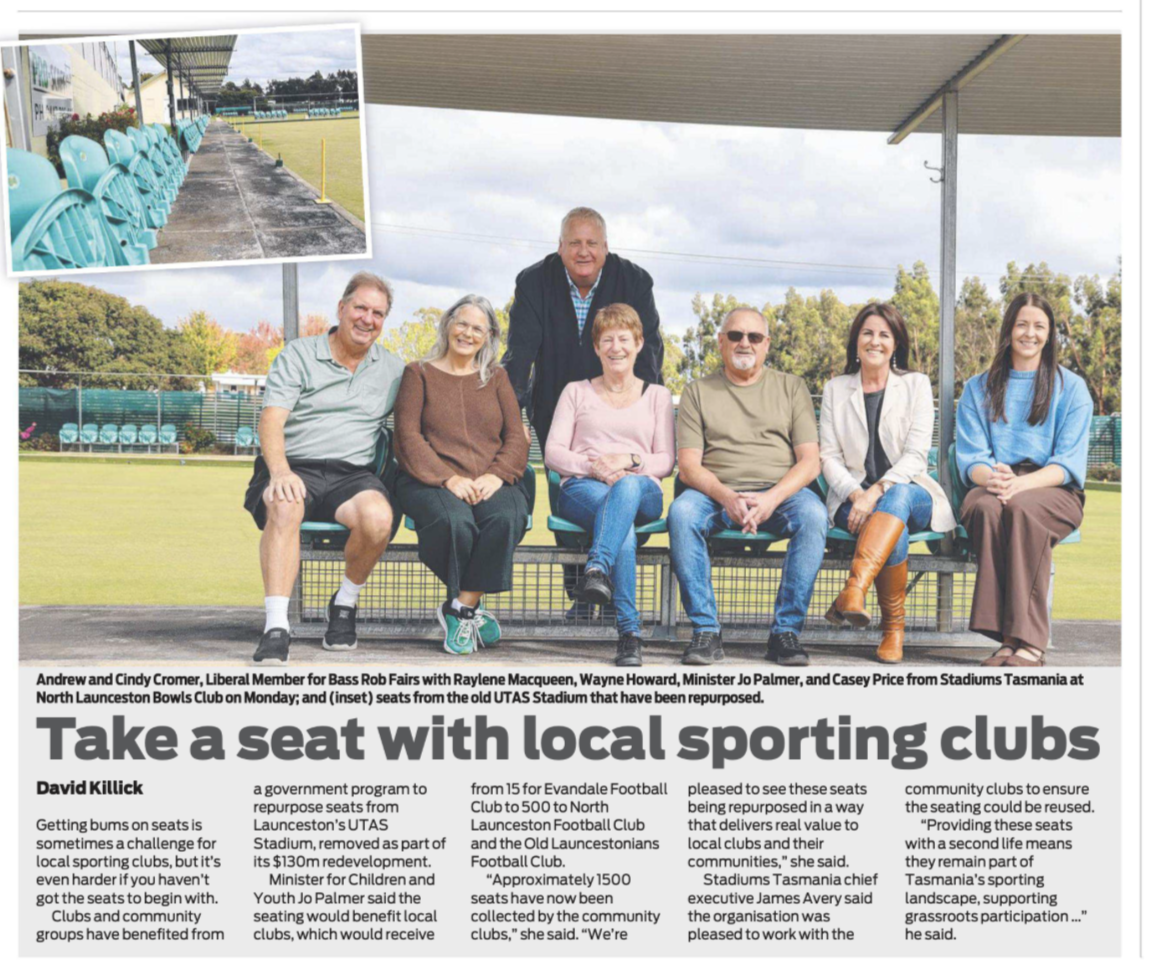
The Mercury 7 April 2026
I was scrolling when I saw the announcement.
“Stadium seating finds new life with local sporting clubs.”
At first glance, a great idea.
More than 1,500 seats removed from UTAS Stadium, redistributed to 15 local clubs.
Sustainable. Practical. Community focused.
Exactly the kind of initiative you want to see.
And then you look a little closer.
The Announcement
The Tasmanian Government, through Jo Palmer, confirmed that:
more than 1,500 seats were redistributed
15 clubs received them
and “every club that applied got what they were after”
On face value, fair.
No complaints there.
But that sentence shifts the question.
The List
When you look at the clubs, the picture becomes clearer.
The recipients are overwhelmingly Australian Rules football clubs, along with one bowls club.
No football clubs.
Not Launceston City FC
Not Launceston United FC
Not Riverside Olympic FC
Clubs that play in the NPL.
Clubs with facilities.
Clubs that host games.
Clubs that would absolutely use seating.
And in Launceston United’s case, the seats would have been closer to their colours than most.
But it doesn’t stop there.
Across the north there are Championship clubs, community clubs, and social teams who would also have benefited.
Clubs where people stand on the sidelines.
Clubs where parents bring their own chairs.
Clubs where even a small bank of seating would make a difference.
This wasn’t just an opportunity for the top end.
It was an opportunity for the whole game.
A Fair System?
Let’s be clear.
There is nothing in the announcement that suggests bias.
In fact, it suggests the opposite.
Every club that applied got seats.
That is, on paper, a fair process.
So the Question Changes
The issue is no longer:
Who got the seats?
It becomes:
Who was told, and how?
Because I cannot find:
a public call-out
an expression of interest
a grant page
a visible application process
Maybe it existed.
Maybe it went through Football Tasmania
Maybe it went through AFL Tasmania
Maybe it was sent directly to clubs
But if it did, it wasn’t visible.
And that matters.
Let’s Be Honest
There are a few possibilities.
Football didn’t know.
Football knew but too late.
Football knew and didn’t act.
All are possible.
None are proven.
But all lead to the same outcome.
And yes, it is possible football clubs knew and didn’t act. That’s a different conversation, but just as important.
AFL Does This Well
It’s also worth saying this clearly.
AFL clubs are organised.
They are connected.
They respond to opportunities.
They are ready when something becomes available.
That is not criticism.
That is reality.
Football Wasn’t in the Room
Because when you strip it back, that’s what this is.
A practical opportunity.
Free infrastructure.
Delivered into one sporting ecosystem.
Not the other.
No outrage required.
No conspiracy needed.
Just a simple observation:
Football doesn’t appear to have been in the room.
This Isn’t About Seats
This is about something bigger.
How information moves.
Who hears it.
Who is organised to respond.
Because too often, football isn’t missing out at the end.
It’s missing out at the start.
A Question Worth Asking
So this isn’t criticism.
It’s a question.
A genuine one.
Who was told, and how?
Because if it was open to all, and only one code responded, that tells us something.
And if it wasn’t broadly communicated, that tells us something else.
Either way, it’s worth understanding.
Because Next Time Matters
There will be another opportunity.
There always is.
The question is whether football will be in the room when it happens.
Or reading about it afterwards.
Dynamic Pricing and the Slow Drift Away from the Fan
The anguish of the England fan
I keep hearing and reading the same story.
Fans who have saved for years.
Planned the trip.
Built it into something close to a life moment.
A World Cup that is bigger than ever before.
And yet, somehow, harder to access.
Because now there is something new waiting for them.
Dynamic pricing.
What is that?
It means the price moves.
Not just a little.
Constantly.
It is the same system used for major concerts and events in the United States.
The kind where tickets for artists like Taylor Swift surge within minutes, or where premium sporting events price themselves according to demand.
Now imagine trying to run a football tour around that.
Flights, hotels, schedules, everything locked in…
Except the one thing that matters most.
Getting in.
What is dynamic pricing?
Dynamic pricing is exactly what it sounds like.
The price is not fixed.
It shifts depending on demand, timing and behaviour.
The same seat, for the same match, can cost very different amounts depending on when you buy and how many others are trying to buy it.
It is already common in airlines, hotels and concerts.
Now it has arrived at the World Cup.
For 2026, FIFA will use it for ticket sales.
Which means there is no true face value.
Only a moving target.
What it actually costs
This is where it becomes real.
Tickets are advertised from around $60 USD for the lowest category seats.
But that is only part of the story.
Typical ranges look like this:
Group matches: roughly $100 to $575 USD
Opening match: up to around $2,700 USD
Round of 16: around $220 to $890 USD
Quarter-finals: up to around $1,600 USD
Semi-finals: up to around $2,700 USD
And the final?
Originally priced around $6,700 USD at the top end.
Now, with dynamic pricing, it has climbed to around $10,000 USD and beyond.
Hospitality packages sit in a completely different world again, stretching into tens of thousands.
So yes, there are cheaper tickets.
But they are limited.
And the real experience sits much higher.
Why it exists
The logic is simple.
Maximise revenue.
The 2026 World Cup is being played largely in the United States. A premium market with enormous demand and spending power.
If people are willing to pay more, the system allows FIFA to charge more.
FIFA would argue this reflects demand, not exclusion.
From a business perspective, it makes sense.
From a football perspective, it raises questions.
Where it becomes uncomfortable
Football has never behaved like a normal market.
It has always carried something more.
Access.
The World Cup was something you could plan for.
Save for.
Work toward.
Now, the price is unpredictable.
Supporters do not know what they will pay.
When they should buy.
Or whether they will be priced out entirely.
And that uncertainty changes everything.
Who this favours
Dynamic pricing does not treat all supporters equally.
It favours those with flexibility.
Those with higher disposable income.
Those buying an experience rather than living it.
And slowly, almost invisibly, it pushes others out.
The supporter who saves for years.
The families who plan together.
The next generation hoping to feel it for the first time.
Still there.
Just further away.
From Australia, you are already looking at thousands in flights alone. Add accommodation, time away from work, and suddenly a single match is not just a ticket.
It is a financial commitment.
The atmosphere question
This is the part that matters most.
Because pricing is not just about money.
It shapes who turns up.
I felt this sitting at Etihad Stadium.
The football was exceptional.
Technically brilliant.
But the crowd felt different.
Full of visitors. Experience seekers. People passing through.
Not worse.
Just less alive.
The football was still fabulous.
But the atmosphere had been curated, not created.
A preview of what is coming
That experience stays with me now.
Because it felt like a glimpse of where this is heading.
This is also the first World Cup with 48 teams. Bigger than ever before. More matches. More nations. More opportunity.
And yet, for many, less access.
The World Cup will not struggle to sell tickets.
The stadiums will be full.
But full of a different mix.
More corporate.
More curated.
Less organic.
And that changes the feeling of the game.
What we risk losing
The World Cup was never just about what happens on the pitch.
It was about colour.
Noise.
Identity.
Belonging.
It was about standing next to someone from the other side of the world and feeling part of the same thing.
That cannot be priced dynamically.
The bigger question
So the question is not whether dynamic pricing works.
It does.
The question is what it changes.
Because once you shift who the game is for,
you shift what the game becomes.
It’s not too late
There is still time to think carefully about this.
Not to reject modern systems.
But to protect what matters.
Because once the authentic fan is priced out,
they do not come back.
And when that happens, the World Cup does not disappear.
It just quietly stops belonging to everyone.
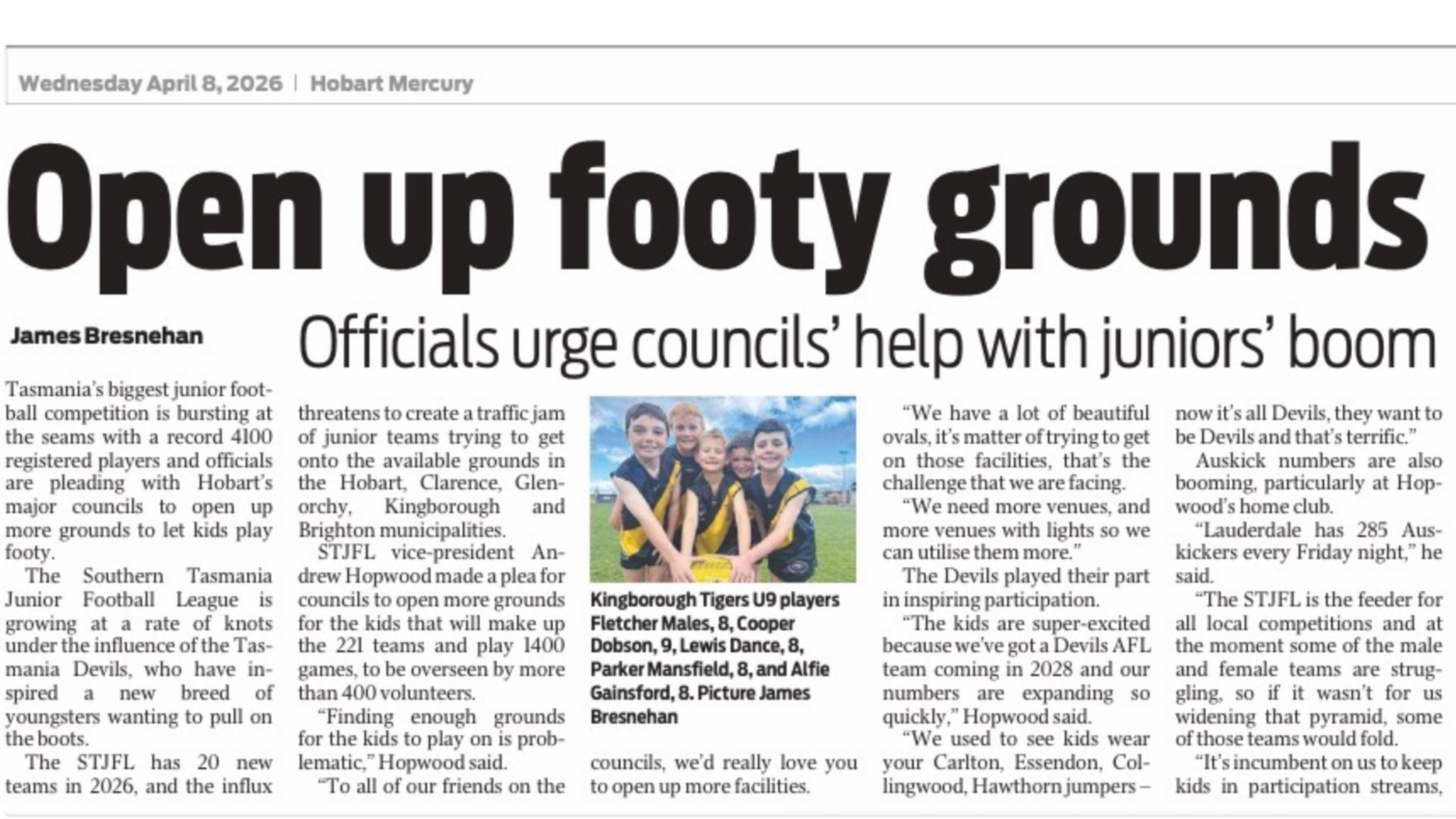
The Silence Of Football

The Mercury 8 April 2026
Here I go again.
Banging the drum.
This damn daylight saving.
I wake at 3am now instead of 4. I have always been an early riser, but it comes at a cost. By mid afternoon I am done. Foggy. Not thinking clearly.
Morning is where it works.
Tea first. Quiet.
Waiting for the UEFA Champions League or the EFL Championship to kick off.
Spoilt for choice at 4.55am.
The game everywhere.
And yet, not here.
A bit of time to read.
So it was no surprise that I opened The Mercury this morning.
And yes, I still subscribe.
Partly habit. Partly interest. Politics, letters to the editor, the odd honest piece buried somewhere in the middle, usually separated by twenty pages of racing before you find the end of it again.
That kind of reading.
But this one wasn’t buried.
It had volume.
Front page.
Editor’s words.
Then the full article.
Three separate moments to say the same thing.
Look at us, again.
4,100 players.
10 per cent growth.
A system under pressure.
It is a good story.
And it is told well.
That’s not just coverage.
That’s amplification.
The packaging
AFL doesn’t just grow the game.
It packages it.
It connects juniors to a club, to a jumper, to a future.
It gives media something clean and simple to publish.
And the media understands it.
It is a broadcast product. It fits.
So the story runs easily.
And runs well.
Alignment
This is not accidental.
Participation, pathway, identity and promotion all point in the same direction.
Junior numbers connect to the Devils.
The Devils connect to the AFL.
The AFL connects to the national stage.
One story.
Clear. Consistent. Repeatable.
Football’s silence
Because those pressures are not unique.
Football is managing the same reality.
I sit inside this every week.
The numbers.
The teams.
The fixtures.
The constant search for space.
Thousands of players.
Hundreds of teams.
Not enough grounds.
Not enough access.
Week after week.
Season after season.
But the story is not being told.
Banging the drum again.
Same old story.
Where is our voice?
The silence is deafening.
Structure, not effort
This is not about people not working hard.
It is about structure.
Clubs speak.
Associations organise.
But there is no single voice.
No consistent narrative.
So nothing cuts through.
Visibility
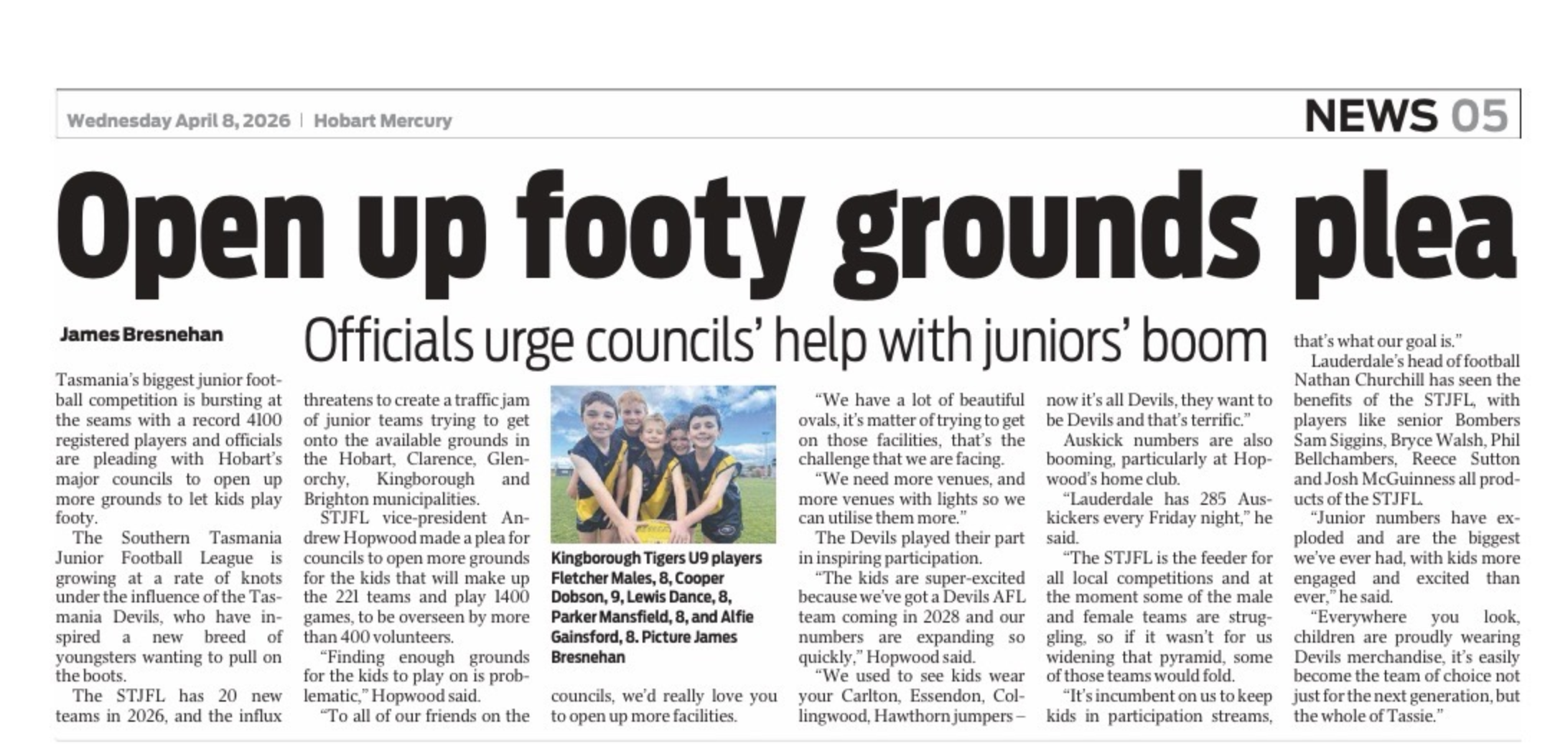
This is not about which code is bigger.
It is about which code is seen.
Football has the numbers.
It just doesn’t have the recognition.
AFL is organised to be visible.
Football is not.
That is the difference.
What follows
When stories are not told, they are not valued.
When they are not valued, they are not funded.
Not planned for.
Not prioritised.
Because visibility drives decisions.
Funding.
Facilities.
Priority.
The truth
We are doing the work.
Someone else is telling the story.
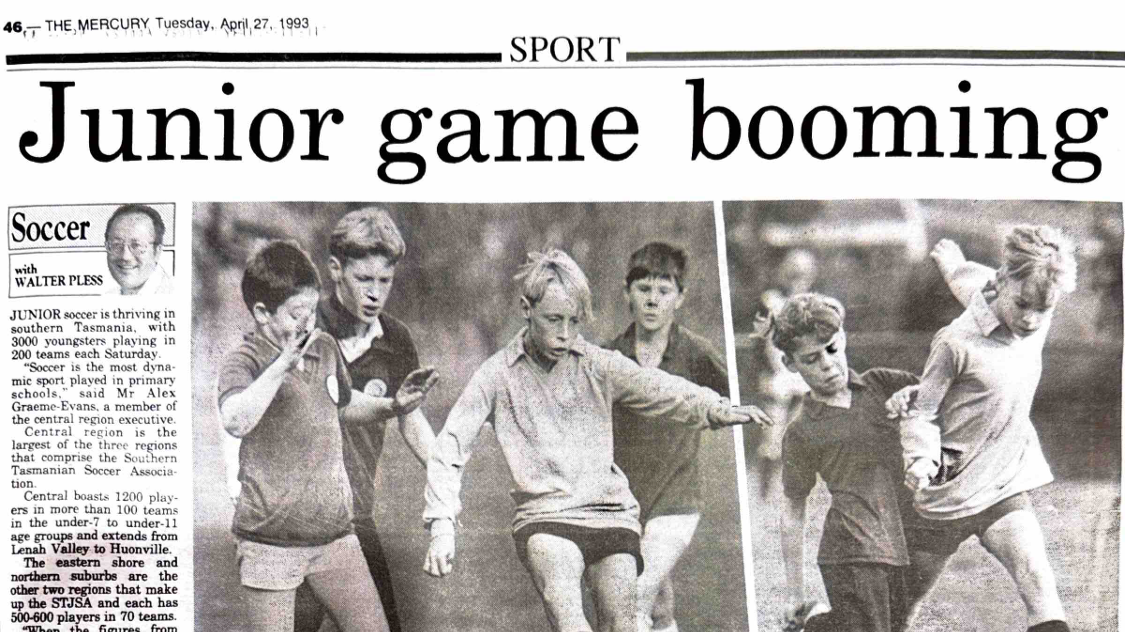
We Grew the Game. The System Didn’t
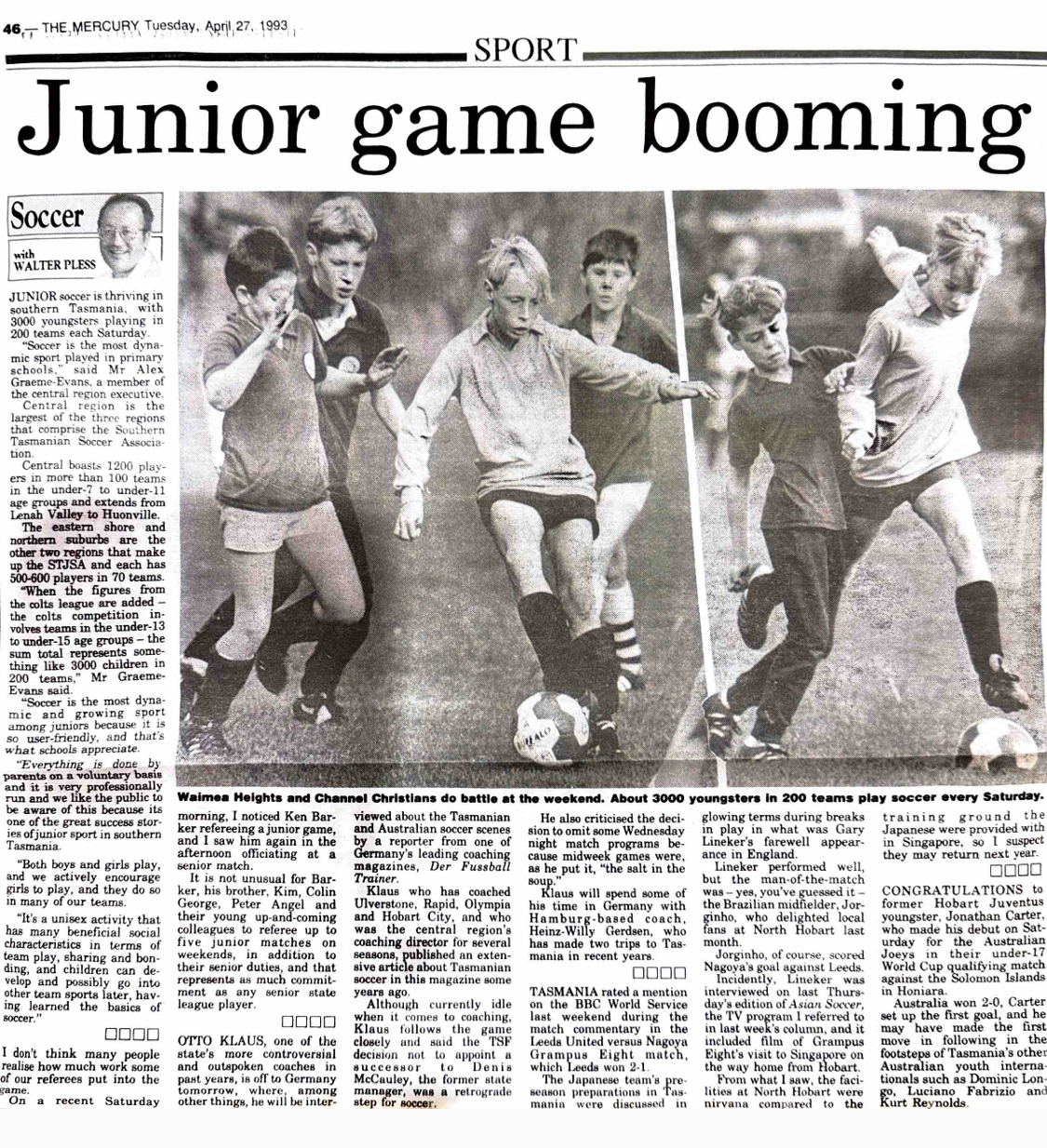
The numbers were always there
The suitcase is proving to be total gold.
Every clipping feels like a window into something we think is new, but isn’t.
Today I came across an article from 1993, written by Walter Pless, a man I had the privilege of interviewing earlier this year. A deep football mind. Observant. Honest. Someone who has watched the game closely, over a long time.
The headline stopped me.
Junior game booming.
Not growing. Not developing. Not “building”.
Booming.
What Walter saw
Walter wrote that junior soccer in southern Tasmania involved around 3,000 youngsters, across 200 teams, playing every Saturday.
He described it as:
“the most dynamic sport played in primary schools”
He pointed to why it worked.
It was accessible.
It was inclusive.
It was run by volunteers.
“Everything is done by parents on a voluntary basis,” he wrote.
And importantly, he didn’t frame it as fragile.
He framed it as strong.
What I see now
As many of you know, I am President of CRJFA. I have been for around a decade.
It is an association I genuinely love.
It exists for a simple reason.
To provide football for children aged U5 to U12.
To keep it affordable.
To let kids play.
And it still runs the same way Walter described.
Delegates from clubs and schools.
Volunteers.
Parents giving up time, week after week.
Holding it together.
But here is the part that matters
Last season, CRJFA alone had around 3,750 registered players.
Read that again.
That is not the whole state.
That is not multiple regions.
That is one association.
Walter’s article refers to around 3,000 players across the system in 1993.
The game has not been built.
It has grown.
So let’s stop pretending
We talk about “growing the game” as if it is something fragile.
As if it needs to be convinced to exist.
It doesn’t.
The game is already here.
It has been for decades.
It has grown quietly, consistently, without fanfare.
Driven by volunteers.
Sustained by community.
Carried, in many cases, despite the system around it.
And this is where it becomes uncomfortable
If junior football is where the numbers are…
Where is the support?
Where are the facilities that reflect that scale?
Where is the investment that matches participation?
Where is the visibility in public conversation, in planning, in funding decisions?
Because there is a gap.
And it is not a small one.
It is a structural gap between:
the number of children playing the game
and
the value placed on it
Walter saw it. We are still living it
What makes this article powerful is not nostalgia.
It is recognition.
Walter described a game that was already organised, already inclusive, already strong.
He described volunteers doing the work.
Referees giving their time.
Communities making it function.
Thirty years later, that foundation still exists.
The numbers are bigger.
The questions are the same.
The truth
We don’t need to prove football matters.
The numbers have already done that.
What we need to ask, honestly, is this:
Why has the system around the game not kept up with the game itself?
The challenge
This is not about growth anymore.
It is about alignment.
Because until the structures, the investment, and the recognition reflect the reality on the ground…
we will keep finding articles like this
and realising
we have been here before
Participation without recognition is not growth.
It is neglect, dressed up as success.
The Suitcase
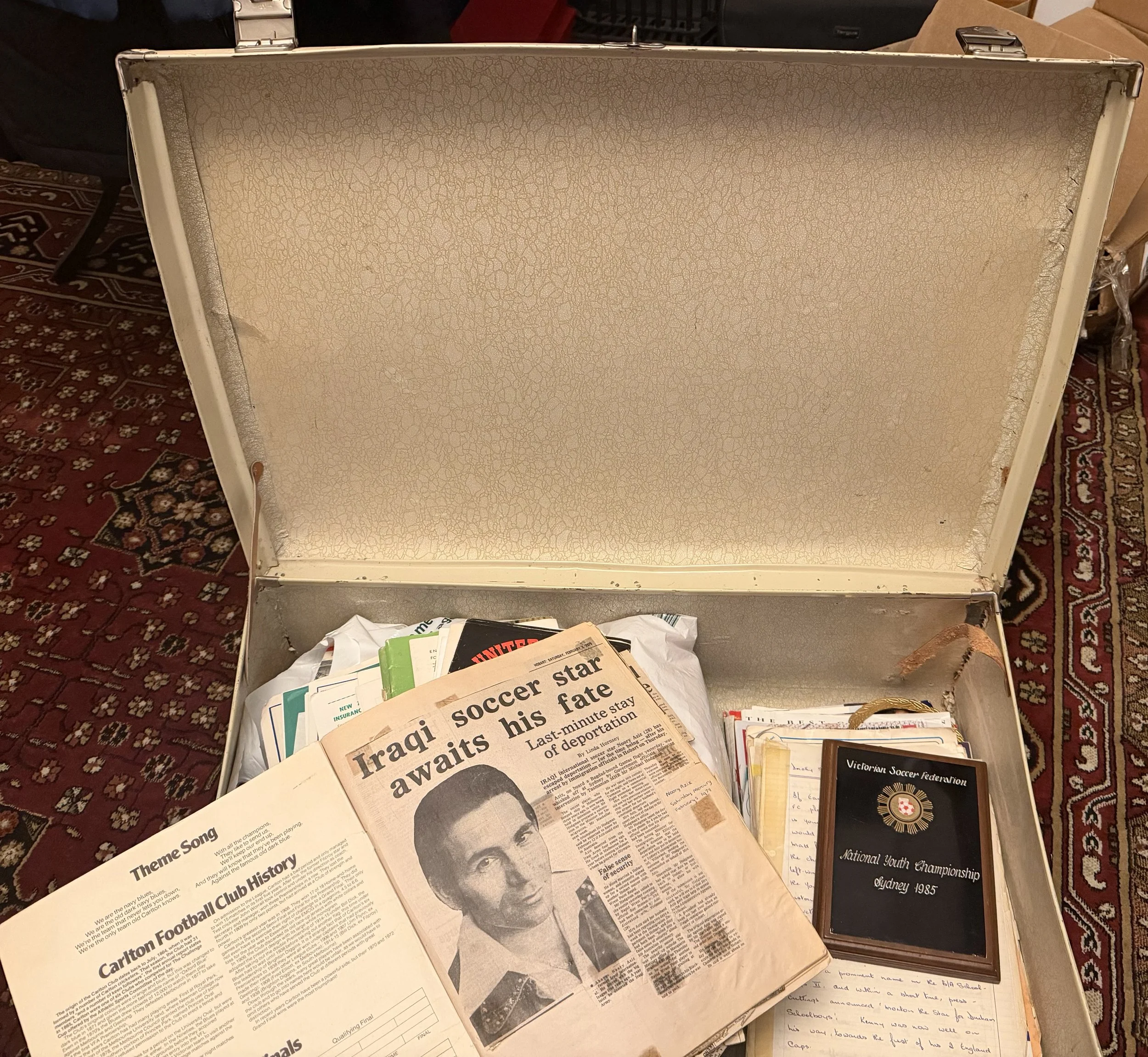
A couple of weeks ago, Nick handed us a suitcase.
Not metaphorically. An actual suitcase.
Inside it were old clippings, scrapbooks, loose pages, carefully cut articles, some yellowed and fragile, others still holding their shape. Thousands of them.
Ken’s life, in pieces.
From Copley to Hobart, and then out into the world.
We have barely scratched the surface, but one thing is already clear.
This is gold.
Not in a nostalgic way. Not in a “how things used to be” way.
In a way that makes you realise how much has been lived, recorded, and then quietly put away.
Trying not to lose anything
I don’t want to lose a single one of them.
That has become slightly obsessive, if I’m honest.
So I’ve started archiving them, slowly, carefully, with the help of my personal assistant, ChatGPT.
Even writing that still feels slightly ridiculous to me.
I learnt to type on a manual typewriter. Moved on to IBM golf ball machines. Used carbon paper. Tippex. If you made a mistake, you felt it.
Now I can take a photo of a 40-year-old newspaper clipping and start building a record of it in seconds.
It is, genuinely, mind blowing.
What you find when you slow down
Most of what’s in the suitcase is football.
Matches. Tours. Teams. Familiar names.
But every now and then, something stops you.
Not because it’s bigger.
Because it’s different.
This one stood apart
I came across a series of clippings.
Not one article. Not one moment.
A sequence.
Headlines that didn’t read like sport.
“Iraqi soccer star awaits his fate.”
“Noory’s scared to death.”
“Plea for Aziz to stay.”
And suddenly, this wasn’t just football anymore.
This was something else.
A life, playing out in public.
And I knew straight away.
This was worth writing about.
A name in headlines
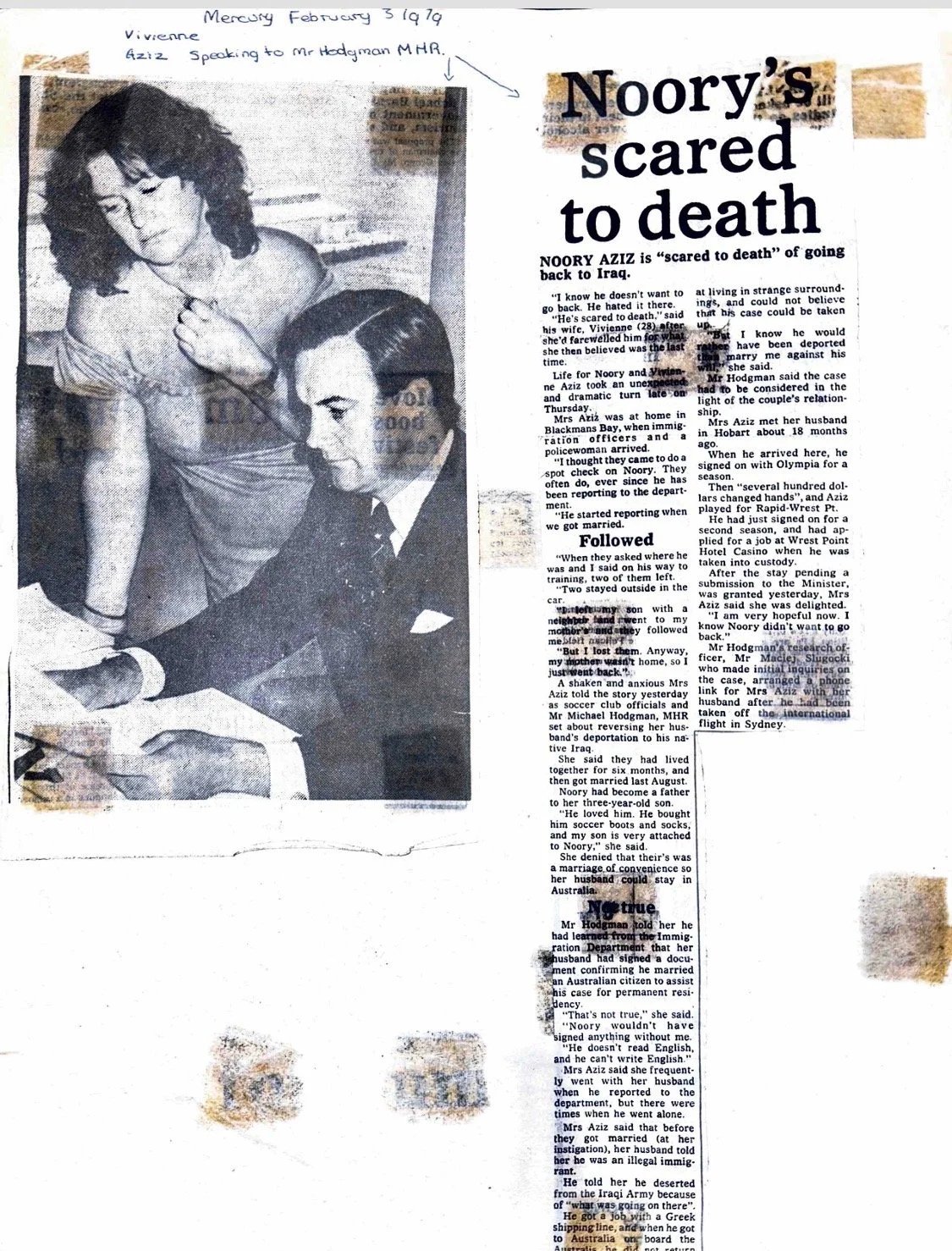
Noory Aziz
Not tucked into a match report.
Not listed in a team sheet.
A headline.
Repeated.
Urgent.
And when you follow the detail across the clippings, a clearer picture forms.
An Iraqi international footballer.
Living in Hobart by the late 1970s.
Playing for clubs including Olympia and Rapid.
Working. Settling. Building a life.
A man between places
But he had not simply moved countries.
By all accounts, he had left Iraq in circumstances that placed him at real risk if he was forced to return, including what appears to have been a form of defection, likely tied to military obligations of the time.
That changes how you read the rest of it.
Because this was never just about paperwork.
It was about what might be waiting for him on the other side.
And then, abruptly, everything shifts.
He is detained by immigration authorities.
Taken from Hobart to Sydney.
Held in Villawood.
A deportation order, already in existence, is acted upon.
He is placed on a flight to Baghdad.
And then, at the last moment, something intervenes.
He is removed from that flight.
One of the clippings captures it in a single line.
His luggage arrived in Baghdad.
He did not.
The public fight
From there, the story spills into the open.
Headlines. Interviews. Appeals.
His wife speaks publicly, describing fear, defending their relationship, explaining their life.
A young family, suddenly exposed.
Politicians become involved, including Tasmanian MP Michael Hodgman.
Submissions are made.
Arguments put forward.
At the time, Australia’s immigration framework still used the language of “prohibited immigrants”, and decisions could be both rigid and difficult to challenge.
And yet, something shifts.
Not cleanly. Not definitively.
But enough.
Football made him visible
It is impossible to read these clippings and not see the role football played.
Without it, he is just another name moving through a system.
With it, he is known.
A player. A teammate. Someone people recognise.
Clubs know him.
People speak up.
The story reaches beyond Tasmania.
There is no organised campaign.
No strategy.
Just connection.
And sometimes, that is enough to slow things down.
The language of the time
There is something else in these pages that matters.
The language.
Direct. At times blunt. Occasionally uncomfortable now.
Nothing filtered.
This was the late 1970s, moving into the 1980s.
Migration was spoken about differently.
Belonging was not assumed, it was argued.
People were described in ways we would not use now.
And yet, within that, there is also honesty.
A rawness.
People saying what they thought.
A wife speaking up.
A community, in its own way, trying to say, this person matters.
The moment that could have gone the other way
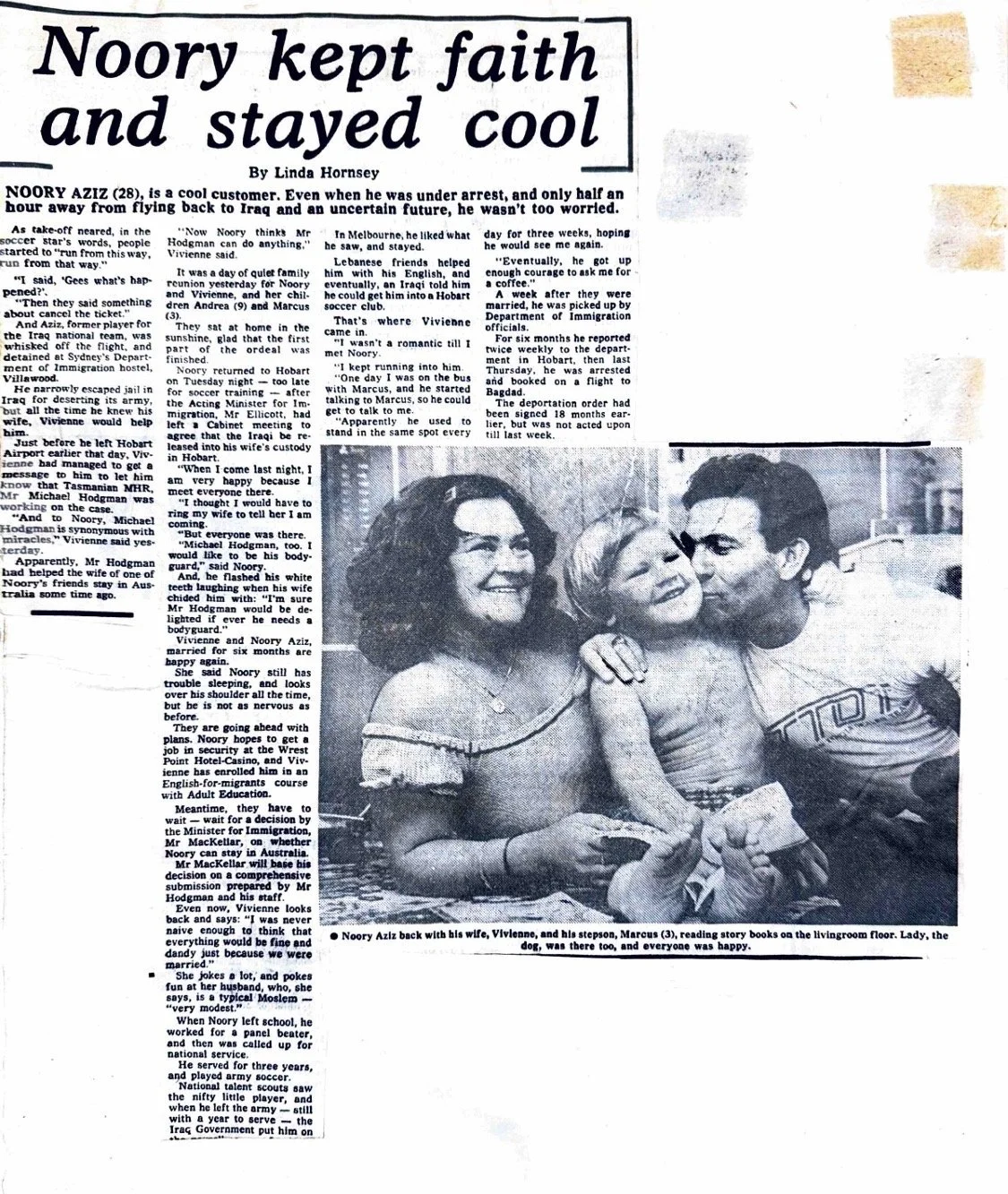
What gives these clippings their weight is not just what happened.
It is what almost did.
The plane could have left.
The decision could have held.
The deportation could have gone through.
And the story would have ended there.
Quietly.
Without record.
Without this suitcase.
It felt familiar
Reading these clippings, there was a sense of recognition.
Not because the details were the same.
They weren’t.
But because the feeling was.
That moment where a footballer is suddenly caught inside something much bigger than the game.
I felt it again years later, when Hakeem al-Araibi, connected to Pascoe Vale FC, was detained in Thailand.
Different era. Different circumstances.
But the same tension.
I still have a photo with him. A letter of thanks.
A small reminder that when football acts as a community, it can matter.
And reading these clippings, it is clear that instinct was there then too.
And then… silence
After the headlines, the story fades.
There is no neat ending.
No confirmed final outcome sitting neatly in the archive.
What the clippings suggest is that he returned to Hobart.
That life resumed, at least for a time.
And then, like so many stories of that era, he disappears from the record.
What stays
The football matters.
It always does.
But it is not what stays with you here.
What stays is the image of a man sitting on a living room floor with his family.
What stays is the line, “scared to death.”
What stays is the understanding that this was never just a football story.
It was a migration story.
A political story.
A human story.
That football happened to hold.
Holding onto it
There are thousands more clippings in that suitcase.
This is just one story.
But it changes how you look at the rest.
Because it reminds you that football has always been more than the game.
It is where people arrive.
Where they are seen.
And sometimes, without anyone quite realising it at the time, where their lives are shaped.
This is one of those stories.
And it deserves to be kept.
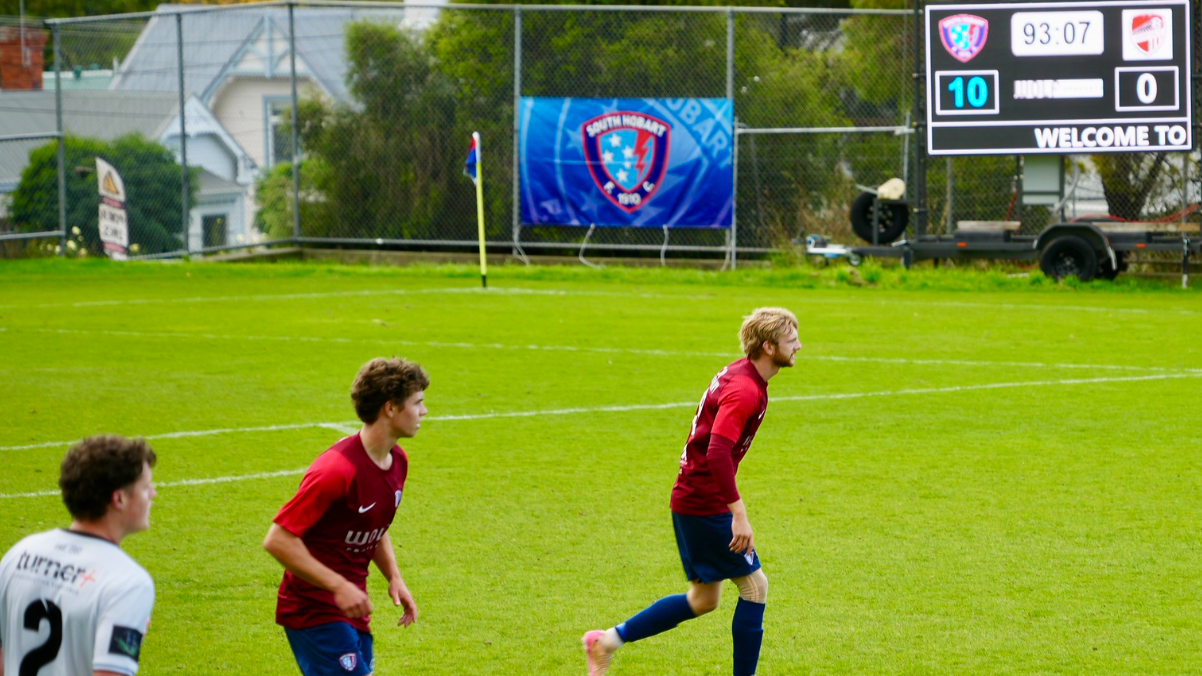
When Ambition Meets Readiness in Tasmanian Football
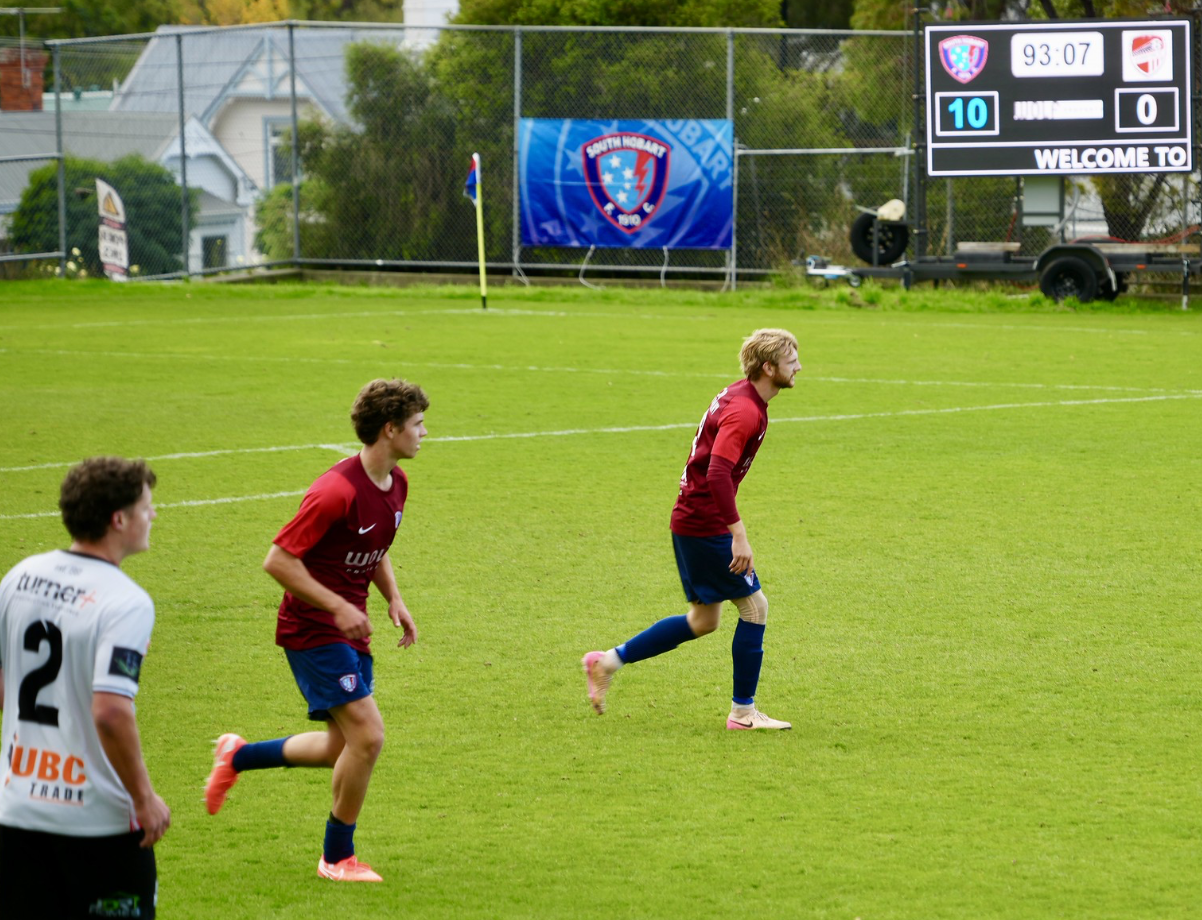
I read with interest the comments on Tassie Football Central following Ulverstone’s loss to South Hobart in the Lakoseljac Cup.
A 10–0 scoreline will always get attention. It should. It is confronting and it tells you something.
But what caught my eye wasn’t the result.
It was the conversation that followed.
Because within that thread sat something much bigger than one game. It revealed competing ideas about what we think football in Tasmania is, and what we expect it to be.
And I’m not sure those ideas are aligned.
Two views of the same moment
Some saw the result as part of the journey.
A necessary step. A hard lesson. The kind of experience clubs have to go through if they want to rise to a higher level.
We’ve seen that before. Clubs take their hits, build, recruit, grow and over time become competitive.
Others saw something very different.
They saw a widening gap. A system stretching itself too thin. Players being asked to compete at a level they are not yet equipped for and doing so without the structures around them to support that jump.
They asked a simple question.
How do players improve when they are repeatedly outmatched?
Watching it play out
I was at the game.
As the goals went in, I found myself saying to Ken, I feel bad for them.
It’s not a nice watch when a game gets away like that. You think about the players, the effort, the travel, what it feels like in those moments.
Ken looked at it differently.
He said, why?
From a coaching point of view, he sees something else. He sees a team executing, a team learning, a team building confidence. For the home side, it’s not just a result, it’s part of their own development.
We’ve both been around the game long enough to recognise both sides of that.
And that’s the tension, right there.
Two completely different reactions to the same game.
Neither of them wrong.
But both sitting inside a much bigger question about what we expect these moments to mean.
The space between ambition and reality
What sits underneath all of this is not Ulverstone.
It is the space between where a club is and where it is being asked to go.
Promotion, expansion, opportunity, these are all positive words. They signal growth. They signal belief.
But exposure on its own is not development, it’s just exposure.
If a club steps up a level, what changes around them?
Do they have access to better coaching support?
Is there a clear technical framework to guide them?
Are there realistic financial expectations?
Is there a shared understanding of what “success” looks like in year one?
Or are they simply placed into a higher competition and expected to find their way?
Those are two very different things.
What this really highlights is a lack of alignment between ambition, competition structure, and the support around it.
Time, or the lack of it
One comment in the thread stayed with me.
They don’t have time.
That cuts through a lot of the theory.
If relegation exists, if financial pressure exists, if players drift when results don’t come, then time is not a luxury. It is a constraint.
We talk about long-term development, but we operate in short-term environments.
And that tension sits at the heart of this.
The cost of competing
Another thread that emerged was cost.
Not just entry fees, but the reality of competing in what is, in many ways, a semi-professional environment.
Player payments. Imports. Travel. Staffing.
Figures were mentioned. Fifty to one hundred thousand dollars.
For community clubs, that is not a small gap to bridge. That is a structural shift.
So again, the question becomes clearer.
What are we asking clubs to become?
And are we supporting them to get there?
The question no one quite asks
And sitting underneath all of this is the question no one quite asks directly.
Are clubs being promoted before they are ready?
It’s an uncomfortable question.
Because clubs want opportunity. They should.
But if that opportunity comes without the structures around it to support success, then we have to be honest about what follows.
Governance is not separate from this
These aren’t match day issues.
They are the direct result of governance decisions.
League size.
Admission criteria.
Expectations of clubs.
The balance between growth and sustainability.
Because pathways don’t build themselves. They are designed, resourced, and supported.
When those decisions are not clearly explained, or not clearly supported in practice, they don’t stay in boardrooms.
They show up here.
In results. In conversations. In frustration.
What happens if we get this wrong
If we get this balance wrong, there are consequences.
Clubs stretch beyond their means.
Players disengage.
The gap between teams widens further.
And the competition itself risks losing credibility.
And once that gap opens, it’s very hard to close.
This isn’t about blame
And I want to be clear about that.
There are good people across clubs and within Football Tasmania trying to grow the game. There are different views, and many of them are valid.
Clubs do need opportunity.
Players do need exposure to higher levels.
Competitions do need to evolve.
But if we are going to expand, promote, and push clubs forward, we also need to be honest about what sits between those steps.
Because right now, it feels like two things are moving at different speeds.
Ambition is moving quickly.
Structure is trying to keep up, and clubs are sitting in between.
What are we trying to build?
That is the question that sits with me after reading all of it, and watching it play out.
Not whether one result was too big. Not whether one club is ready or not.
But what we are actually trying to build across the whole system.
Is the NPL a development league?
Is it a semi-professional competition?
Is it a stepping stone?
Or is it trying to be all three?
Because if it is all three, then we need to be very clear about how clubs move through it.
And how they are supported when they do.
Cup football exposes things quickly. That’s part of its value. It brings different levels together and, in doing so, shows us exactly where the gaps are.
A conversation we need to have
What I saw in that thread wasn’t negativity.
It was people who care.
People with experience. People asking questions. People trying to make sense of where the game is heading.
That’s not something to shut down.
That’s something to listen to.
Because somewhere in between those views is probably a better version of the system than the one we currently have.
And it is a conversation we need to have.
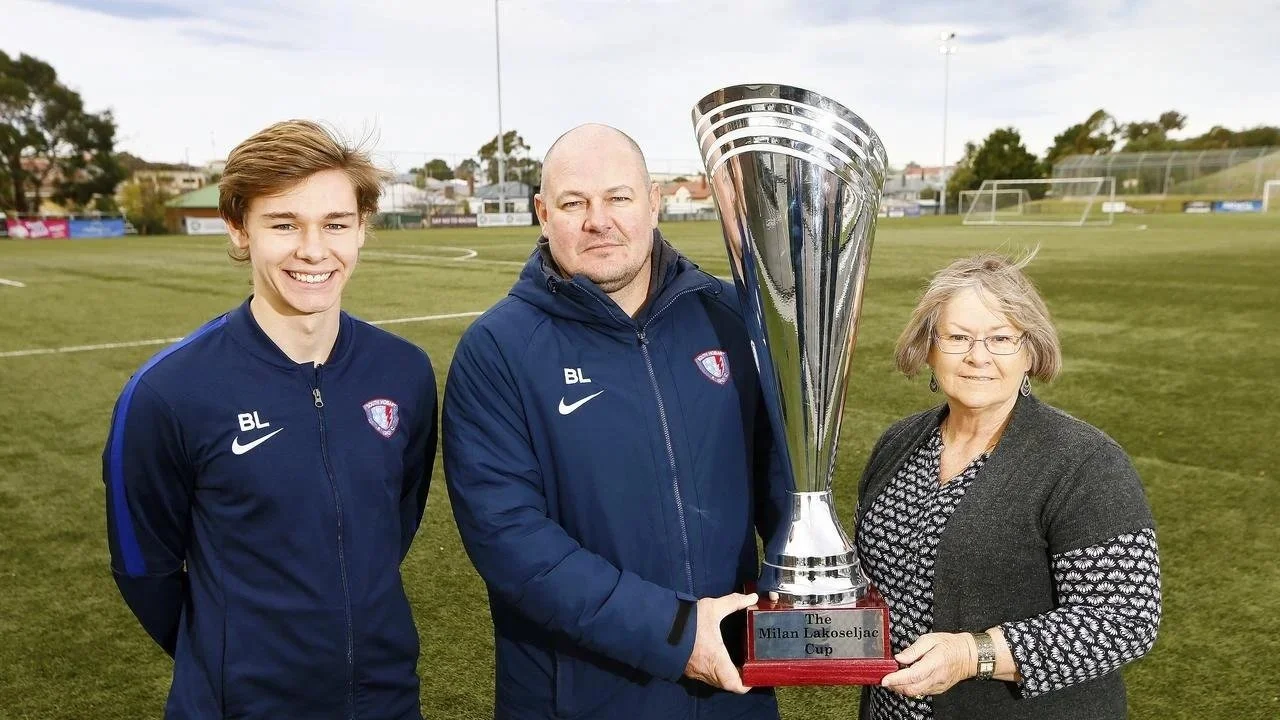
“That’s our Milan Lakoseljac, No.9”

Milan Lakoseljac
If you have been involved in Tasmanian football, you know the feeling.
The draw.
The wait.
We tune in to see what our fate will hold.
Giant or minnow.
Travel or not.
Opportunity or exit.
A step closer to the Round of 32, or the end of the road.
There is a moment, when the ball is pulled, where everything shifts.
That is the Milan Lakoseljac Cup.
And the name Lakoseljac is synonymous with it.
A quick 101
The Cup didn’t always carry that name.
It began in 1963 as the Ampol Cup.
Later, it became the Statewide Cup.
In 2000, it was renamed in honour of Milan Lakoseljac after his passing.
The format has remained simple.
A knockout competition open to clubs across the state.
One game. One result. No second chances.
That simplicity is its strength.
Because it is the one competition where everyone meets.
North and south.
Top tier and lower divisions.
Experienced and unknown.
And for years, it has carried something even bigger.
The pathway to the Australia Cup.
A chance for Tasmanian clubs to step onto the national stage.
To test themselves. To be seen. To measure where they sit.
Even now, with the emergence of the National Second Division, offering a different kind of pathway, the Cup holds something that structure never can.
Chance.
Why this Cup, and why him?
The Cup is open.
Unpredictable.
Built on community.
In many ways, it reflects the era Milan came from.
An era where football in Tasmania wasn’t built by systems, but by people.
By communities.
By migrants who arrived, settled, and shaped the game in their own way.
That is the connection.
Not just a name on a trophy.
A reflection of where the game came from.
At the end of a big Easter round of Cup football, I wanted to understand more about that name.
Not the records. Not the goals.
The person.
So I reached out to Brendon Lakoseljac, Milan’s son.
What came back was generous, thoughtful, and quietly humble.
“Thankyou so much for this, it means a lot to all of us.”
That, in itself, tells you something.
The man, not the footballer
For all the talk of goals and honours, Brendan starts somewhere else.
“Dad was a great dad and husband who we love and miss dearly.”
And it’s worth pausing on that.
Because before anything else, before football, before records, that is who he was to them.
He was a hard worker in construction. He worked on the Bowen Bridge when it replaced the Bailey Bridge, and on many other major projects.
“He was a very likeable and sociable person… very smart and could do anything he put his mind to.”
Self-taught. Driven.
Because he arrived in Australia at 16, alone, without a word of English.
That part sits underneath everything else.
A life beyond the game
Football wasn’t the whole story.
He loved Eaglehawk Neck. Fishing. Catching his crays.
He followed the Geelong Cats, because Geelong was the first place he lived when he arrived in Australia.
And his other love, Manchester United. GGMU.
Work. Football. Family. Weekends away.
A life built, not given.
When the game finds you
Brendan doesn’t describe a single moment where he realised his dad was “someone”.
“It crept up on us.”
Conversations at grounds. People approaching. Stories shared.
“The last one being last night at the cup game at the Den with a supporter who played against dad that I didn’t know.”
That’s how legacy works in Tasmania.
Not in headlines.
In conversations.
Carrying the name
“Carrying the Lakoseljac name was an honour more than pressure.”
His memories are of being a kid at KGV, watching big crowds, stalls, atmosphere.
“I was in awe of the atmosphere and that is all I wanted to be a part of.”
And in a small, very Tasmanian detail:
“I also used to catch tadpoles in the creek at the back of KGV so that was pretty cool too.”
The player
“Fast and fit, very quick.”
So quick he earned the nickname “Monaro”, after the two-door HT Monaro he bought off the showroom floor.
“I wish we still had that.”
He was a team player. Demanded standards. Played in a strong, successful side.
But it’s the detail that stands out.
“He was very tactical and looked for defenders/goalkeepers weaknesses that he could exploit.”
Positioning. Instinct. Calmness.
“The finishing with the prowess and calmness of a number 9.”
And later, as a coach, he passed that thinking on.
The migrant game
The club wasn’t just football.
It was community.
“His friends at the club were his family.”
Card games. Bocce. Sundays.
“For our family, the Croatian community gave us the understanding of our heritage and culture.”
A home away from home.
“That era created and shaped football for sure.”
Is that understood now?
“To be honest I think it’s fading, but it’s still there.”
You still see the generational names.
You still see families in the game.
But the connection to that original generation is not as strong as it once was.
The Cup
When the Cup was named, the reaction was simple.
“We were humbled, grateful and so very proud.”
And still are.
“There are so many great names in Football Tasmania that would be warranted… so we are truly honoured.”
As Brendan explains, the family has never seen the name as something to own, but something to carry.
They support all teams in the competition equally.
Their priority is the competition itself, and the people in it.
That tells you everything about how they see it.
Is the name still connected?
Brendan believes it is.
Three generations of Lakoseljacs have played in Tasmania.
“There are so many people who can connect to the name in some way, good or bad over them 50+ years.”
He points to something small but telling.
“When people comment about the ‘Laka Cup’… that’s a personal note.”
It hasn’t drifted.
It still belongs.
And with Milan’s induction into both the Football Tasmania Hall of Fame and the Croatian Soccer Association of Australia Hall of Fame, that connection has only strengthened.
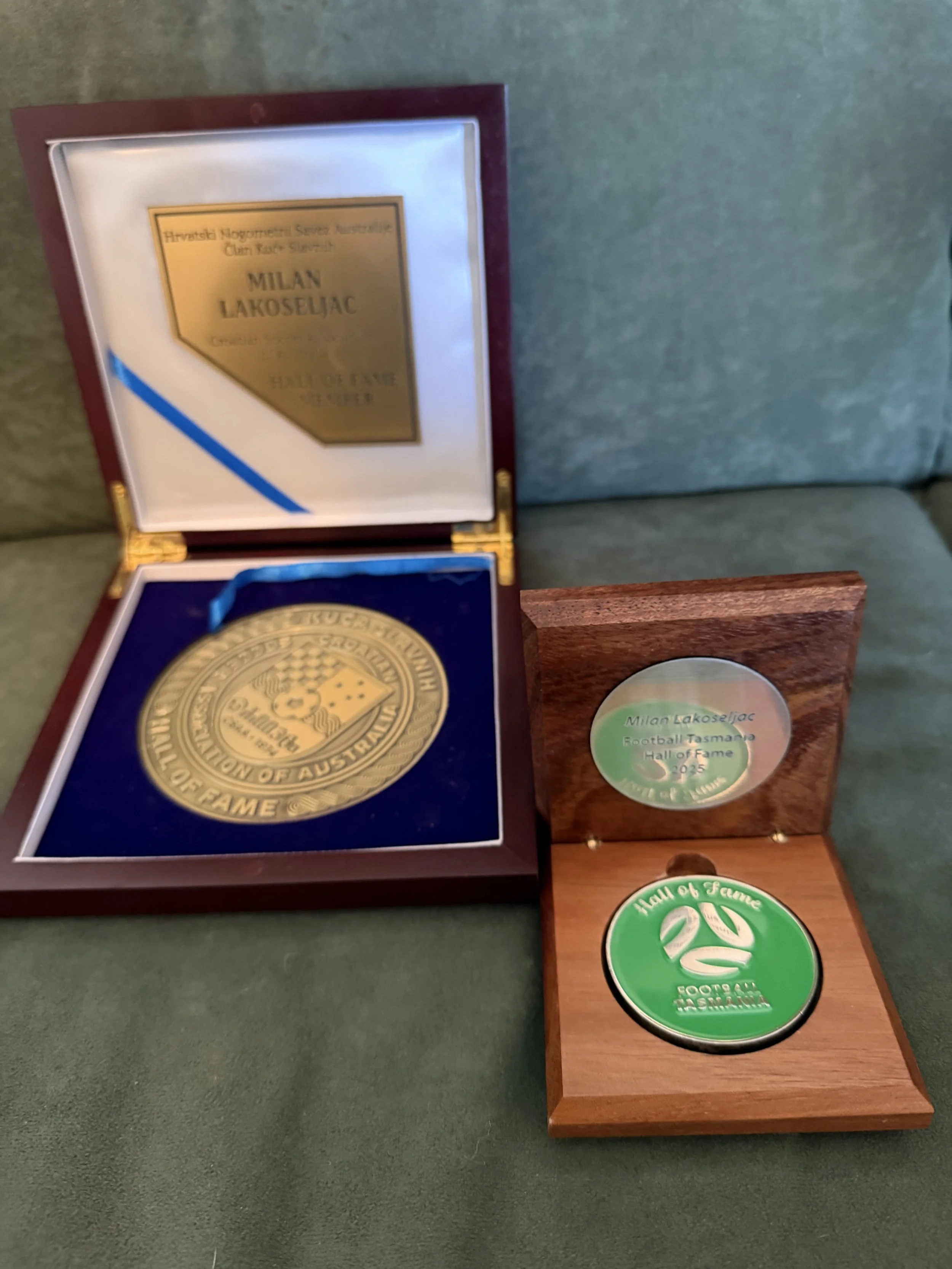
Milan’s medals
Cup football
When Brendan talks about the difference between league and Cup football, you can feel it.
League football is the grind.
Consistency. Depth. Rivalries. Week after week.
“A reward for maintained consistency.”
But Cup football is something else.
“A final every game, no second chances.”
“A chance for a medal. A chance for a memory.”
“The elation of a win, the hurt of a loss… cup games have it all.”
Why we remember it
Because it gives you something rare.
“Not everyone gets to play in a final in their career… it gives them that feeling every round.”
David versus Goliath.
The unthinkable.
“The memories and stories from cup games tend to live a long life.”
The bigger stage
“To play against the best in Australia is an experience you will not forget.”
“It may be the experience that changes your life.”
Three generations
“Being able to talk to current players with whom I have played against their dads and their grandfathers that have played against my dad is a very special part of what the game gives you.”
It’s not just family.
It’s continuity.
“A strong testament is seeing regular generational names returning to the game together with new growth.”
And Milan?
“We talk about this as a family every year.”
And the answer is simple.
“He would be humbled… and wonder what all the fuss is about.”
“He would feel undeserved… because he respected so many good names in Tasmanian football.”
A hard grafter.
A people person.
A man who loved the game.
And wanted others to experience it.
And every year, when the draw is made, when the games are played across the state, when clubs chase their moment…
that name is carried forward again.
“That’s our Milan Lakoseljac. No.9.”